
Non-FictionProfessional's Cheat SheetBrand Voice
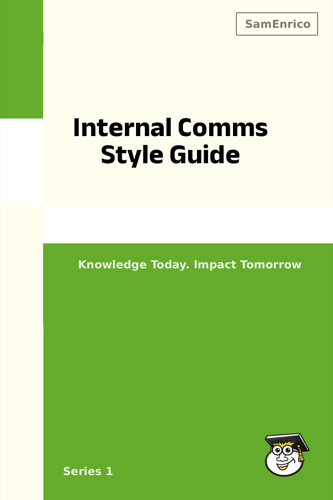
Internal Comms Style Guide eBook
Standardize tone, formatting, and terminology acro
Standardize tone, formatting, and terminology across all internal messages.
Formats
Free sample
Chapter 1: The $2.3 Million Typo--–- Every internal communicator knows the feeling. You draft a message, run it through three rounds of approvals, hit send, and then watch in horror as a single typo travels at the speed of Slack to 5,000 employees. Someone screen-shots it. Someone else puts it on a meme. A third person forwards it to their personal email "for posterity." The typo is funny.
You laugh it off. But here is the truth that no one tells you about internal communication: most of the damage is not from the typos you notice. It is from the confusion you never see.Confusion does not announce itself. It does not arrive in your inbox with a subject line that says "I was confused by your message." Instead, confusion hides. It hides in the employee who spends an extra twenty minutes decoding what "align on synergies" actually means.
It hides in the manager who forwards a vaguely worded policy update to their team with a note that says "I think this means we are supposed to do X, but honestly I am not sure." It hides in the silence when you ask "any questions?" and no one raises their hand because no one wants to admit they did not understand.This chapter is about making the invisible visible. It is about calculating the true cost of unclear internal messaging. It is about building a business case for standardization that does not rely on "it feels more professional" or "it looks better." Those arguments fail with leadership. Spreadsheets do not.The Cost of a Single Ambiguous Directive Let us start with a simple math problem. You have one thousand employees.
You send one ambiguous directive. That directive is unclear enough that each employee wastes just ten minutes figuring out what it means, asking a colleague for clarification, or doing the wrong thing and then redoing it correctly.Ten minutes per employee. One thousand employees. That is ten thousand minutes. Divide by sixty.
That is 166.6 hours. Divide by eight. That is nearly twenty-one full workdays. All lost to a single confusing message.Now multiply that by the number of confusing messages your organization sends every week. A typical company of one thousand employees sends approximately forty internal messages per week across email, Slack, the intranet, and team meetings.
If just ten percent of those messages – four per week – create ten minutes of confusion each, you lose 666 hours per week. That is eighty-three workdays. Every week. Before lunch on Wednesday, your company has already lost two full weeks of productivity to messages that could have been written more clearly.Here is where the math gets uncomfortable. Most IC teams do not think in terms of ten minutes of confusion per message.
They think in terms of typos. But typos are not the problem. The problem is messages that are technically correct but practically useless.Consider a real example from a mid-sized technology company that I worked with. The HR team sent a memo about "flexible work arrangements." The memo was grammatically perfect. No typos.
Proper punctuation. The CEO approved it personally. But here is what the memo did not do: it did not define what "flexible" meant. Did it mean remote work? Did it mean core hours with flexible start and end times?
Did it mean compressed workweeks? The memo said all of these options were "under consideration" and that employees should "stay tuned for guidance."The result was chaos. The engineering manager told his team they could work from home three days a week. The sales director told her team that "flexible" meant they could adjust their start times between 8 and 10 AM but that they still needed to be in the office five days a week. The customer support team, which was unionized, filed a grievance because their interpretation of "flexible" differed from engineering's.
The company spent six weeks and approximately forty thousand dollars in legal fees clarifying a single word in a single memo.That is the cost of ambiguity. Not typos. Ambiguity.Why Leadership Cares About Risk, Not Aesthetics Here is the single most important sentence in this entire book: Internal communication is a risk management function, not an aesthetic preference.Most IC professionals approach leadership with the wrong argument. They say things like "we need a style guide to make our messages look more professional" or "consistency will improve our brand perception internally." These arguments fail because leadership hears them and thinks "that sounds nice, but we have more important things to spend money on."Leadership cares about risk. Leadership cares about liability.
Leadership cares about the cost of doing things wrong. And internal communication, when done poorly, creates all three.Consider the legal risk of inconsistent messaging. In 2019, a retail company with forty thousand employees announced a restructuring. The announcement came from three different departments. HR sent one memo that used the phrase "voluntary separation program." Operations sent a separate memo that used the phrase "performance-based reductions." The CEO sent a video message that used the phrase "rightsizing our workforce." None of these three messages contradicted each other explicitly.
But they did not align either.Employees did not know what was happening. Were they being offered a voluntary package? Were they being fired for performance reasons? Was the company simply "rightsizing" which meant something else entirely? The confusion led to a class action lawsuit.
The plaintiffs argued that the inconsistent language constituted deceptive communication under labor law. The company settled for two point three million dollars.That is not a typo. That is not a formatting error. That is the cost of not having a centralized style guide that standardizes terminology across every department.The judge in that case noted something striking. In her ruling, she wrote: "The company's internal communications were not false.
But they were materially misleading because a reasonable employee could not determine which message governed their situation." That phrase – "materially misleading" – is legal language. It means the company did not lie, but it also did not tell the truth clearly enough. That is the danger zone for internal comms. It is where lawsuits live.Voice Versus Tone: The Foundation of Style Before we go further, we need to establish a distinction that will appear throughout this book. The distinction between voice and tone.Voice is your organization's stable personality.
It is who you are all the time, regardless of what you are communicating. Voice answers the question: "If our company were a person, what kind of person would it be?" Would it be supportive? Direct? Playful? Authoritative?
Collaborative? Your voice should be consistent across every message you send.Tone is the adjustment you make for a specific situation. Tone answers the question: "Given who we are, how do we need to sound right now?" If your company's voice is supportive, your tone might become instructional when you are explaining a new process. It might become urgent when there is a security breach. It might become celebratory when a team hits a major goal.
Your voice stays the same. Your tone flexes.Here is where most style guides fail. They try to prescribe tone without first establishing voice. They say things like "use active voice" or "avoid…
This is the end of the free sample. Get the eBook to keep going. Buy now
About this book
Details
- Author
- Blank Denisse
- Publisher
- SamEnrico
- Language
- English
- Genre
- Non-Fiction, Professional's Cheat Sheet, Brand Voice
- Released
- 2026-06-09
- Pages (approx.)
- 133
- Available as
- eBook, Audiobook

Read better in the ZLOADR app
Your eBooks on your phone or tablet. Sign in with your SamEnrico account and start reading.
More by Blank Denisse
 Grandparenting And Self IdentityBlank Denisse$11.99
 The Gambling Urge Surfing GuideBlank Denisse$11.99
 Loving Kindness For Parent EstrangementBlank Denisse$11.99
 The Reflective Listening GuideBlank Denisse$11.99
 The Copycat Code: How a Serial Killer’s Playlist Inspired a Nation of MurderersBlank Denisse$11.99
 Textile Recycling SortingBlank Denisse$11.99
 Understanding Sonoda SyndromeBlank Denisse$17.99
 HARO Success Metrics TrackingBlank Denisse$12.99
 Real Time Pricing SystemsBlank Denisse$12.99
 How to Start a Acoustics and Vibration Testing Business (Beginners Guide)Blank Denisse$11.99
You may also like
 Hong Kong Handover 1997Dunn Johnnie$11.99
 Zumba For Postnatal Recovery CourseNeal Christian$11.99
 Zumba for BeginnersLadner Nikia$11.99
 YouTube Comment Mining GuideHumes Pandora$12.99
 Worry Box MeditationCarlin Rudy$11.99
 Workplace Stress MeditationNguyen Lynn$11.99
 Workplace Stress and Sleep RepairHawley Ivory$11.99
 Workplace Perfectionism CureDelaney Jeffry$11.99
 Workplace Injustice Anger GuideWallen Isabelle$11.99
 Work Addiction and Burnout LinkGreenwood Ester$11.99
 Women in Yoga and WellnessBeattie Galina$11.99
 Women in Stand Up ComedyChun Evangeline$11.99