
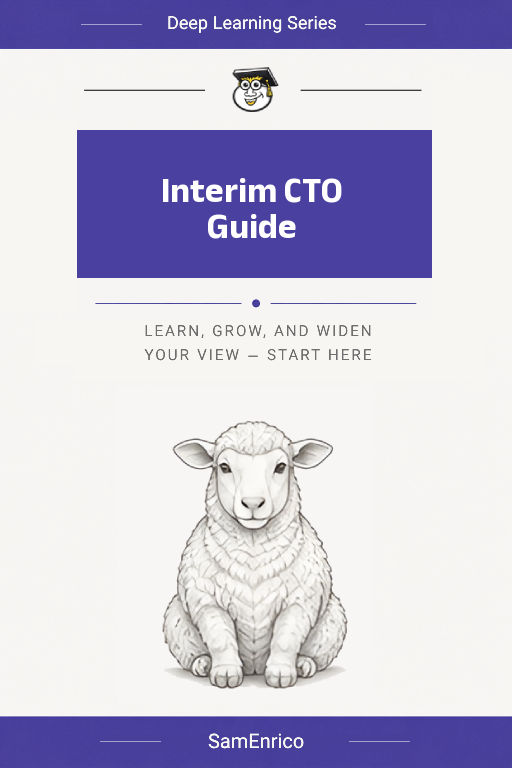
Interim CTO Guide eBook
Hire an interim CTO while you search for permanent
Hire an interim CTO while you search for permanent leadership. Bridge the technical gap temporarily.
Formats
Free sample
Chapter 1: The 11:47 PM Slack--–- The message arrives on a Sunday night. Your phone buzzes. Then again. Then again. The CEO’s name lights up your screen: “We need you tomorrow.
The CTO quit four hours ago. The site crashed twice today. The team is crying. Or quitting. Maybe both.
Can you be here at 8 AM?”You have 72 hours to prove you aren’t making things worse. You have 90 days total. And you have exactly one advantage: everyone’s expectations are so low that you can’t possibly disappoint them—unless you try to do too much, too fast, or too perfectly.This chapter is the playbook for those first three days. It will teach you how to distinguish between a fire that will kill the company and a slow leak that can wait. It will show you how to talk to a panicking CEO, a defensive team, and your own racing mind.
And it will give you a single, measurable goal for the first 72 hours: stop the bleeding, demonstrate calm competence, and leave every long-term decision for the chapters that follow.If you try to fix everything in the first week, you will fail. If you try to avoid conflict entirely, you will also fail. The path is narrow. This is how to walk it.The Two Types of Crisis: Burning Platform vs. Slow Bleed Most incoming leaders make one of two mistakes.
The first is treating every problem as an emergency. They arrive with a fire extinguisher in each hand, spraying wildly at technical debt, team morale, process inefficiencies, and product strategy all at once. By Friday, they have alienated the engineers, exhausted the CEO, and accomplished nothing except demonstrating that they cannot prioritize.The second mistake is treating every problem as a slow, manageable issue that can be addressed with careful planning and stakeholder alignment. They spend their first week in back-to-back meetings, taking notes, building rapport, and promising to “develop a comprehensive assessment.” Meanwhile, the site crashes again. A major customer churns.
The CEO starts drafting the job description for your replacement.The truth is that not all problems are equal. An interim leader must distinguish between a burning platform and a slow bleed—and treat each very differently.The Burning Platform A burning platform is an active, ongoing threat to the business. It is not theoretical. It is not “technical debt that might cause problems someday.” It is happening now.Examples of burning platforms include:Active outages or service degradations affecting customers Security breaches or active vulnerabilities being exploited Critical path failures that block revenue generation or core functionality Imminent compliance violations with regulatory deadlines Key personnel threatening to quit unless something changes immediately If you ignore a burning platform, the company may not survive the week. Your job in the first 72 hours is to identify these fires and put them out—or contain them so they stop spreading.The Slow Bleed A slow bleed is a systemic issue that degrades the organization over time but is not actively destroying value right now.
It needs attention, but not at the expense of ignoring a fire.Examples of slow bleeds include:Technical debt that slows down feature development but doesn’t break anything Morale issues that make the team unhappy but not unproductive Process inefficiencies that waste time but don’t block critical work Outdated documentation that confuses new hires but doesn’t stop them from contributing Architectural decisions that limit scalability but aren’t yet causing failures If you treat a slow bleed like a fire, you overreact. You will waste precious hours rewriting code that works fine while the actual fire spreads. If you treat a fire like a slow bleed, the company dies. The art of the first 72 hours is telling the difference.The Test: Is It Burning?Ask three questions about any problem you encounter in the first day:Is the company losing money right now because of this? If yes, it is a fire.
If no, it may be a slow bleed.Will a customer leave this week if this is not fixed? If yes, it is a fire. If no, it may be a slow bleed.Is the CEO asking about this every hour? If yes, it is a fire—or at least it is a fire in the CEO’s mind, which is functionally the same thing.Any problem that passes these three tests goes to the top of your triage list. Everything else goes to a second list labeled “Monitor and Document for the Permanent CTO.”The Stop-Start-Continue Framework (Day 1)You have been in the office for three hours.
You have met the CEO, shaken hands with the engineering manager, and stared at a whiteboard full of half-finished architecture diagrams. Now what?The Stop-Start-Continue framework is a triage tool that forces you to make explicit decisions about what changes immediately, what stays the same, and what begins today. It takes thirty minutes to complete and will guide your entire first week.Stop: What Is Actively Harming the Business?Make a list of everything that is causing active damage. Be specific. Do not write “bad process.” Write “deployments take six hours and fail 40% of the time.” Do not write “toxic culture.” Write “the senior engineer yells at junior staff in daily stand-up.”Common items on the Stop list include:Risky deployment practices that break production regularly Meetings that waste time and generate no decisions Security alerts that are being ignored Communication patterns that create confusion (e.g., “the CEO emails engineering directly at 2 AM”)Work that is actively being done on the wrong priorities For each item, ask: “Can we stop this today without causing more damage?” If yes, stop it.
If no, schedule it for day two or three.Start: What Is Missing That Would Provide Immediate Relief?Make a list of things that do not exist but should. These are not long-term strategic initiatives. They are bandages, tourniquets, and temporary workarounds.Common items on the Start list include:A daily 15-minute incident stand-up to coordinate firefighting A single source of truth for current outages (a shared document, a Slack channel, a whiteboard)A clear escalation path for emergencies (“if X happens, call the CEO immediately”)A “read-only Friday” rule to prevent risky changes before the weekend A five-minute daily check-in with the CEO to align on priorities For each item, ask: “Can someone on the team start this today without complex planning?” If yes, assign it to the most junior person available. Simple tasks build confidence.Continue: What Is Working That You Must Not Accidentally Destroy?This is the most overlooked part of the framework. In your rush to fix things, you will be tempted to change everything.
Resist that temptation. The team has been working here longer than you have. Some things are working well. Identify them, name them, and protect them.Common items on the Continue list include:A solid CI pipeline that catches bugs before they reach production A high-morale sub-team that delivers consistently A code review culture that catches mistakes A customer support process that actually works A relationship with a key vendor that keeps the lights on For each item, ask: “What would break…
This is the end of the free sample. Get the eBook to keep going. Buy now
About this book
Details
- Author
- Renteria Anamaria
- Publisher
- SamEnrico
- Language
- English
- Genre
- Non-Fiction, Startup Guide, Executive Search
- Released
- 2026-06-01
- Pages (approx.)
- 136
- Available as
- eBook, Audiobook

Read better in the ZLOADR app
Your eBooks on your phone or tablet. Sign in with your SamEnrico account and start reading.
More by Renteria Anamaria
 Born Standing Up MemoirRenteria Anamaria$11.99
 Cognitive Restructuring MDDRenteria Anamaria$11.99
 Foster Care Therapy CouchRenteria Anamaria$11.99
 Failure Resilience for TeensRenteria Anamaria$11.99
 The Gender App Preference StudyRenteria Anamaria$11.99
 Arachne's Web: The Weaver Who Defied the GodsRenteria Anamaria$11.99
 Multiple Domain StrategyRenteria Anamaria$12.99
 The Breeder's Guide to Romeldale SheepRenteria Anamaria$11.99
 Park InterpreterRenteria Anamaria$11.99
 How to Become a Oven OperatorRenteria Anamaria$11.99
You may also like
 Vesting for CTO GuideSigler Susy$12.99
 Remote CTO Hiring GuideKitchen Hollie$12.99
 Managing CTO RelationshipLundberg Rosalina$12.99
 International CTO HiringBest Latasha$12.99
 Hiring a CTO Non Technical GuideCurrie Rey$12.99
 Finding CTO Candidates GuideSam Rebbeca$12.99
 Equity for First CTO GuideEscalante Gabriele$12.99
 CTO Onboarding GuideCreech Natashia$12.99
 CTO for SaaS StartupsCarlisle Cleotilde$12.99
 CTO for Healthtech StartupsOverby Khalilah$12.99
 CTO for Edtech StartupsHorne Tesha$12.99
 CTO for Blockchain StartupsKiser Emogene$12.99