
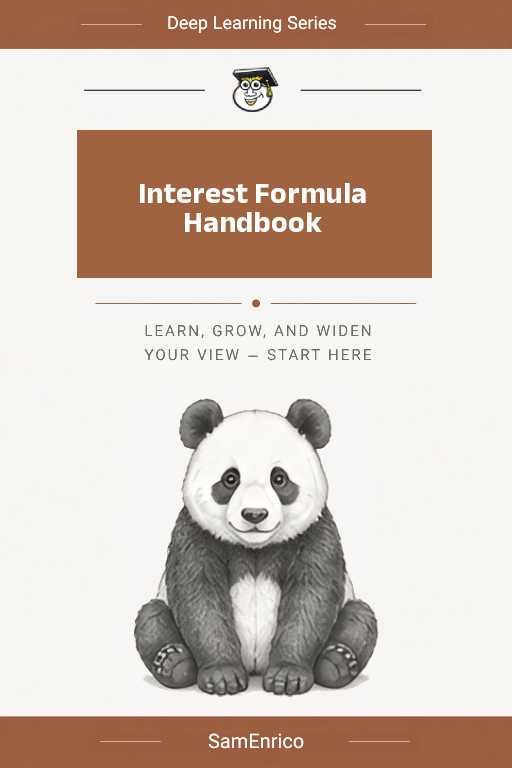
Non-FictionHandbookFinance Tutorial
Interest Formula Handbook
Master simple interest, compound interest, and eff
Master simple interest, compound interest, and effective annual rate calculations. Includes amortization and present value formulas for finance applications.
Formats
About this book
Free sample
Chapter 1: The Silent Engine--–- Every morning, millions of people sign loan documents, swipe credit cards, or check their savings account balances without ever realizing that a single mathematical idea governs almost all of modern finance. That idea is simple interest. It is the bedrock, the starting point, the most primitive yet most widely used interest mechanism in short-term lending and borrowing. Before the dazzling complexity of compound interest, before amortization schedules and yield curves, there is the straightforward, linear, almost humble calculation of simple interest: I=P×r×t I = P \times r \times t I=P×r×t.Yet its simplicity is precisely why it remains indispensable. Treasury bills, commercial paper, promissory notes, bridge loans, and many bank deposits under one year all rely on simple interest.
Why? Because for short time horizons, the difference between simple and compound interest is negligible, but the computational ease of simple interest is enormous. This chapter strips away the mystery and gives you a master-level understanding of simple interest, including day count conventions that trip up even professional traders. By the end, you will not only calculate simple interest accurately but also know exactly when to use it—and, just as important, when to run away from anyone trying to use it for long-term loans.The Core Identity: I=P×r×t I = P \times r \times t I=P×r×t At its heart, simple interest is a linear function. The interest earned or owed is the product of three numbers: the principal (P), the annual interest rate (r), and the time in years (t).
The formula I=P×r×t I = P \times r \times t I=P×r×t contains no exponent, no compounding frequency, no infinite series. It is direct and unforgiving.Consider a concrete example. You lend 10,000toafriendfor6monthsatanannualsimpleinterestrateof510,000 to a friend for 6 months at an annual simple interest rate of 5%. Here, \( P = 10,000 \), \( r = 0.05 \), and \( t = 0.5 \) years (since 6 months is half a year). The interest is \( 10,000 \times 0.05 \times 0.5 = 250 \).
Your friend owes you 10,000toafriendfor6monthsatanannualsimpleinterestrateof5250 in interest plus the original 10,000,foratotalmaturityvalueof10,000, for a total maturity value of 10,000,foratotalmaturityvalueof10,250.That is almost…
This is the end of the free sample. Get the eBook to keep going. Buy now
Contents
- Chapter 1
- Chapter 2
- Chapter 3
- Chapter 4
- Chapter 5
- Chapter 6
- Chapter 7
- Chapter 8
- Chapter 9
- Chapter 10
- Chapter 11
- Chapter 12
Details
- Author
- Byrne Margarite
- Publisher
- SamEnrico
- Language
- English
- Genre
- Non-Fiction, Handbook, Finance Tutorial
- Released
- 2026-06-01
- Pages (approx.)
- 128
- Available as
- eBook, Audiobook

Read better in the ZLOADR app
Your eBooks on your phone or tablet. Sign in with your SamEnrico account and start reading.
More by Byrne Margarite
 Gratitude for Past SelfByrne Margarite$11.99
 Senior Gratitude Esteem GuideByrne Margarite$11.99
 Emotional Intelligence for BurnoutByrne Margarite$11.99
 Birthday Without PartyByrne Margarite$11.99
 Mindfulness for Insomnia Beginners GuideByrne Margarite$11.99
 The Lioness of Djenne: The Untold Love and War of Queen TassaditByrne Margarite$11.99
 Understanding Myocardium DisorderByrne Margarite$17.99
 Amazon SWOT Analysis Library GuideByrne Margarite$12.99
 How to Become a Label RemoverByrne Margarite$11.99
 Automotive Finance And Insurance ManagerByrne Margarite$11.99
You may also like
 Hong Kong Handover 1997Dunn Johnnie$11.99
 Zumba For Postnatal Recovery CourseNeal Christian$11.99
 Zumba for BeginnersLadner Nikia$11.99
 YouTube Comment Mining GuideHumes Pandora$12.99
 Worry Box MeditationCarlin Rudy$11.99
 Workplace Stress MeditationNguyen Lynn$11.99
 Workplace Stress and Sleep RepairHawley Ivory$11.99
 Workplace Perfectionism CureDelaney Jeffry$11.99
 Workplace Injustice Anger GuideWallen Isabelle$11.99
 Work Addiction and Burnout LinkGreenwood Ester$11.99
 Women in Yoga and WellnessBeattie Galina$11.99
 Women in Stand Up ComedyChun Evangeline$11.99