
Non-FictionTrue CrimeInnocence Litigation
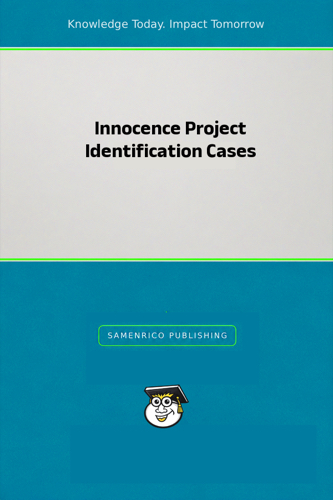
Innocence Project Identification Cases
Analyzes overturned convictions where mistaken ide
Analyzes overturned convictions where mistaken identification was the primary evidence and what went wrong.
Formats
About this book
Free sample
Chapter 1: The Memory Myth...--–- The case of Calvin Willis began like so many others in the American criminal justice system: with a crime, a victim, and a witness who believed she would never forget the face of the man who attacked her. In 1981, a 10-year-old girl in Shreveport, Louisiana, was brutally raped in her home. She was young, frightened, and determined to help the police find her assailant. When investigators presented her with a photographic line-up, she studied the images carefully and pointed to Calvin Willis. She was certain.
Her certainty would send Willis to prison for 21 years. In 2002, DNA testing proved what Willis had maintained from the moment of his arrest: he was innocent. The real perpetrator had never been a suspect. The little girl had not lied. She had not been malicious.
She had simply been wrong. And her honest mistake cost Calvin Willis more than two decades of his life.The question that haunts Willis’s case is the same question that haunts hundreds of similar cases across the United States: How can someone be so certain and so wrong? The answer lies not in malice or dishonesty but in the fundamental nature of human memory. We like to believe that our memories are recordings—faithful, permanent, and replayable. We like to believe that if we experience something traumatic, we will remember it with special clarity.
We like to believe that when a witness points a finger at a defendant and declares certainty, that certainty is a reliable guide to truth. All of these beliefs are scientifically indefensible. Memory is not a recording. It is a reconstruction. And every time we reconstruct, we risk distortion.The Science of Forgetting The German psychologist Hermann Ebbinghaus published his landmark work on memory in 1885, forever changing how scientists understand the human mind.
Using himself as a test subject, Ebbinghaus memorized lists of nonsense syllables—meaningless combinations like “ZOF” and “KAD”—and then tested his recall at various intervals. What he discovered became known as the “forgetting curve,” and it remains one of the most replicated findings in all of psychology.Ebbinghaus…
This is the end of the free sample. Get the eBook to keep going. Buy now
Contents
- Chapter 1
- Chapter 2
- Chapter 3
- Chapter 4
- Chapter 5
- Chapter 6
- Chapter 7
- Chapter 8
- Chapter 9
- Chapter 10
- Chapter 11
- Chapter 12
Details
- Author
- Smoot Cassondra
- Publisher
- SamEnrico
- Language
- English
- Genre
- Non-Fiction, True Crime, Innocence Litigation
- Released
- 2026-06-06
- Pages (approx.)
- 125
- Available as
- eBook, Audiobook

Read better in the ZLOADR app
Your eBooks on your phone or tablet. Sign in with your SamEnrico account and start reading.
More by Smoot Cassondra
 Staffing Agency Transaction AnalysisSmoot Cassondra$11.99
 183 Day Rule AvoidingSmoot Cassondra$11.99
 Engineers Guide to Creative ThinkingSmoot Cassondra$11.99
 Arnold Palmer Army StorySmoot Cassondra$11.99
 The Amazon Forest VictimSmoot Cassondra$11.99
 Alcohol and Cancer RiskSmoot Cassondra$11.99
 Checking OCD GuideSmoot Cassondra$11.99
 The Great Bitcoin Heist: How a Rogue Trader Bankrupted Mt. GoxSmoot Cassondra$11.99
 The King and the Crown: The Divorce That Shook Middle Eastern FootballSmoot Cassondra$11.99
 How to Produce a Hot PlateSmoot Cassondra$11.99
 A Collector's Handbook to the Ford Zodiac Ii 206eSmoot Cassondra$11.99
 FSC Recycled Export GuideSmoot Cassondra$12.99
You may also like
 Hong Kong Handover 1997Dunn Johnnie$11.99
 Zumba For Postnatal Recovery CourseNeal Christian$11.99
 Zumba for BeginnersLadner Nikia$11.99
 YouTube Comment Mining GuideHumes Pandora$12.99
 Worry Box MeditationCarlin Rudy$11.99
 Workplace Stress MeditationNguyen Lynn$11.99
 Workplace Stress and Sleep RepairHawley Ivory$11.99
 Workplace Perfectionism CureDelaney Jeffry$11.99
 Workplace Injustice Anger GuideWallen Isabelle$11.99
 Work Addiction and Burnout LinkGreenwood Ester$11.99
 Women in Yoga and WellnessBeattie Galina$11.99
 Women in Stand Up ComedyChun Evangeline$11.99