
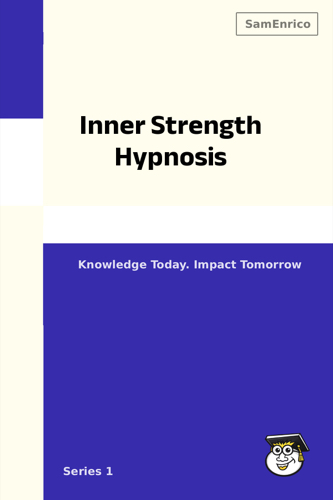
Non-FictionSelf-HelpInner Strength
Inner Strength Hypnosis eBook
Accesses core resilience and power.
by Whyte Maegan
Accesses core resilience and power.
Formats
Free sample
Chapter 1: The 95% Problem...--Most people who try to change their lives fail not because they lack desire, not because they lack intelligence, and not because they lack willpower. They fail because they are fighting the wrong battle with the wrong weapons. They bring logic to a fight that was never about logic. They bring affirmations to a brain that doesn't speak in words. And they bring conscious effort to a system that runs almost entirely on autopilot.Consider this for a moment.
Every day, millions of people wake up and tell themselves, "I am confident. I am worthy. I am enough." They repeat these phrases like mantras, hoping that repetition will somehow rewire the deep-seated feelings of inadequacy that have haunted them for years. And every day, millions of people find that these affirmations change nothing. The knot in the stomach remains.
The voice in the head that says "you're not good enough" continues its relentless commentary. The body still tenses up before a difficult conversation, still floods with panic before a presentation, still collapses into numbness when criticized.Why? Because the conscious mind—the part that repeats affirmations, sets goals, and makes New Year's resolutions—represents less than five percent of your total mental processing. The other ninety-five percent runs beneath the surface, silently, automatically, relentlessly. And that ninety-five percent does not speak your language.This is what I call the 95% Problem.
And until you understand it, every attempt at personal transformation will be like trying to steer a supertanker with a rowboat's oar. You might make a tiny ripple on the surface, but the massive vessel beneath continues in its original direction, indifferent to your efforts.The good news—and the entire premise of this book—is that the 95% can be accessed, communicated with, and rewritten. Hypnosis is not mind control, not stage tricks, and not magical thinking. It is the scientifically validated art and science of speaking directly to the subconscious mind, bypassing the critical filter of the conscious mind, and installing new patterns of feeling, thinking, and behaving at the deepest level. This chapter will show you why your previous efforts have failed, how your brain actually processes change, and why ego-strengthening hypnosis is the most direct route to the inner strength you already possess but cannot currently access.The Myth of Willpower Let me begin by dismantling one of the most persistent and damaging myths in all of self-help: the myth of willpower.
We have been told, through countless books, motivational speeches, and cultural narratives, that success is simply a matter of trying harder, of pushing through, of exerting more conscious control over our impulses and behaviors. If you are overweight, just eat less. If you are anxious, just calm down. If you are stuck, just try harder.This advice is not merely unhelpful—it is actively harmful. It creates a cycle of shame and failure that reinforces the very patterns you are trying to break.The scientific literature on willpower is now extensive and unambiguous.
The psychologist Roy Baumeister, one of the world's leading researchers on self-control, demonstrated through dozens of studies that willpower functions like a muscle. It tires with use. It depletes. When you force yourself to resist one temptation, you have less capacity to resist the next. This phenomenon, called ego depletion, shows that conscious effort is a finite resource.
You cannot rely on it for sustained change because it will always, eventually, run out.But there is a deeper problem with willpower. Even when it works temporarily, it only addresses the symptom, not the cause. Willpower is a conscious override of an automatic pattern. It is the rowboat oar against the supertanker. You might win a few small battles, but the underlying program remains intact, waiting for the moment your conscious attention wavers—which it always does, because you are human and your attention is limited.Think of the last time you tried to break a habit.
Perhaps you decided to stop checking your phone first thing in the morning. For a few days, you succeeded through sheer conscious effort. You left the phone in another room. You put a sticky note on the bathroom mirror. You told yourself "no" when your hand reached for the screen.
And then one morning, you were tired, or stressed, or just not paying attention, and your thumb unlocked the phone before you even realized what was happening. The habit had not been eliminated. It had merely been suppressed. And suppression always fails eventually.This is not a moral failing. It is neuroscience.
The procedural memories that drive habits—the automatic sequences of behavior that run without conscious thought—are stored in the basal ganglia, a primitive part of the brain that operates below the level of awareness. No amount of conscious "trying" can erase a procedural memory. The only way to change it is to overwrite it with a new procedural memory, created through repetition and emotional engagement. And that is precisely what hypnosis does.How Your Brain Actually Processes Change To understand why hypnosis works where willpower fails, you need to understand a basic distinction in how your brain processes information. This distinction is between declarative memory and procedural memory, and it is the single most important concept in this entire book.Declarative memory is what most people think of when they say "memory." It is the storage system for facts, events, and conscious knowledge.
You know that Paris is the capital of France. You know what you had for breakfast yesterday. You know that you are a worthy human being who deserves love and success. These are declarative memories. They are stored in the hippocampus and related structures, and they are accessible to conscious recall.
You can say them out loud. You can write them down.Procedural memory is entirely different. It is the storage system for skills, habits, emotional responses, and automatic behaviors. You do not consciously remember how to ride a bicycle—you just get on and your body knows what to do. You do not consciously recall the sequence of movements for tying your shoes—your hands simply perform the動作.
And most importantly, you do not consciously decide to feel anxious in certain situations—your body just responds, automatically, as if it has been programmed to do so. Because it has.Procedural memories are stored in the basal ganglia, the cerebellum, and the amygdala (for emotional learning). They operate entirely below the level of conscious awareness. And here is the critical point: declarative memories and procedural memories are largely independent systems. You can know something declaratively and feel the complete opposite procedurally.This explains the central paradox of human psychology.
You can know, with absolute certainty, that you are intelligent, capable, and worthy. You can recite this knowledge to yourself a hundred times a day. And yet, when you walk into a room full of strangers, or sit down to take an important test, or speak up in a meeting, your body tightens, your heart races, and a voice in your head whispers, "You don't belong here. You're going to fail. Everyone can see that you're a fraud."The declarative knowledge—"I am worthy"—has not touched the procedural memory—"I am…
This is the end of the free sample. Get the eBook to keep going. Buy now
About this book
Details
- Author
- Whyte Maegan
- Publisher
- SamEnrico
- Language
- English
- Genre
- Non-Fiction, Self-Help, Inner Strength
- Released
- 2026-06-06
- Pages (approx.)
- 149
- Available as
- eBook, Audiobook

Read better in the ZLOADR app
Your eBooks on your phone or tablet. Sign in with your SamEnrico account and start reading.
More by Whyte Maegan
 Political Firsts After FiftyWhyte Maegan$11.99
 Menopause And Creativity GuideWhyte Maegan$11.99
 Telegram Channel Pressure GuideWhyte Maegan$11.99
 Personal Branding for AuthorsWhyte Maegan$11.99
 Time Blocking for StudentsWhyte Maegan$11.99
 Email Unsubscriber Bot UseWhyte Maegan$11.99
 Career Pivot After Job LossWhyte Maegan$11.99
 The Great Gold Sprint: How Alice Coachman Stole the Show from Hitler's OlympicsWhyte Maegan$11.99
 The Phantom of Park Lane: The $1.5M Ferrari Heist That Shocked MonacoWhyte Maegan$11.99
 Mastering Tobin Tax: Currency Transaction LevyWhyte Maegan$11.99
 Exploring Figure Drawing & Figure Painting: Anatomy & PoseWhyte Maegan$11.99
 Brazil Anti Fraud Address Verification GuideWhyte Maegan$12.99
You may also like
 Hong Kong Handover 1997Dunn Johnnie$11.99
 Zumba For Postnatal Recovery CourseNeal Christian$11.99
 Zumba for BeginnersLadner Nikia$11.99
 YouTube Comment Mining GuideHumes Pandora$12.99
 Worry Box MeditationCarlin Rudy$11.99
 Workplace Stress MeditationNguyen Lynn$11.99
 Workplace Stress and Sleep RepairHawley Ivory$11.99
 Workplace Perfectionism CureDelaney Jeffry$11.99
 Workplace Injustice Anger GuideWallen Isabelle$11.99
 Work Addiction and Burnout LinkGreenwood Ester$11.99
 Women in Yoga and WellnessBeattie Galina$11.99
 Women in Stand Up ComedyChun Evangeline$11.99