
Informational Interview Guide eBook
Request, prepare for, and follow up on career conv
Request, prepare for, and follow up on career conversations that build mentor relationships.
Formats
Free sample
Chapter 1: The Seed, Not The Ask--–- The most important career conversation I ever had lasted exactly twenty-three minutes, and I never asked for a single thing.Her name was Dr. Elena Vasquez. She was the head of research at a biomedical firm I desperately wanted to work for. I was twenty-six, unemployed, and living on my cousin’s couch in a city where I knew exactly three people. My bank account had $412 in it.
My resume had been rejected by seventeen companies in six weeks. I was, by any reasonable measure, in no position to turn down anything that resembled a job lead.And yet, when I sat down across from Elena at a coffee shop near her office, I had decided—consciously, deliberately—that I would not ask her for a job. I would not ask for a referral. I would not ask her to look at my resume. I would not ask for the name of someone else who was hiring.
I would ask her one question, listen to her answer, ask follow-up questions based on what I heard, and then thank her and leave.The question I had prepared was this: “Your lab published a paper last year on the failure rate of early-stage drug trials. What did you learn in the six months after that paper came out that you wish you had known before you published it?”Elena blinked. She tilted her head. She said, “No one has ever asked me that before.”Then she talked for twenty-three minutes. She talked about the backlash from investors who felt the paper made the industry look bad.
She talked about the junior researchers who were afraid to attach their names to the findings. She talked about the one email—from a scientist at a competing firm—that had made her cry in her office because it was so unexpectedly kind. She talked about everything except the one thing I had promised myself I would not ask for: a job.At the end of our twenty-three minutes, she looked at her watch, then back at me, and said, “I don’t know what you’re looking for right now. But whatever it is, I want to help you find it. Not because you asked me for anything.
Because you listened.”She introduced me to three people before the week was over. One of them hired me six weeks later. That job led to the next, which led to the next, which led to everything I have done since. I have not spoken to Elena in five years. But I think about her constantly, because she taught me something I have spent the rest of my career trying to teach others: the person who gets help is rarely the person who asks for it most directly.
The person who gets help is the person who plants seeds instead of making demands.This chapter is about that distinction. It is about why most people conduct informational interviews exactly backward, why the phrase itself is a trap, and how reframing your purpose from extraction to cultivation will change everything about the results you get.The Vocabulary Problem Let me name the problem directly. The term “informational interview” is one of the most misleading phrases in the entire lexicon of career development. It was popularized in a different era—largely through Richard Bolles’ seminal work “What Color Is Your Parachute?”—and while Bolles himself understood the relational potential of these conversations, the phrase has taken on a life of its own. Today, it evokes something cold, clinical, and fundamentally backward.Consider the word “informational.” It suggests that the primary value of the conversation is the transfer of data.
It implies that you are there to collect facts—about an industry, a company, a role, a career path—and that the person across from you is primarily a source of information. This framing is not merely inaccurate. It is actively harmful, because it trains you to see other people as means to an end.Consider the word “interview.” An interview is a power-imbalanced interaction in which one party evaluates another. When you go on a job interview, you are being judged. When you conduct an informational interview, you are supposedly doing the judging—asking questions, taking notes, evaluating whether this career path might suit you.
But this framing is also inaccurate. In practice, most informational interviews feel like something else entirely: a supplicant asking a powerful person for scraps.The combination of “informational” and “interview” creates a mental model that works against your goals. It encourages you to prepare a list of questions, to take copious notes, to treat the conversation as a research project. It discourages you from listening deeply, from following unexpected threads, from allowing the conversation to become something other than what you planned.There is a better way. I call it the relational career conversation.
The goal is not to extract information. The goal is to plant a seed—a seed of genuine connection, genuine curiosity, and genuine mutual recognition. That seed may take months or years to grow. It may never grow at all. But when it does grow, it produces something that no amount of informational extraction can match: a relationship that generates opportunities organically, without you having to ask for them.The Transactional Reflex Most people who reach out for career conversations suffer from what I call the Transactional Reflex.
They have been taught—explicitly or implicitly—that networking is a numbers game, that every interaction should have a clear ask, and that the goal is to move people through a funnel toward a specific outcome. This reflex is so deeply ingrained that many people cannot imagine any other way of approaching a stranger.The Transactional Reflex sounds like this: “I need to make this conversation worth my time. I need to get something concrete out of it. A referral, an introduction, a piece of insider information, a job lead. Something I can put in my spreadsheet and track.”This reflex is understandable.
Career uncertainty is anxiety-producing. When you are unemployed, underemployed, or stuck in a role that is going nowhere, the pressure to produce results is intense. Every email you send feels like a Hail Mary. Every conversation feels like a last chance. Under that kind of pressure, transactional thinking feels like the only rational response.But here is the paradox: the Transactional Reflex produces worse results precisely because it is so desperate to produce results.
When you approach someone with a transactional mindset, you communicate neediness, extraction, and impatience. These are not attractive qualities. They do not make people want to help you. They make people want to escape the conversation as quickly as possible.Let me give you a concrete example. Two different people reach out to the same senior executive at the same company.Person A writes: “Hi, I’m currently looking for a product management role and I saw that your team has an opening.
Would you be willing to refer me to the hiring manager? I’ve attached my resume for your review.”This email is pure transaction. It asks for something concrete and immediate without any prior relationship, without any…
This is the end of the free sample. Get the eBook to keep going. Buy now
About this book
Details
- Author
- Hutto Dominique
- Publisher
- SamEnrico
- Language
- English
- Genre
- Non-Fiction, First 30 Days, Interview Prep, Follow-Up, Self-Help, Career Exploration
- Released
- 2026-06-09
- Pages (approx.)
- 146
- Available as
- eBook, Audiobook

Read better in the ZLOADR app
Your eBooks on your phone or tablet. Sign in with your SamEnrico account and start reading.
More by Hutto Dominique
 The Assertiveness for Salespeople GuideHutto Dominique$11.99
 Infertility Couples Stress GuideHutto Dominique$11.99
 Mitch Kapor LotusHutto Dominique$11.99
 Teen Emotion DecodeHutto Dominique$11.99
 Belgian Congo CatastropheHutto Dominique$11.99
 Persuasive Website Redesign BriefHutto Dominique$11.99
 Peasant Participation GuideHutto Dominique$11.99
 Bias Blind Spot AwarenessHutto Dominique$11.99
 The Silent Bridge: How a Forgotten Diplomat Averted Nuclear WarHutto Dominique$11.99
 Harmony of the Spheres: Kepler’s Musical CosmosHutto Dominique$11.99
 The Feast of Genius: A Culinary Celebration of Black Nobel Laureates in ScienceHutto Dominique$11.99
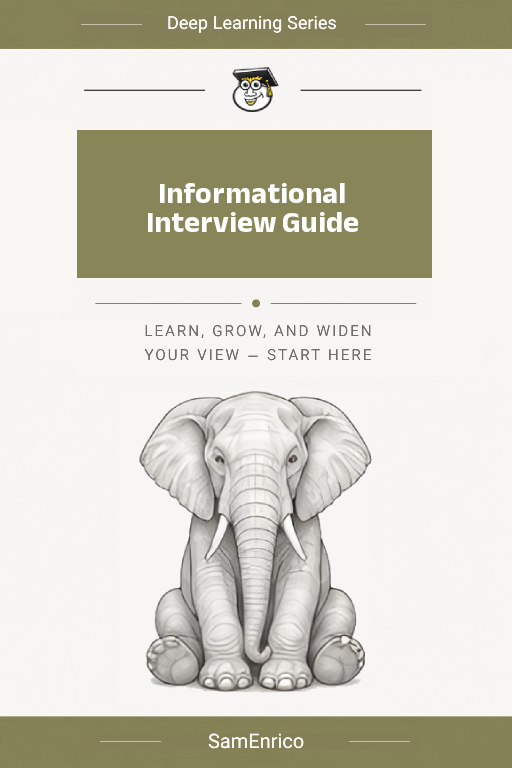 Informational Interview GuideHutto Dominique$12.99