
Infant Microbiome Development eBook
Support healthy bacterial colonization from birth
by Archer Jules
Support healthy bacterial colonization from birth through early childhood.
Formats
Free sample
Chapter 1: The Hidden Seed...--–- The image arrives without warning: a pristine, silent universe. For decades, textbooks and pediatric guides painted the newborn’s gut as a sterile vessel—a blank slate waiting to be written upon by the outside world. Parents were told that birth was the moment of first contact, that the baby emerged into a world of microbes and began the slow work of colonization from scratch. This narrative felt clean, controllable, and reassuring. It was also, by the best available evidence, completely wrong.The shift in understanding has been nothing short of revolutionary.
Over the past fifteen years, advanced sequencing technologies have allowed scientists to detect bacterial DNA in places previously assumed to be sterile—including the placenta, the amniotic fluid, and the meconium (the baby’s first stool, passed within hours of birth). These discoveries have overturned the “sterile womb” paradigm and replaced it with something far more complex and, for parents, far more empowering: the understanding that microbial inheritance begins months before the first cry, inside the quiet, dark ecosystem of the womb itself.This chapter will guide you through the emerging science of the prenatal microbiome. You will learn what we actually know—and what remains hotly debated—about the bacteria that may reach the fetus before birth. You will discover how your own body changes during pregnancy to shape the microbial legacy you pass to your child. And, most importantly, you will walk away with a concrete, evidence-informed action plan for optimizing your prenatal microbiome, reducing unnecessary antibiotic exposure, and managing gestational stress in ways that benefit not just you but the trillions of microscopic passengers your baby will one day carry.The Paradigm Shift: From Sterile Womb to Microbial Continuum For most of medical history, the fetus was considered biologically sealed off from the external environment.
The placenta was viewed as an impenetrable filter, the amniotic fluid as sterile bathing solution, and the newborn’s gut as a pristine territory awaiting its first microbial settlers during vaginal delivery. This model was logical, tidy, and deeply comforting—it suggested that the womb was a protected sanctuary, free from the risks of infection.The trouble was that the evidence never quite fit.As early as the 1920s, researchers occasionally isolated bacteria from umbilical cord blood and placental tissue, but these findings were dismissed as contamination—sloppy lab technique or microbes introduced during sample collection. And for decades, that dismissal was reasonable. The technology simply did not exist to distinguish true fetal colonization from environmental contamination with any confidence.Then came the genomic revolution.Using high-throughput sequencing of bacterial 16S ribosomal RNA genes (a kind of genetic barcode that identifies microbial species), researchers began detecting bacterial DNA in placental tissue, amniotic fluid, and fetal membranes—samples taken under strict sterile conditions designed to rule out contamination. One landmark study published in Science Translational Medicine analyzed placentas from over 300 women and found a consistent, though low-abundance, microbial community dominated by Firmicutes, Proteobacteria, and Bacteroidetes—the same phyla that dominate the adult gut and vaginal microbiome.The scientific community erupted.
Critics pointed out that bacterial DNA does not necessarily mean live bacteria; dead bacterial fragments or even contamination from lab reagents (which are notoriously contaminated with bacterial DNA) could produce false signals. Defenders countered that the patterns were too consistent, too specific to the placental environment, and too similar across global populations to be dismissed as noise.Where does the truth lie? At the time of this writing, the consensus leans cautiously toward the following: the womb is not sterile, but neither is it heavily colonized. The fetus likely encounters a very low-abundance, low-diversity set of microbial signals—perhaps including live bacteria, perhaps only bacterial cell wall components and metabolites—that may prime the developing immune system without establishing a true resident microbiome. In other words, the baby’s gut does not become “colonized” before birth in the same way it will after delivery, but neither does it develop in complete microbial isolation.For parents, the takeaway is both humbling and hopeful: your baby’s microbial journey begins before birth, but the prenatal environment is about signaling and preparation, not full-scale colonization.
The real explosion of microbial diversity still happens during and after birth. What happens in the womb sets the stage—but the actors do not fully arrive until labor, feeding, and the first months of life.The Pregnancy Microbiome Shift: How Your Body Transforms If the fetus is not exactly colonized before birth, how does the prenatal environment influence the infant’s future microbiome? The answer lies in the mother’s own changing microbial landscape.Pregnancy is not merely a nine-month waiting period for the birth event. It is a profound physiological transformation that reshapes nearly every system in the female body—including the microbial communities that reside in the gut, vagina, mouth, and even the skin. This collective change is now known as the pregnancy microbiome shift, and it appears to be an evolved adaptation designed to prepare both mother and infant for the microbial challenges of birth and breastfeeding.The Gut Microbiome in Pregnancy Early in the first trimester, the gut microbiome of a pregnant woman often resembles that of a non-pregnant healthy adult.
But as pregnancy progresses toward the third trimester, dramatic changes emerge. Studies have shown that between the first and third trimesters, the relative abundance of beneficial Faecalibacterium (a major butyrate producer) tends to decrease, while Proteobacteria (including potentially inflammatory species) and certain Bifidobacterium strains increase. At first glance, this looks like dysbiosis—a shift toward a less healthy profile.But researchers now believe this shift is intentional. The late-pregnancy gut microbiome begins to resemble the inflammatory, low-diversity profile seen in individuals with metabolic syndrome—not because pregnancy is a disease, but because low-grade inflammation helps the mother’s body prepare for the metabolic demands of late gestation and lactation. Some degree of insulin resistance and inflammatory signaling is necessary to shunt nutrients to the growing fetus.
The gut microbiome appears to play a supporting role in this process.More importantly for the infant, this maternal gut shift influences the types of bacteria that populate the vaginal tract (via direct microbial transfer from the rectal area) and the breastmilk (via the entero-mammary pathway, discussed in Chapter 4). What the mother carries in her gut during the third trimester has a direct line of influence—through complex, fascinating routes—to the microbes that will first greet her baby.The Vaginal Microbiome in Pregnancy The vaginal microbiome undergoes an equally striking transformation. In non-pregnant women of reproductive age, vaginal microbial communities vary widely—some dominated by Lactobacillus crispatus, others by L. iners, and still others by a mix of anaerobic bacteria. Vaginal p H tends to be higher (less acidic) outside of pregnancy, allowing greater diversity.During healthy pregnancy, however, the vaginal microbiome converges toward a remarkably consistent state: high abundance of Lactobacillus species (especially L.
crispatus and L. jensenii), low diversity, and low p H (highly acidic). This shift appears to be driven by rising estrogen levels, which increase glycogen production in vaginal epithelial cells. Lactobacillus species ferment this glycogen into lactic acid, creating an environment that is hostile to…
This is the end of the free sample. Get the eBook to keep going. Buy now
About this book
Details
- Author
- Archer Jules
- Publisher
- SamEnrico
- Language
- English
- Genre
- Non-Fiction, Health & Wellness, Pediatrics
- Released
- 2026-06-09
- Pages (approx.)
- 160
- Available as
- eBook, Audiobook

Read better in the ZLOADR app
Your eBooks on your phone or tablet. Sign in with your SamEnrico account and start reading.
More by Archer Jules
 Off Peak Driving ScheduleArcher Jules$11.99
 Post Quit Weight Management GuideArcher Jules$11.99
 Cleopatra Religious Authority as PharaohArcher Jules$11.99
 The Parent Estrangement DeathArcher Jules$11.99
 Pillars of Power: The Untold Rise of the Sackler DynastyArcher Jules$11.99
 The Lost Caravans of the Andes: Rediscovering South America's Forgotten Trade RoutesArcher Jules$11.99
 Payment Reconciliation Made EasyArcher Jules$12.99
 Cohort Mattress Spending PatternsArcher Jules$12.99
 Investment AccountantArcher Jules$11.99
 How to Start a Cutlery for Domestic Use Business (Beginners Guide)Archer Jules$11.99
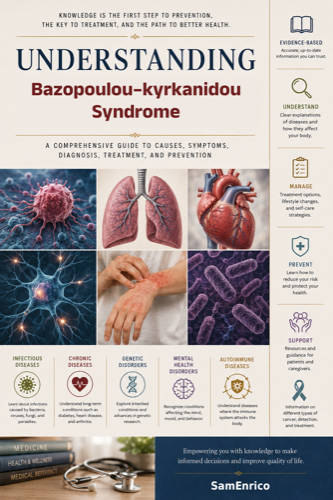 Understanding Bazopoulou–kyrkanidou SyndromeArcher Jules$17.99
You may also like
 Restless Leg Syndrome In Children GuideDelaney Layne$11.99
 Food Intolerance in ChildrenHowerton Delcie$11.99
 Naturopathy for Pediatric HealthGagnon Akilah$11.99
 HGH Children Short StatureRoby Cecila$11.99
 Cocaine and BreastfeedingCrook Junita$11.99
 Keto for Children GuideMorrill Rickie$11.99
 DTaP Vaccine Schedule GuideMark Richelle$11.99
 Diarrhea in ChildrenMorley Mathilde$11.99
 Neonatal Abstinence Syndrome GuideMatheson Whitley$11.99
 Constipation in ChildrenTemple Euna$11.99
 The Childhood Immunization ScheduleAguilar Janet$11.99
 Pediatric HGH DeficiencyClancy Eusebia$11.99