
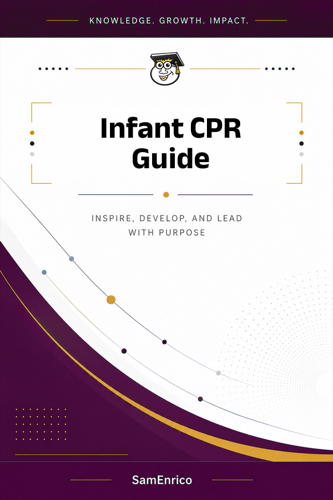
Non-FictionHealth & WellnessInfant
Infant CPR Guide eBook
Teaches two finger compressions and mouth to mouth
by Maupin Emmie
Teaches two finger compressions and mouth to mouth.
Formats
Free sample
Chapter 1: The 3 AM Fear--–- The soft blue glow of the baby monitor casts shadows on your bedroom ceiling. It’s 3:00 AM. Your three-month-old daughter has been fighting a cold for two days, and you’ve been sleeping in thirty-minute chunks, your ears tuned to every sniffle and sigh. Then you hear it: a sound you’ve never heard before. A wet, struggling, almost silent gasp.
Then nothing. The monitor shows her small body rigid, then limp. You run to her room, your heart already pounding, your hands already shaking. You scoop her up. Her lips are turning blue.
She is not breathing.In that moment—the moment every parent dreads and no parent truly believes will happen to them—two versions of you exist. The first version freezes. Her mind races through a thousand thoughts: Did I put her to sleep wrong? Should I call 911? What if I hurt her?
What if I do it wrong and make it worse? The second version acts. She tilts the baby’s head to neutral, places two fingers on the sternum, and begins compressions. The difference between these two versions of you is not intelligence. It is not love.
It is not even knowledge. It is preparedness—the kind of deep, muscle-memory, psychological readiness that cannot be acquired by scrolling through social media or watching a two-minute You Tube video.This book exists to make sure you are the second version.The Gap Between Knowing and Doing Let me tell you something uncomfortable. You have probably already watched a CPR video. Maybe during pregnancy, when you were nesting and reading everything you could about keeping your baby safe. Maybe after a friend shared a tragic story.
You saw the two-finger compressions. You saw the puffy-cheek breaths. You thought, I could do that. And you were right. You could.
But “could” and “will under extreme stress” are two entirely different things.Researchers who study emergency response call this the “knowledge-action gap.” In study after study, parents who have watched CPR demonstrations—even multiple times—still hesitate for thirty, forty, sometimes sixty seconds when faced with a real, unexpected infant arrest. They do not hesitate because they are bad parents. They hesitate because the human brain, when flooded with adrenaline and fear, defaults to one of three responses: freeze, flee, or fight. In the context of a blue, limp infant, “freeze” is by far the most common. Your brain is trying to protect you from an overwhelming threat, and in doing so, it shuts down higher reasoning.
You stand there holding your baby, and the part of your brain that remembers the CPR video goes dark.This book is not another video. It is not a passive viewing experience. It is an active, repetitive, psychologically-grounded training manual designed to override your freeze response before it ever has a chance to engage. By the time you finish these twelve chapters, the sequence of actions—tap, shout, neutral, look, listen, feel, thirty compressions, two puffs—will be as automatic as reaching for your phone when it buzzes. You will not think.
You will do.The First Two Minutes: Why You Are the Only One Who Can Save Your Baby Here is a statistic that should be printed on every baby oneside: For every minute that passes without CPR, an infant’s survival rate drops by 7 to 10 percent. After just two minutes, survival has dropped by nearly 20 percent. After four minutes, brain damage becomes increasingly likely. After six minutes, survival is rare.Now consider the average emergency response time. In a dense urban area, an ambulance might arrive in five to seven minutes.
In a suburban or rural area, it can take ten to fifteen minutes. That means if you wait for paramedics to arrive before starting CPR, your baby’s chance of surviving with full neurological function is effectively zero. The math is brutal and unforgiving. You are not a backup plan. You are the plan.
The paramedics are the backup.This is not meant to terrify you into paralysis. It is meant to liberate you. Because once you accept that you are the first and most critical responder, you also accept that you have enormous power. The power to keep oxygen moving to the brain. The power to maintain circulation until advanced help arrives.
The power to be the difference between a funeral and a graduation, between a tragedy and a story your child will one day hear about the time mom or dad saved their life.I have interviewed parents who performed CPR on their own infants. Their stories are remarkably similar. They do not describe themselves as heroes. They describe themselves as terrified, shaking, crying—and moving. Moving because they had practiced.
Moving because someone had told them, You cannot make it worse. A baby in cardiac arrest is already clinically dead. Your job is not to perform perfect CPR. Your job is to do something—anything—instead of nothing.The Cognitive Reframe: You Cannot Make It Worse Let that sink in. Read it again.
You cannot make it worse.When parents freeze, it is often because they are afraid of causing harm. What if I break a rib? What if I push too hard? What if I give too much air and burst a lung? These are reasonable fears.
But they are also irrelevant in the moment of arrest. An infant who is not breathing and has no pulse is, by definition, in a state that is already unsurvivable without intervention. The broken rib heals. The bruised lung recovers. The baby who receives no CPR does not recover.
Period.This is what psychologists call a “cognitive reframe.” You are not choosing between perfect CPR and no harm. You are choosing between imperfect CPR and no CPR at all. And the data is unequivocal: any CPR—even poorly performed CPR—is better than no CPR. Even if you forget to tilt the head perfectly. Even if your compressions are a little too slow or a little too shallow.
Even if you pause too long between cycles. The act of compressing the chest and delivering rescue breaths, even imperfectly, still moves some oxygenated blood to the brain. That is infinitely better than moving none.I want you to internalize this before we move to any of the mechanics. This is not a disclaimer. This is a psychological tool.
When the moment comes, and your hands are shaking, and your baby is blue, and your brain is screaming, you will hear this sentence: You cannot make it worse. And that sentence will unlock your frozen muscles and get you moving.The “Freezing Phenomenon” Explained Why do smart, capable, loving parents freeze? The answer lies in the amygdala—the almond-shaped cluster of neurons in your brain that processes fear. When you perceive a threat, the amygdala sends a distress signal to the hypothalamus, which activates the sympathetic nervous system. Adrenaline floods your body.
Your heart rate spikes. Your pupils dilate. Blood rushes away from your digestive system and toward your large muscles. Your prefrontal cortex—the part of your brain responsible for planning, reasoning, and recalling learned information—partially shuts down.This is the fight-or-flight response. It worked beautifully…
This is the end of the free sample. Get the eBook to keep going. Buy now
About this book
Details
- Author
- Maupin Emmie
- Publisher
- SamEnrico
- Language
- English
- Genre
- Non-Fiction, Health & Wellness, Infant
- Released
- 2026-06-10
- Pages (approx.)
- 124
- Available as
- eBook, Audiobook

Read better in the ZLOADR app
Your eBooks on your phone or tablet. Sign in with your SamEnrico account and start reading.
More by Maupin Emmie
 Jaw and Face RelaxationMaupin Emmie$11.99
 Design Thinking for EcommerceMaupin Emmie$11.99
 Alcohol Home Detox SupervisionMaupin Emmie$11.99
 Group Creativity Space DesignMaupin Emmie$11.99
 Remote Work for FreelancersMaupin Emmie$11.99
 Napoleon s Death at St HelenaMaupin Emmie$11.99
 Empathy for DisabilitiesMaupin Emmie$11.99
 Pangu's Cosmic Hammer: The Forge of Heaven and EarthMaupin Emmie$11.99
 Charlemagne's Court: The Symphony of a Renaissance KingMaupin Emmie$11.99
 How to Produce Tom-tomsMaupin Emmie$11.99How to Produce Tom-tomsMaupin Emmie$11.99
 How to Start a Enriched Uranium Production Business (Beginners Guide)Maupin Emmie$11.99
You may also like
 Hong Kong Handover 1997Dunn Johnnie$11.99
 Zumba For Postnatal Recovery CourseNeal Christian$11.99
 Zumba for BeginnersLadner Nikia$11.99
 YouTube Comment Mining GuideHumes Pandora$12.99
 Worry Box MeditationCarlin Rudy$11.99
 Workplace Stress MeditationNguyen Lynn$11.99
 Workplace Stress and Sleep RepairHawley Ivory$11.99
 Workplace Perfectionism CureDelaney Jeffry$11.99
 Workplace Injustice Anger GuideWallen Isabelle$11.99
 Work Addiction and Burnout LinkGreenwood Ester$11.99
 Women in Yoga and WellnessBeattie Galina$11.99
 Women in Stand Up ComedyChun Evangeline$11.99