
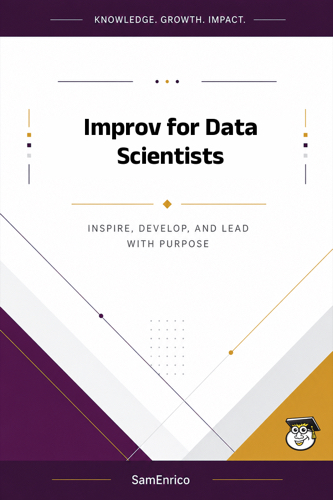
Improv for Data Scientists eBook
Spontaneous analysis pivots.
by Close Myles
Spontaneous analysis pivots.
Formats
Free sample
Chapter 1: The 2 AM Scream--The numbers were impossible.Maya stared at her laptop screen in the empty conference room, the glow of seventeen dashboard panels painting her face in shades of panic blue. The fintech startup’s flagship churn prediction model—the one she had spent six months building, validating, and defending—had just collapsed. Not degraded. Not drifted. Collapsed.At 11:47 PM, the AUC score was 0.92.
Industry-leading. Deployable. Safe.At 12:34 AM, it was 0.68. Concerning but recoverable.At 1:52 AM, it was 0.51.That was not a model. That was a coin flip.The CEO’s Slack message arrived at 2:03 AM: “Dashboard looks weird on my end.
What’s happening?”Maya typed nothing. Deleted it. Typed “looking into it.” Deleted that too. She had nothing. Every diagnostic she ran pointed to a different cause.
Feature drift? Maybe. Data pipeline failure? Possibly. A bug in yesterday’s deployment?
She didn’t know. The logs were a forest of green checkmarks and red herrings.This was not what they taught her in graduate school.The Pipeline That Never Existed Let us rewind to a fantasy—the fantasy that every data science education sells.In textbooks and boot camps, the data science workflow is a beautiful, linear thing. You start with clean data. You explore it. You engineer features.
You train a model. You validate it on a holdout set. You deploy it. You monitor it. Everyone claps.This pipeline—Clean Data → Perfect Model → Actionable Insight—is the single most damaging myth in modern analytics.
Not because it describes nothing, but because it describes almost nothing that actually happens in the wild. It is the data science equivalent of a physics problem that assumes no friction, a perfect vacuum, and spherical cows.Maya’s reality, like that of every data scientist reading this page, was nothing like that.Her data arrived late, often missing entire weeks of transactions. Her features broke silently when upstream APIs changed without warning. Her stakeholders changed their questions mid-analysis. Her model, which performed beautifully on last quarter’s data, failed catastrophically on today’s.And now, at 2 AM, she was supposed to think on her feet—a skill nobody had ever taught her.The VUCA World You Actually Work In The military has a term for Maya’s environment.
It is called VUCA—Volatility, Uncertainty, Complexity, Ambiguity. Coined at the U.S. Army War College after the Cold War, VUCA describes the kind of operational environment where traditional planning fails and commanders must rely on agility instead of certainty.Let us translate each term into data science.Volatility means the data changes fast and unpredictably. The distribution of a feature today is not the distribution of that feature yesterday. Customer behavior shifts overnight.
Seasonality patterns break. What was a strong signal last week is noise this week.Maya saw this in real time. Her churn model relied heavily on transaction frequency. But a competitor had launched a promotional campaign at midnight, and thousands of customers had shifted their spending patterns within hours. Her model was not wrong about the old patterns.
It was wrong about the new patterns—and it had no way to know the difference.Uncertainty means you do not know what you do not know. In Maya’s case, the data pipeline had failed silently for six hours. Transactions were being logged, but a critical join key had changed format, so customer IDs no longer matched. The data looked complete. It was not.
Maya could not see the problem because the problem was invisible by design.Complexity means causes and effects are not linear. You cannot trace a model failure to a single root cause because the system has too many interacting parts. The pipeline failure, the competitor launch, a minor change in feature engineering from last month, and a Slack message from the product team requesting “one small tweak”—all of these interacted to produce the 2 AM Scream. No single culprit. No simple fix.Ambiguity means the same data can support multiple, contradictory interpretations.
Was the AUC drop a data problem, a model problem, or a business problem? Different diagnostics pointed to different answers. Maya could not wait for certainty. She had to act on the best available guess.Here is the hard truth: If your data science education did not prepare you for VUCA, it did not prepare you for data science. It prepared you for a laboratory.
You do not work in a laboratory.Why Algorithms Are Not the Problem A common reflex among data scientists facing a crisis is to reach for a more sophisticated algorithm. “If only I had used XGBoost instead of logistic regression.” “If only I had tuned my hyperparameters more carefully.” “If only I had more layers in my neural network.”This reflex is usually wrong.Maya’s churn model was not failing because of its algorithm. It was failing because the assumptions underlying that algorithm had broken. The assumption that the training distribution would match the production distribution. The assumption that features would remain available and stable.
The assumption that the business question would stay the same.Algorithms are not the problem. Cognitive agility is the problem.Most data science programs teach the “what”—what algorithm to use, what statistical test to run, what visualization to create. They do not teach the “how”—how to think when the plan fails, how to pivot when the data contradicts you, how to stay curious instead of freezing.This book is about that gap.The Improv Bridge: Why Theater People Know Something You Don’t This is where the book takes its strangest turn. Because the people who have studied this problem most deeply—the problem of thinking on your feet when the script breaks—are not data scientists. They are not even technologists.
They are improvisational comedians.Improv is the art of creating something from nothing, in real time, with no script, no safety net, and a partner who is just as surprised as you are. An improv scene starts with an offer—a word, a gesture, a character choice—and two performers build a world around it, moment by moment, never knowing what comes next.This sounds like chaos. It is actually a rigorous discipline.The core principle of improv, taught in every beginner class around the world, is called “Yes, And.” When your scene partner makes an offer, you do two things: First, you say “Yes”—you accept the reality they have created, even if it is weird or inconvenient or contradictory to your plan. Second, you say “And”—you add something of your own, moving the scene forward.“Yes, And” is not a positivity mantra. It is a validation framework for generative collaboration.Now apply this to data science.When Maya’s model collapsed at 2 AM, her instinct—trained by years of academic perfectionism—was to say “No.” No, this data cannot be right.
No, the model should not be failing. No, I will not accept this outcome. She wanted to reject the reality of the situation because that reality was threatening.“Yes, And” offers a different path.“Yes” means accepting the reality of the data exactly as it is. Not the way you want it to be. Not the way…
This is the end of the free sample. Get the eBook to keep going. Buy now
About this book
Details
- Author
- Close Myles
- Publisher
- SamEnrico
- Language
- English
- Genre
- Non-Fiction, Self-Help, Data
- Released
- 2026-06-05
- Pages (approx.)
- 115
- Available as
- eBook, Audiobook

Read better in the ZLOADR app
Your eBooks on your phone or tablet. Sign in with your SamEnrico account and start reading.
More by Close Myles
 Thunberg Factory Farming FightClose Myles$11.99
 Bipolar And Genetics GuideClose Myles$11.99
 Pattern Recognition Study GuideClose Myles$11.99
 Homework Battles Parent AngerClose Myles$11.99
 Seasonal Inventory AI ModelClose Myles$11.99
 The Hormonal Weight Loss GuideClose Myles$11.99
 Public Speaking for EngineersClose Myles$11.99
 From the Streets to the Stadium: The Rise of MC SolaarClose Myles$11.99
 Trafalgar's Thunder: Nelson's Last Stand Against the Franco-Spanish FleetClose Myles$11.99
 How to Produce a Concrete MixerClose Myles$11.99
 How to Become a Copra ProcessorClose Myles$11.99
 A Collector's Handbook to the Tatra Type 77Close Myles$11.99
You may also like
 Hong Kong Handover 1997Dunn Johnnie$11.99
 Zumba For Postnatal Recovery CourseNeal Christian$11.99
 Zumba for BeginnersLadner Nikia$11.99
 YouTube Comment Mining GuideHumes Pandora$12.99
 Worry Box MeditationCarlin Rudy$11.99
 Workplace Stress MeditationNguyen Lynn$11.99
 Workplace Stress and Sleep RepairHawley Ivory$11.99
 Workplace Perfectionism CureDelaney Jeffry$11.99
 Workplace Injustice Anger GuideWallen Isabelle$11.99
 Work Addiction and Burnout LinkGreenwood Ester$11.99
 Women in Yoga and WellnessBeattie Galina$11.99
 Women in Stand Up ComedyChun Evangeline$11.99