
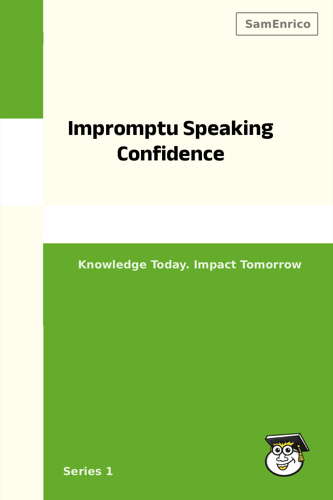
Non-FictionSelf-HelpSpontaneous Speaking
Impromptu Speaking Confidence eBook
Master techniques for thinking on your feet when c
Master techniques for thinking on your feet when called upon unexpectedly.
Formats
Free sample
Chapter 1: The Invention Myth--–- Let me tell you something that will either infuriate you or liberate you: there is no such thing as a natural impromptu speaker. Not one. Not the executive who fields hostile questions with a disarming smile. Not the colleague who always has a crisp answer when the boss calls on them cold. Not the politician who pivots from a scandal question to a vision statement without breaking eye contact.
Every single one of them learned to do what they do. Every single one of them was once exactly where you are right now—heart pounding, mouth dry, mind a white-screen-of-death void, praying that someone else in the room would speak first.The belief that some people are born quick thinkers while others are not is the single most damaging myth in public speaking. It is also, according to decades of research in cognitive psychology and behavioral neuroscience, completely false. What we call “natural” spontaneity is actually invisible preparation—habits, structures, and mental models that have been practiced until they become reflexive. You cannot see these habits because they happen inside the speaker’s head in microseconds.
You see only the result: a smooth, confident response that looks effortless. And because effort is invisible, you assume it was never required.This chapter will dismantle that myth. We will explore the science of why your brain freezes under pressure (spoiler: it is not because you are stupid or slow). We will introduce the single most important mindset shift you will make in this entire book: moving from performer to contributor. And we will end with a reframe that will change how you experience every unexpected question for the rest of your life.
Confidence is not a feeling that precedes action. It is a byproduct of having a reliable process. Let us build that process.The Anatomy of a Freeze Close your eyes for a moment. Actually, do not just read that instruction—do it. Close your eyes and recall the last time you were called upon unexpectedly and your mind went blank.
Maybe it was a meeting where your manager asked, “What do you think about the Q3 numbers?” Maybe it was a family gathering where someone said, “Tell everyone about your new project.” Maybe it was a wedding toast where you suddenly forgot the couple’s names. Feel the physical sensations. Heart rate? Up. Palms?
Damp. Chest? Tight. That internal monologue? Probably something like: Why can’t I think?
I know this. I just talked about this yesterday. Say something. Anything. Why are they all staring?Now open your eyes.
Here is the liberating truth: that experience is not a sign of weakness. It is a sign that your brain is working exactly as evolution designed it to work. The problem is that evolution designed your brain for saber-toothed tigers, not quarterly reviews.Let me introduce you to a concept called cognitive load theory. Your working memory—the part of your brain that holds and manipulates information in real time—has a limited capacity. Cognitive psychologists estimate that you can hold roughly four to seven discrete pieces of information in your working memory at any given moment.
That is not a lot. Under normal conditions, that capacity is enough to formulate a sentence, recall a fact, and monitor your audience’s reaction simultaneously. But under stress, something changes.When you perceive a social threat—and being called upon unexpectedly in front of others is processed by your brain as a genuine threat to your social standing, which your ancient limbic system treats as a threat to survival—your amygdala (the brain’s alarm system) activates. It floods your system with cortisol and adrenaline. Your heart rate increases.
Your breathing becomes shallow. Blood flow shifts away from your prefrontal cortex (the seat of executive function, logic, and working memory) and toward your muscles and extremities. Your body is preparing to fight or flee. This is the amygdala hijack, a term coined by psychologist Daniel Goleman.Here is what that means for impromptu speaking: exactly when you need your working memory the most, your brain reduces its blood supply. Your cognitive load capacity shrinks from four to seven pieces of information down to maybe one or two.
You are not stupid. You are not slow. You are physiologically impaired in the same way a runner with a pulled hamstring is impaired. The solution is not to try harder. The solution is to reduce the friction.Think of it this way.
Imagine trying to drive a car through a city street. Under normal conditions, the street is wide, the traffic is light, and you can navigate easily. Now imagine that same street during a flash flood. The water is rising. Debris is floating.
You can barely see the road. That is what happens to your working memory during an amygdala hijack. The solution is not to drive faster. The solution is to know exactly where you are going before you turn the key.The Performer vs. The Contributor Here is where most advice about impromptu speaking goes wrong.
Most books, courses, and well-meaning mentors will tell you to “be more confident” or “just relax” or “pretend the audience is in their underwear.” These suggestions fail because they address the symptom (anxiety) rather than the cause (the pressure to perform perfectly). You cannot relax your way out of a perceived threat any more than you can relax your way out of a burning building. The threat is real to your brain. What you can change is the nature of the threat.The most transformative shift you can make is to move your identity from performer to contributor. A performer stands on a stage and is judged.
Every word is evaluated. Silence is failure. Mistakes are catastrophic. The performer’s goal is to be impressive. A contributor sits at a table and is part of a conversation.
Their goal is not to dazzle but to add value. Silence is just silence. Mistakes are correctable. The contributor’s goal is to be useful.Let me make this concrete. Imagine two people in the same meeting.
The boss asks, “What do we do about the client who is threatening to leave?” The performer thinks: I need to say something smart. Everyone is looking. My reputation is on the line. What if I say the wrong thing? What if I sound stupid?
The contributor thinks: I have one piece of information that might help. I will share it. If it is useful, great. If not, someone else will build on it. No big deal.Which person is more likely to speak?
Which person is more likely to speak clearly? Which person, ironically, is more likely to sound confident and authoritative? The contributor. Because the contributor has removed the crushing weight of performance. The contributor is not trying to be impressive.
They are trying to be useful. And here is the paradox: people who try to be useful almost always end up sounding more impressive than people who try to be impressive. Trying to be impressive signals insecurity. Trying to be useful signals confidence.This is not just philosophy. It is backed by research.
In a study published in the Journal of Experimental Social Psychology, researchers found that participants who were instructed to focus…
This is the end of the free sample. Get the eBook to keep going. Buy now
About this book
Details
- Author
- Brooks Guadalupe
- Publisher
- SamEnrico
- Language
- English
- Genre
- Non-Fiction, Self-Help, Spontaneous Speaking
- Released
- 2026-06-06
- Pages (approx.)
- 133
- Available as
- eBook, Audiobook

Read better in the ZLOADR app
Your eBooks on your phone or tablet. Sign in with your SamEnrico account and start reading.
More by Brooks Guadalupe
 Handling the Silent TreatmentBrooks Guadalupe$11.99
 The Boundary Setting Step NineBrooks Guadalupe$11.99
 IBS Yoga And Movement GuideBrooks Guadalupe$11.99
 Unmet Expectation ProtocolBrooks Guadalupe$11.99
 Inpatient Alcohol Detox GuideBrooks Guadalupe$11.99
 Anxiety and Smoking CessationBrooks Guadalupe$11.99
 Probiotic Strains GuideBrooks Guadalupe$11.99
 The Stone Poets: Visionaries of the Gothic SkyBrooks Guadalupe$11.99
 The Siege of the Savoy: London's Forgotten Gangland StandoffBrooks Guadalupe$11.99
 How to Produce Interior LaTeX Eggshell PaintBrooks Guadalupe$11.99
 Indian Income Tax GuideBrooks Guadalupe$12.99
 Competitive Research BlockingBrooks Guadalupe$12.99
You may also like
 Hong Kong Handover 1997Dunn Johnnie$11.99
 Zumba For Postnatal Recovery CourseNeal Christian$11.99
 Zumba for BeginnersLadner Nikia$11.99
 YouTube Comment Mining GuideHumes Pandora$12.99
 Worry Box MeditationCarlin Rudy$11.99
 Workplace Stress MeditationNguyen Lynn$11.99
 Workplace Stress and Sleep RepairHawley Ivory$11.99
 Workplace Perfectionism CureDelaney Jeffry$11.99
 Workplace Injustice Anger GuideWallen Isabelle$11.99
 Work Addiction and Burnout LinkGreenwood Ester$11.99
 Women in Yoga and WellnessBeattie Galina$11.99
 Women in Stand Up ComedyChun Evangeline$11.99