
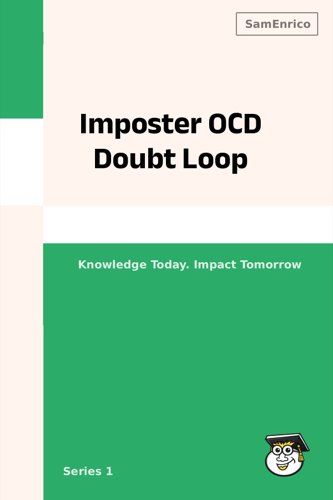
Imposter OCD Doubt Loop eBook
Break the compulsive checking and reassurance-seek
by Villa Noelia
Break the compulsive checking and reassurance-seeking that feeds uncertainty about your competence.
Formats
Free sample
Chapter 1: The Fraud Factory--You have accomplished something real. Perhaps you earned a degree, landed a promotion, received positive feedback, or built something from nothing. And yet, instead of feeling pride, you feel a low hum of dread. Somewhere beneath your daily routine, a quiet voice whispers: They’re going to find out. You don’t actually belong here.
Any minute now, someone will discover the truth—that you’re a fraud.If you have spent years over-preparing for meetings, re-reading emails until your eyes blur, or asking colleagues for reassurance you immediately forget, you are not merely insecure. You may be trapped inside a specific, exhausting, and widely misunderstood psychological loop: Imposter OCD.This chapter dismantles the common understanding of Imposter Syndrome and rebuilds it as something far more specific and treatable. We will draw a sharp line between the familiar feeling of being a fraud and the compulsive, doubt-driven cycle of Imposter OCD. You will learn why your highest values—integrity, excellence, honesty—have become weapons against you. You will understand why OCD is called the “doubting disorder” and how it specifically attacks the three tools you need to feel competent: memory, perception, and judgment.
Finally, we will bust the myths that keep you stuck, including why positive affirmations and confidence-building exercises not only fail but often make the problem worse.By the end of this chapter, you will have a new lens through which to see your struggle. You will stop asking “Am I a fraud?” as if it were a question to be answered. Instead, you will begin treating that thought as a symptom—not a problem to be solved.The Exhaustion You Cannot Name Let us begin with a moment of honesty. If you are reading this book, you are likely exhausted in a way that sleep does not fix. You have achieved things that others would call success.
Your resume looks good. Your performance reviews range from solid to outstanding. People come to you for answers. And yet, inside your own head, there is a second, parallel reality where none of it counts.In that parallel reality, every piece of positive feedback is a fluke. Every completed project is a near-miss disaster that you barely caught in time.
Every compliment is met with an internal flinch because you know—you know—that if they saw what you really did, or how long it took, or how many times you checked and rechecked, they would change their minds.This is not simple low self-esteem. People with low self-esteem generally feel bad about themselves. You, on the other hand, may feel fine about yourself as a person but terrified about your competence in specific domains. You believe in your values. You work hard.
You care deeply about doing good work. That is precisely the problem.The exhaustion you feel is not from working hard. It is from working twice: once to do the task, and again to check, verify, re-check, and seek reassurance that you actually did it correctly. And then a third time to mentally review whether your checking was thorough enough. You are running a race where the finish line moves every time you get close.This chapter is the first step toward naming that exhaustion and, more importantly, understanding its true architecture.The Critical Distinction: Imposter Syndrome vs.
Imposter OCDThe term “Imposter Syndrome” entered popular culture decades ago, and for many people, it describes a real and painful experience: the feeling that you do not deserve your success and will eventually be exposed. Standard Imposter Syndrome is characterized by feelings of phoniness, attributing success to luck or effort rather than ability, and a persistent fear of being “found out.” It fluctuates with mood, context, and life circumstances. It responds, for some people, to talk therapy, peer support, and confidence-building.Imposter OCD is different. It is not a syndrome or a feeling. It is a compulsive loop.In Imposter OCD, the fear of being a fraud does not just float through your mind.
It attaches itself to specific tasks, demands immediate attention, and drives you to perform rituals—checking, editing, asking, reviewing, confessing—to temporarily reduce the anxiety. But here is the cruel trick: the rituals do not create certainty. They destroy it. The more you check, the less confident you become. The more reassurance you seek, the more you need.This is the defining feature of OCD in any of its forms.
Whether the obsession is about contamination, harm, symmetry, or—in this case—competence, the structure is identical: an intrusive doubt triggers distress, a compulsion provides temporary relief, and the relief trains your brain to repeat the cycle. Over time, the doubt grows louder because you have taught your brain that doubt is an emergency requiring immediate action.If you have ever found yourself re-reading the same sentence five times and still not being sure what it says, or asking a colleague “Does this look okay?” immediately after they already said yes, or replaying a meeting in your head for hours to check for social errors—you are not just insecure. You are in the grip of a compulsion.And compulsions are treatable.Competence-Based OCD: When Your Values Become Weapons Here is something that will sound paradoxical at first: Imposter OCD does not attack people who do not care about their work. It attacks people who care deeply.The disorder uses your highest values against you. If you value integrity, OCD will whisper: What if you made an error and no one catches it?
That would be dishonest. If you value excellence, OCD will whisper: This is not good enough. A truly excellent person would keep working. If you value honesty, OCD will whisper: If you are actually incompetent, pretending otherwise is a lie.Your conscience, your work ethic, your commitment to quality—these are virtues. But in the architecture of OCD, they become the hook that the disorder uses to sink its teeth into your attention.
The obsession attaches itself to what matters most.This is why standard advice for Imposter Syndrome often backfires for people with Imposter OCD. Telling someone with standard Imposter Syndrome to “list your accomplishments” or “practice self-compassion” can be helpful. Telling someone with Imposter OCD to do the same thing often becomes another compulsion. They do not list their accomplishments once and feel better. They list them repeatedly, checking for flaws, comparing each accomplishment to someone else’s, mentally reviewing whether each one “really counts.”The value itself—excellence, honesty, integrity—is not the problem.
The problem is that the disorder has hijacked that value and turned it into an engine of self-doubt.The Doubting Disorder: How OCD Attacks Memory, Perception, and Judgment OCD is often called the “doubting disorder” for good reason. It does not create doubt about trivial things. It creates doubt about the very cognitive tools you rely on to navigate the world.Memory. You complete a task. You check it.
You check it again. But after the third or fourth check, something strange happens: you can no longer remember checking it with certainty. The memory feels foggy, distant, almost dreamlike. You think: Did I actually check that? Or do I just remember thinking…
This is the end of the free sample. Get the eBook to keep going. Buy now
About this book
Details
- Author
- Villa Noelia
- Publisher
- SamEnrico
- Language
- English
- Genre
- Non-Fiction, Self-Help, OCD
- Released
- 2026-06-08
- Pages (approx.)
- 127
- Available as
- eBook, Audiobook

Read better in the ZLOADR app
Your eBooks on your phone or tablet. Sign in with your SamEnrico account and start reading.
More by Villa Noelia
 India FCPA Violation LogVilla Noelia$11.99
 Transcendental Meditation PostureVilla Noelia$11.99
 Therapy Without Borders Access GuideVilla Noelia$11.99
 Party Planning ShortcutVilla Noelia$11.99
 Single Person LTC GuideVilla Noelia$11.99
 The Midnight Couriers: China's Forgotten Underground RailroadVilla Noelia$11.99
 Breath and Mental States ConnectionVilla Noelia$11.99
 Indigenous Grief Rituals ManualVilla Noelia$11.99
 Whispers of the Sky: The Vanishing City of the CloudsVilla Noelia$11.99
 Silent No More: The Unfinished Fight for the 19th AmendmentVilla Noelia$11.99
 Sixty Second Nervous System ResetVilla Noelia$12.99
 Procurement Assistant PathVilla Noelia$12.99
You may also like
 Social Media and OCDStephens Jasmine$11.99
 Rescripting Nightmares For OCDCardenas Anabel$11.99
 Sexual Addiction and OCD OverlapSisk Aron$11.99
 Self Hypnosis for Compulsive BehaviorsHooker Yer$11.99
 Parenting OCD ManagementGolden Gianna$11.99
 Parental OCD Self Care GuideSoliz Kraig$11.99
 Gambling Addiction And OCDKetchum Rueben$11.99
 Breath for OCDRohr Monroe$11.99
 Breath Counting for OCDFerris Dawna$11.99
 Body Scan for OCDStevens Lydia$11.99
 OCD Student Academic GuideTurpin Tessa$11.99
 Nightmare Processing For OCDArevalo Albina$11.99