
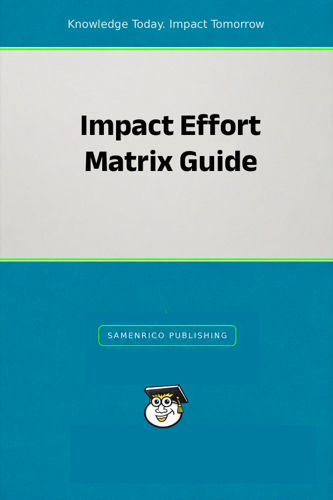
Non-FictionSelf-HelpPrioritization Matrix
Impact Effort Matrix Guide eBook
Plots ideas to identify quick wins and major proje
Plots ideas to identify quick wins and major projects.
Formats
Free sample
Chapter 1: The Effort Paradox--–- Imagine you are handed a list of one hundred good ideas. Not bad ideas. Not mediocre ideas. One hundred genuinely promising, potentially valuable, completely defensible ideas. Your team has the resources to execute exactly ten of them this year.
Which ten do you choose?Most people answer this question by reaching for a spreadsheet. They try to assign scores, calculate returns, build elaborate models. But within weeks, that beautiful spreadsheet is abandoned. The team is back to fighting over whatever feels most urgent, whatever the loudest stakeholder demands, whatever was mentioned in last week’s all-hands meeting. The spreadsheet wasn’t wrong.
It was just irrelevant.This is the Effort Paradox: the more good ideas you have, the worse your execution becomes. Not because your team is lazy or undisciplined, but because the human brain is terrible at comparing options across different types of value. You can easily say “this feature will generate more revenue than that feature.” But how do you compare revenue against user satisfaction? Against strategic positioning? Against technical debt reduction?
Against competitive pressure? You can’t. So you guess. And your guesses become arguments. And arguments become politics.
And politics become paralysis.The Effort Paradox explains why so many teams are busy but unproductive. They are not sitting around doing nothing. They are working eighty-hour weeks, shipping constantly, checking boxes furiously. And yet the metrics don’t move. The strategic goals remain unmet.
The major projects slip quarters, then years, then into the graveyard of forgotten initiatives.I have watched this pattern destroy teams across every industry. A marketing team that launches thirty campaigns in a quarter but grows zero new accounts. A product team that ships fifty features but increases retention by nothing. An engineering team that fixes two hundred bugs but still gets the same support tickets every week. They are working hard.
They are working smart, even, by many definitions. But they are working on the wrong things.The problem is not a lack of effort. The problem is a lack of a shared language for comparing effort against impact. You cannot prioritize what you cannot compare. And you cannot compare what you cannot measure on a single scale.That is why this book exists.
The Impact Effort Matrix is not a new tool. It has been around for decades, hiding in strategy workshops and product management textbooks. But almost everyone uses it wrong. They treat it as a simple quadrant exercise: put sticky notes on a whiteboard, draw a cross, and declare victory. Then they go back to their old habits because the exercise felt simplistic and produced no real clarity.This book is the antidote to that failure.
Over the next twelve chapters, you will learn not just how to draw the matrix, but how to turn it into a living decision engine. You will learn why most people misdefine effort and impact, how to spot the diagonal boundary that changes everything, why quick wins are both more powerful and more dangerous than you think, and how to say no to good ideas so you can say yes to great ones.But first, we need to understand why this is so hard. And that requires confronting the three hidden traps that make prioritization feel impossible.The Three Hidden Traps Before we build a solution, we must diagnose the disease. Most teams fail at prioritization not because they lack discipline, but because they fall into three traps that are baked into human psychology and organizational structure. These traps are invisible to the people inside them.
You will recognize each one immediately.Trap One: The Urgency Bias Your brain is wired to prioritize immediate threats over long-term opportunities. This is not a character flaw. It is a survival mechanism. A rustle in the bushes might be a predator, so your ancestors who dropped everything to investigate lived longer than those who calmly finished weaving baskets.But in modern knowledge work, the rustle in the bushes is usually an email, a Slack message, or a request from a senior leader. It feels urgent because it just arrived.
It feels important because someone asked. But urgency and importance are not the same thing. The urgent email about a typo on the website is not more important than the strategic initiative to rebuild the checkout flow. But your brain treats it that way because the typo is here now and the checkout flow is somewhere in the future.The Urgency Bias creates a predictable pattern: your team spends Monday through Thursday fighting fires, then Friday trying to remember what the strategic priorities were supposed to be. By Monday, the fires are back.
The cycle repeats. Strategic work never gets more than four hours of focus per week. And because strategic work requires deep concentration, four hours is not enough. So the strategic work slips. And slipping strategic work creates more fires in the future, which makes the urgency bias worse.This is a downward spiral.
The only way out is to build a system that separates urgency from importance automatically, without requiring heroic willpower from your team.Trap Two: The Impact Illusion Every stakeholder believes their idea is high impact. Not because they are dishonest, but because they are looking at different definitions of impact. The sales leader defines impact as revenue this quarter. The product leader defines impact as user retention over six months. The engineering leader defines impact as technical debt reduction.
The CEO defines impact as strategic positioning for next year.All of these definitions are valid. None of them are wrong. But they are incommensurable. You cannot put them on the same scale without first deciding which definition matters most right now. And most teams never have that conversation.
They skip straight to arguing about whether a specific feature is “high impact” without ever defining what impact means.The Impact Illusion leads to endless debates where everyone is right according to their own definition and everyone is frustrated because no one else agrees. The solution is not to pick one definition forever. The solution is to explicitly choose which definition applies to the current decision, and to revisit that choice regularly.Trap Three: The Effort Fallacy Your team systematically underestimates effort. This is not because they are optimistic. It is because effort has at least three components, and most people only consider one.The first component is time.
How many person-hours or calendar days will this take? This is the component everyone thinks about. But time alone is misleading. A task that takes two hours might require four approvals, which means it will take three days of calendar time. A task that takes forty hours might have zero dependencies and can be done in one focused week.The second component is complexity.
How many dependencies, unknown technologies, or cross-team handoffs are involved? Complexity is not the same as time. A technically simple task can take weeks if it requires legal review. A technically complex task can take days if the team has deep expertise.The third component is risk. What is the chance of failure?
Not the chance of taking longer than expected, but the chance of delivering zero value? Risk is often the most…
This is the end of the free sample. Get the eBook to keep going. Buy now
About this book
Details
- Author
- Werner Charline
- Publisher
- SamEnrico
- Language
- English
- Genre
- Non-Fiction, Self-Help, Prioritization Matrix
- Released
- 2026-06-06
- Pages (approx.)
- 134
- Available as
- eBook, Audiobook

Read better in the ZLOADR app
Your eBooks on your phone or tablet. Sign in with your SamEnrico account and start reading.
More by Werner Charline
 Twelve Step Recovery IntroductionWerner Charline$11.99
 ABCDE For Anxiety ManagementWerner Charline$11.99
 Hospital Environmental Toxin GuideWerner Charline$11.99
 Pregabalin Nerve PainWerner Charline$11.99
 Mindful Movement MBSR SequenceWerner Charline$11.99
 Air Freshener Chemical ExposureWerner Charline$11.99
 Sarcopenia Cognitive Decline LinkWerner Charline$11.99
 Timeline Problem IncubationWerner Charline$11.99
 The Treasure of the Antikythera: Decoding the World's First ComputerWerner Charline$11.99
 Anansi’s Golden Web: The Spider’s Wisdom and DeceptionWerner Charline$11.99
 The Last Broadcast: Chelyabinsk’s FireballWerner Charline$11.99
 The Dancer's Guide to Vintage DanceWerner Charline$11.99
You may also like
 Hong Kong Handover 1997Dunn Johnnie$11.99
 Zumba For Postnatal Recovery CourseNeal Christian$11.99
 Zumba for BeginnersLadner Nikia$11.99
 YouTube Comment Mining GuideHumes Pandora$12.99
 Worry Box MeditationCarlin Rudy$11.99
 Workplace Stress MeditationNguyen Lynn$11.99
 Workplace Stress and Sleep RepairHawley Ivory$11.99
 Workplace Perfectionism CureDelaney Jeffry$11.99
 Workplace Injustice Anger GuideWallen Isabelle$11.99
 Work Addiction and Burnout LinkGreenwood Ester$11.99
 Women in Yoga and WellnessBeattie Galina$11.99
 Women in Stand Up ComedyChun Evangeline$11.99