
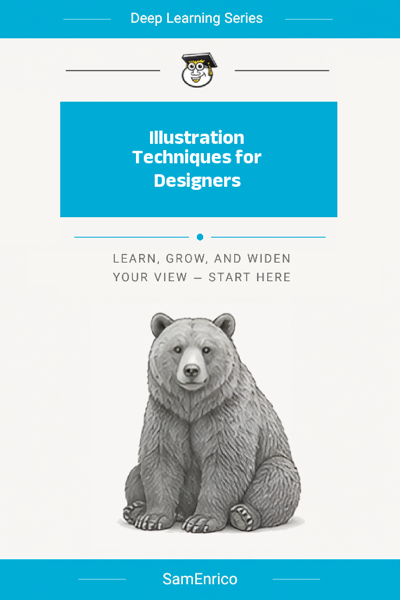
Non-FictionInformativeEducational
Illustration Techniques for Designers
A Coursebook on Illustration Techniques for Design
A Coursebook on Illustration Techniques for Designers
Formats
About this book
Free sample
Chapter 1: The Lie of the Almond Eye...― The first thing every design student hears is a lie. It is whispered in foundation classes, repeated in You Tube tutorials, and reinforced every time you pick up a pencil. The lie sounds harmless, even helpful: “Just draw what you see.” But those four words are useless without a second, unspoken instruction: Learn to stop seeing what you already know. Because you do not actually see an eye when you look at a face. You see a symbol for an eye—a flattened almond shape with a circle inside, perhaps a curved line above for the brow.
You have drawn this symbol a thousand times since childhood. It is efficient. It is recognizable. And it is completely wrong for a designer who needs to communicate specific, original, persuasive visual ideas.This chapter is not about drawing beautifully. It is about drawing truthfully.
Before you can master line weight, color theory, perspective, or any of the techniques in this book, you must rewire how your brain translates light into line. The exercises that follow will feel strange, even frustrating. You will draw faces upside down, trace the edge of your own hand without looking at the paper, and spend twenty minutes on a crumpled paper bag. By the end, you will have experienced a perceptual shift—a quiet but permanent change in how you see the world. And you will have established the daily habit that will sustain every other skill in this book.The Symbol-Making Machine Your brain is not a camera.
It is a ruthless efficiency engine. Every second, your eyes send roughly ten million bits of information to your visual cortex. Your conscious mind can process only about fifty of those bits. The rest are filtered, summarized, and—most dangerously for an illustrator—labeled.This labeling is called symbolic representation. It is the reason a child’s drawing of a house looks like a square with a triangle on top, regardless of what actual house the child was looking at.
The square-with-triangle is not a drawing of a specific house at a specific time of day under specific light. It…
This is the end of the free sample. Get the eBook to keep going. Buy now
Contents
- Chapter 1
- Chapter 2
- Chapter 3
- Chapter 4
- Chapter 5
- Chapter 6
- Chapter 7
- Chapter 8
- Chapter 9
- Chapter 10
- Chapter 11
- Chapter 12
Details
- Author
- Hawkins Pearl
- Publisher
- SamEnrico
- Language
- English
- Genre
- Non-Fiction, Informative, Educational
- Released
- 2026-05-06
- Pages (approx.)
- 159
- Available as
- eBook, Audiobook

Read better in the ZLOADR app
Your eBooks on your phone or tablet. Sign in with your SamEnrico account and start reading.
More by Hawkins Pearl
 TM for Busy ProfessionalsHawkins Pearl$11.99
 Gout Arthritis ManagementHawkins Pearl$11.99
 Therapy Social Media PressureHawkins Pearl$11.99
 Bathroom Toxin Elimination PlanHawkins Pearl$11.99
 Appetite Loss After GriefHawkins Pearl$11.99
 Mindfulness For Caregivers MBSRHawkins Pearl$11.99
 Carnegie Quotes GuideHawkins Pearl$11.99
 Breath for HomelessnessHawkins Pearl$11.99
 Sarcopenia Fall Prevention PlanHawkins Pearl$11.99
 The Ghosts of Vukovar: Siege of the Iron CityHawkins Pearl$11.99
 Letters from the Sky: The Love That Defied the BlitzHawkins Pearl$11.99
 The Fire Below: Unveiling the Indian Ocean's Volcanic SecretsHawkins Pearl$11.99
You may also like
 Hong Kong Handover 1997Dunn Johnnie$11.99
 Zumba For Postnatal Recovery CourseNeal Christian$11.99
 Zumba for BeginnersLadner Nikia$11.99
 YouTube Comment Mining GuideHumes Pandora$12.99
 Worry Box MeditationCarlin Rudy$11.99
 Workplace Stress MeditationNguyen Lynn$11.99
 Workplace Stress and Sleep RepairHawley Ivory$11.99
 Workplace Perfectionism CureDelaney Jeffry$11.99
 Workplace Injustice Anger GuideWallen Isabelle$11.99
 Work Addiction and Burnout LinkGreenwood Ester$11.99
 Women in Yoga and WellnessBeattie Galina$11.99
 Women in Stand Up ComedyChun Evangeline$11.99