
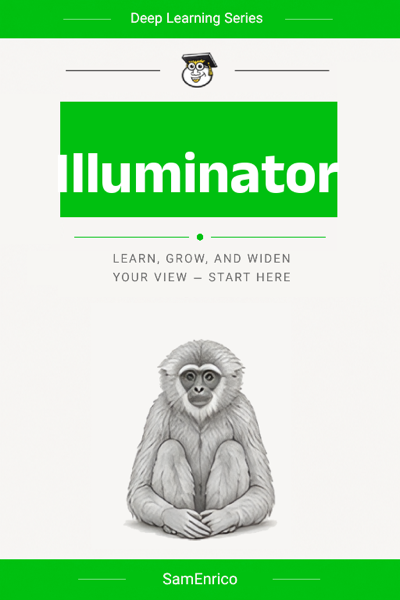
Illuminator eBook
A Coursebook on Illuminator
A Coursebook on Illuminator
Formats
Free sample
Chapter 1: The Unlit Room...--You are sitting in a room right now. Look up. What do you see? Not the objects—the light. Where is it coming from?
A window? An overhead fixture? A lamp in the corner? Now look at the shadows. Where does the light stop?
What does it choose not to show you?This is not a rhetorical exercise. This is the first and most important question the Illuminator asks, in every medium and every age: What is the relationship between what is lit and what is left dark?The answer to that question has determined the course of human history. It decided which gospel passages received the most expensive gold leaf in the Book of Kells. It decided where the first electric streetlights were installed in 1880s London—and thus which neighborhoods were considered "safe" and which were left in darkness. It decides, right now, in the hospital where you might one day lie, whether the surgical team sees your anatomy clearly enough to save your life or whether a glare on a monitor hides a critical reading.
It decides, in the office where you work, whether your eyes ache at 3 PM because the color temperature of the overhead LEDs is telling your brain that it is noon when it is actually dusk.You are already an Illuminator. You just do not know it yet. Every time you have chosen which paragraph to read first in a dense report, you have illuminated. Every time you have arranged furniture in a room to catch the morning light, you have illuminated. Every time you have told a story and decided which detail to reveal first and which to hold back, you have illuminated.
The only difference between you and the monks who painted the Lindisfarne Gospels or the engineers who designed the lighting for the Sistine Chapel is intention and craft. They knew what they were doing. You have been doing it by instinct.This book exists to replace instinct with mastery.The Darkness You Did Not Know You Lived In Let us begin with a confession. The word "illuminator" is almost certainly not what you think it means.If you are like most people who pick up this book, you have one of three images in your head. The first is a medieval monk, hunched over a desk with a quill and gold leaf, painting impossibly intricate letters in a book that took him ten years to complete.
The second is a lighting technician at a concert, fingers dancing across a control board, making the stage explode with color in perfect sync with the drums. The third—and this one is rarer—is a consultant or a teacher, someone who "illuminates" a subject with clarity and insight.All three are correct. None of them is complete.The problem is not that these images are wrong. The problem is that they are separate. We have taken a single human capacity—the capacity to bring light where there was darkness, to make clear what was confused, to guide attention where it needs to go—and we have fractured it into a dozen unrelated professions.
The manuscript illuminator does not talk to the lighting engineer. The lighting engineer does not talk to the management consultant. The management consultant has never ground a pigment or focused a gobo. And all three have lost something essential: the understanding that they are doing the same thing, using different tools.This book is an act of reclamation. It argues that illumination is a universal discipline, as foundational as mathematics or language.
It has principles. It has techniques. It has a history stretching back fifteen centuries. And it can be taught.But first, you must unlearn something. You must unlearn the assumption that "light" is simply the opposite of "dark"—that more light is better, that darkness is failure, that your job as an illuminator is to flood every corner with brightness until nothing remains hidden.That is not illumination.
That is erasure.The Three Pillars: A New Vocabulary Every craft has its foundational concepts. Carpenters have grain, joinery, and load-bearing. Cooks have heat, acid, fat, and salt. Illuminators have three pillars, and every chapter of this book will return to them because they are the grammar of everything that follows.Pillar One: Technical Skill This is the domain of how. How do you grind lapis lazuli into a pigment fine enough to paint a saint's robe?
How do you calculate the lux level required for a surgical theater? How do you structure an argument so that the primary claim lands before the secondary evidence? Technical skill is muscle memory, tool knowledge, and procedural fluency. It is the part of illumination that can be measured, tested, and improved through deliberate practice. Without it, you have good intentions and bad outcomes.
With it, you have the ability to translate an idea into a material reality.Pillar Two: Historical Awareness This is the domain of where we came from. Why do illuminated manuscripts place the most important image in the lower right quadrant of the left page? (The answer involves the way the human eye moves across a two-page spread and the medieval theology of the cross.) Why do modern office buildings still use 500 lux as the standard for cubicle lighting? (The answer involves a study from 1972 that has been largely debunked but is now embedded in building codes.) Historical awareness is not nostalgia. It is the intelligent use of precedent.
It is knowing which solutions have been tried before, which failed, which succeeded, and which succeeded for reasons that no longer apply. Without it, you reinvent wheels that were already square. With it, you stand on the shoulders of every illuminator who came before you.Pillar Three: Conceptual Clarity This is the domain of why. Why does this page need illumination at all? Why does this room need light at 3 AM?
Why does this argument need a narrative arc? Conceptual clarity is the most difficult pillar because it requires you to stop doing and start thinking. It requires you to ask the question that every illuminator wants to skip: What is the darkness I am trying to replace? Not "what is the problem"—that is too vague. The darkness is specific.
It is the gap between what the viewer currently understands and what they need to understand. It is the shadow where confusion lives. Conceptual clarity is the act of naming that darkness before you lift a single brush, flip a single switch, or write a single word.These three pillars do not exist in isolation. They are a system. Technical skill without historical awareness is craft without wisdom—you can execute perfectly but you do not know why the technique was developed or when it might fail.
Historical awareness without conceptual clarity is scholarship without purpose—you know everything about the past but you cannot apply it to the present. Conceptual clarity without technical skill is dreaming without building—you see the darkness clearly but you cannot bring light to it.The Illuminator holds all three in balance. This book will teach you to do the same.The Three Domains: Where Illumination Lives If the three pillars are the…
This is the end of the free sample. Get the eBook to keep going. Buy now
About this book
Details
- Author
- Morrell Ardelia
- Publisher
- SamEnrico
- Language
- English
- Genre
- Non-Fiction, Informative, Educational
- Released
- 2026-05-11
- Pages (approx.)
- 154
- Available as
- eBook, Audiobook

Read better in the ZLOADR app
Your eBooks on your phone or tablet. Sign in with your SamEnrico account and start reading.
More by Morrell Ardelia
 Marital Status Fitness DivideMorrell Ardelia$11.99
 Equifax Executive Stock SalesMorrell Ardelia$11.99
 Tunisia Bourguiba ModernizationMorrell Ardelia$11.99
 Metta for Pregnancy and PostpartumMorrell Ardelia$11.99
 Self Doubt for First Generation ProfessionalsMorrell Ardelia$11.99
 The Trollwife of Dovrefjell: A Nordic Folktale of Cunning and RedemptionMorrell Ardelia$11.99
 Home Depot Pro GuideMorrell Ardelia$12.99
 Technical Writing Training AIMorrell Ardelia$12.99
 Understanding Moreno–zachai–kaufman SyndromeMorrell Ardelia$17.99
 How to Become a Cloth-washer OperatorMorrell Ardelia$11.99