
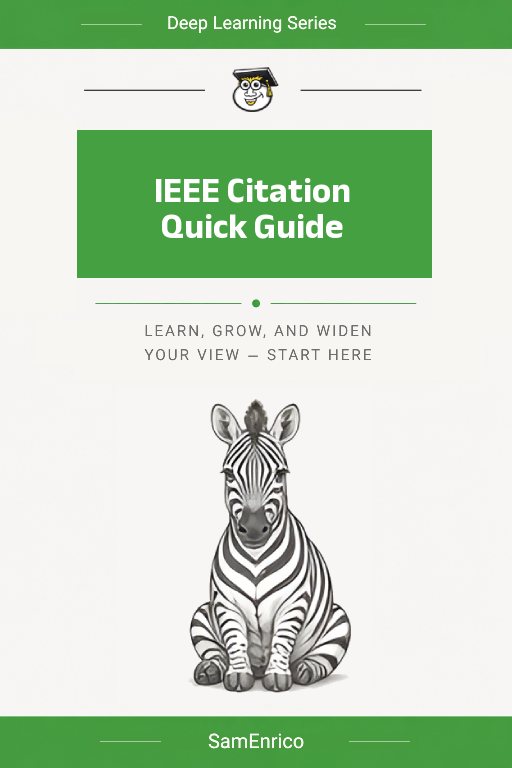
Non-FictionStudent's ShortcutIEEE
IEEE Citation Quick Guide
Cite technical sources using IEEE bracket-number s
by Hawks Tisha
Cite technical sources using IEEE bracket-number system for engineering and computer science.
Formats
About this book
Free sample
Chapter 1: The Numbered Path...-- In the world of engineering and computer science, where every second of processing time matters and every line of code competes for space, the way you cite your sources can either clear a path for your reader or scatter obstacles across their journey. Imagine reading a dense technical paper on quantum error correction, your eyes darting between the main argument and a string of parenthetical author names and dates—(Smith, 2022), (Chen & Patel, 2023), (Rodriguez et al., 2024)—each one interrupting the flow of equations and algorithms like a sudden pothole on a smooth highway. Now imagine the same paper transformed: instead of those cluttered interruptions, you see clean, minimal bracketed numbers—[1], [2], [3]—discrete signposts that guide you to the back of the document without ever pulling you out of the technical narrative. This is not a minor formatting preference. This is the core philosophy behind the IEEE citation style: maximum readability, minimal distraction, and ruthless efficiency for the reader.The IEEE (Institute of Electrical and Electronics Engineers) citation system is the dominant referencing standard for engineering, computer science, robotics, telecommunications, biomedical engineering, and a growing list of technical disciplines.
Unlike the author-date systems you may have learned in humanities or social science courses—APA, MLA, Chicago—IEEE uses a bracket-number system that prioritizes speed and space economy. Every source you cite receives a number in square brackets, assigned in the order you first mention it. That number follows the source throughout your document. The reader never has to decode author names or publication years in the middle of a technical argument. They see [5], glance at the numbered reference list at the end, and instantly find the full citation.
The result is a reading experience that feels less like navigating citations and more like following the pure logic of your ideas.This chapter does something unusual for a citation guide: it will not burden you with rules about commas, periods, or hanging indents just yet. Those rules are essential, and they will come in Chapter 2, but first you need to understand why you are learning them. A mechanic who…
This is the end of the free sample. Get the eBook to keep going. Buy now
Contents
- Chapter 1
- Chapter 2
- Chapter 3
- Chapter 4
- Chapter 5
- Chapter 6
- Chapter 7
- Chapter 8
- Chapter 9
- Chapter 10
- Chapter 11
- Chapter 12
Details
- Author
- Hawks Tisha
- Publisher
- SamEnrico
- Language
- English
- Genre
- Non-Fiction, Student's Shortcut, IEEE
- Released
- 2026-06-01
- Pages (approx.)
- 159
- Available as
- eBook, Audiobook

Read better in the ZLOADR app
Your eBooks on your phone or tablet. Sign in with your SamEnrico account and start reading.
More by Hawks Tisha
 Freelancer Platform ComparisonHawks Tisha$11.99
 Antwerp Heist Master KeyHawks Tisha$11.99
 Long Breath Mindfulness TrainingHawks Tisha$11.99
 Gambling Addiction For Gig Economy WorkersHawks Tisha$11.99
 Pelvic Organ Prolapse PreventionHawks Tisha$11.99
 Emotional Regulation In MarriageHawks Tisha$11.99
 Shirley MacLaine SearchHawks Tisha$11.99
 Financial Modeling For BeginnersHawks Tisha$11.99
 The Beat Behind the Medals: How Middle Eastern Producers Shaped Olympic AnthemsHawks Tisha$11.99
 The Vanishing Heiress: The Kidnapping That Shocked Victorian EuropeHawks Tisha$11.99
 How to Become a Roller CovererHawks Tisha$11.99
 Past Performance Database GuideHawks Tisha$12.99
You may also like
 Hong Kong Handover 1997Dunn Johnnie$11.99
 Zumba For Postnatal Recovery CourseNeal Christian$11.99
 Zumba for BeginnersLadner Nikia$11.99
 YouTube Comment Mining GuideHumes Pandora$12.99
 Worry Box MeditationCarlin Rudy$11.99
 Workplace Stress MeditationNguyen Lynn$11.99
 Workplace Stress and Sleep RepairHawley Ivory$11.99
 Workplace Perfectionism CureDelaney Jeffry$11.99
 Workplace Injustice Anger GuideWallen Isabelle$11.99
 Work Addiction and Burnout LinkGreenwood Ester$11.99
 Women in Yoga and WellnessBeattie Galina$11.99
 Women in Stand Up ComedyChun Evangeline$11.99