
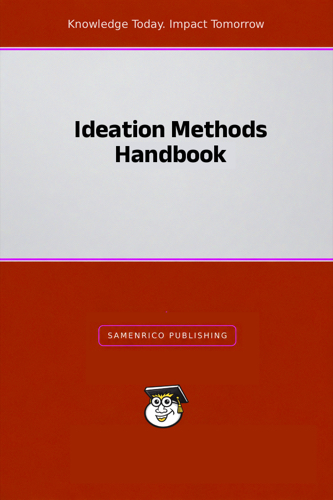
Non-FictionSelf-HelpCreative Methods
Ideation Methods Handbook eBook
Use SCAMPER, brainwriting, and other techniques wi
Use SCAMPER, brainwriting, and other techniques with this design thinking guide.
Formats
Free sample
Chapter 1: The Brainstorming Lie--–- Most brainstorming sessions are a complete waste of time. Not because people aren't creative. Not because the team lacks intelligence or passion. But because nearly everything we've been told about brainstorming is wrong.This is not an opinion. It is a conclusion supported by decades of behavioral psychology research, organizational behavior studies, and real-world observation of hundreds of teams across Fortune 500 companies, startups, and government agencies.
The evidence is clear: the traditional "gather in a room, shout out ideas, build on each other's energy" approach that dominates modern business culture produces less innovation, less diversity of thought, and less actionable output than almost any structured alternative.And yet, the myth persists.We have been sold a fantasy. The fantasy says that creativity is a wild, untamable force that flourishes only in the absence of constraints. The fantasy says that the best ideas emerge from free association, from the chaos of unfiltered conversation, from the magical collision of random thoughts. This fantasy has been reinforced by popular culture—movies showing genius inventors struck by lightning bolts of inspiration, TED talks celebrating the "creative genius" who defies all structure, and every manager who has ever started a meeting with the phrase "Let's just brainstorm some ideas."The problem is that this fantasy does not work. It has never worked.
And continuing to believe in it costs organizations billions of dollars in wasted time, lost opportunities, and mediocre ideas that feel innovative in the moment but crumble under the slightest scrutiny.This chapter is the antidote to the Brainstorming Lie. It will show you why free-form brainstorming fails, what the research actually says about how ideas emerge, and—most importantly—how structure, constraints, and process become the unexpected engines of genuine creativity. By the end of this chapter, you will understand why the most innovative companies in the world have abandoned the traditional brainstorm and replaced it with something far more effective: a system.The Anatomy of a Failed Brainstorm Let me describe a scene that you have likely experienced many times.It is 10:00 AM on a Tuesday. Seven people file into a conference room with a whiteboard, a pack of colorful markers, and a vague sense of obligation. The manager stands at the front and says something like, "We need fresh ideas for the customer onboarding problem.
Nothing is off the table. Let's just get everything out there."For the first five minutes, there is silence. People stare at the whiteboard. Someone offers a safe, obvious idea. The manager writes it down and says "Good, keep going." Another person offers a slight variation on the first idea.
Then the loudest person in the room—let's call him Dave—jumps in with a high-energy, half-baked concept that sounds exciting but is completely infeasible. The group, eager to demonstrate enthusiasm, nods along. Three more people offer ideas that are essentially the same as Dave's but with different words.Twenty minutes pass. The whiteboard has fifteen sticky notes. Four of them say roughly the same thing.
Two are impossible. The rest are so vague that no one could act on them. The manager says, "Great session, everyone. Let me synthesize these and get back to you." The meeting ends. Everyone returns to their desks feeling slightly exhausted and vaguely accomplished.Nothing happens next.
The sticky notes are photographed, emailed to the team, and never looked at again. Two months later, a different manager schedules another brainstorm about the same problem. The cycle repeats.This scene is not a failure of individual creativity. It is a failure of structure. And it unfolds in thousands of organizations every single day.The Three Myths That Keep Us Stuck To understand why unstructured brainstorming fails, we must first name the myths that sustain it.
These myths are not just harmless beliefs—they actively prevent teams from adopting the structured approaches that actually work.Myth #1: The best ideas come from free-form brainstorming.This myth rests on the assumption that creativity requires freedom. But freedom without constraint does not produce novelty; it produces chaos. Research in cognitive psychology has repeatedly demonstrated that the human brain generates more creative output when given specific constraints, prompts, or boundaries. A study from the Journal of Creative Behavior found that participants given restrictive parameters generated ideas rated 40% more original than those given no parameters. Constraints force the brain to work harder, to make unexpected connections, to explore territory it would otherwise ignore.Free-form brainstorming, by contrast, allows the brain to take the path of least resistance.
When someone says "anything goes," your brain defaults to familiar patterns, existing solutions, and safe ideas that have worked before. The result is not breakthrough thinking. It is the illusion of thinking.Myth #2: More ideas automatically mean better ideas.This myth is seductive because it contains a grain of truth: you cannot have a great idea without having many ideas. Volume is necessary. But volume alone is insufficient.
The goal is not to fill a whiteboard with sticky notes. The goal is to generate a small number of ideas that are genuinely novel, genuinely useful, and genuinely actionable.Unstructured brainstorming produces high volume but low quality. The ideas are repetitive, shallow, and heavily influenced by the first few people who spoke. Research on "anchoring" in group settings shows that the first idea offered in a session disproportionately shapes all subsequent ideas—not because it is the best, but because it is the first. The group then spends its energy elaborating on that anchor rather than exploring genuinely different directions.Myth #3: Creativity cannot be scheduled or structured.This is perhaps the most damaging myth of all.
It suggests that creativity is a muse that visits randomly, that you cannot force innovation, that the best you can do is create a nice environment and hope for the best. This belief is widespread, deeply held, and completely false.Creativity is not magic. It is a cognitive process. And like any cognitive process—decision-making, memory retrieval, logical reasoning—it can be structured, supported, and optimized. The most innovative organizations in the world—IDEO, Pixar, Google, and others—do not leave creativity to chance.
They have systematized it. They have developed repeatable methods, trained facilitators, and designed spaces specifically to maximize creative output. They schedule creativity. They structure it. And they outperform everyone else as a result.What the Research Actually Says The evidence against unstructured brainstorming is overwhelming.
Let me walk you through the key findings.Social Loafing: In group settings, individuals exert less effort than they would working alone. This effect, first documented by psychologist Bibb Latané in the 1970s, occurs because people assume others will pick up the slack. In a brainstorming session, participants unconsciously reduce their cognitive effort, producing fewer and less original ideas than they would generate independently.Evaluation Apprehension: People fear being judged. Even in supposedly "safe" brainstorming environments, participants hold back ideas that might seem stupid, unrealistic, or embarrassing. This fear is rational—in many workplace cultures, proposing an unusual idea carries real social risk.
The result is a narrowing of the idea pool toward safe, conventional, non-threatening concepts.Production Blocking: In verbal brainstorming, only one person can speak at a time. While…
This is the end of the free sample. Get the eBook to keep going. Buy now
About this book
Details
- Author
- Mooney Tennille
- Publisher
- SamEnrico
- Language
- English
- Genre
- Non-Fiction, Self-Help, Creative Methods
- Released
- 2026-06-09
- Pages (approx.)
- 145
- Available as
- eBook, Audiobook

Read better in the ZLOADR app
Your eBooks on your phone or tablet. Sign in with your SamEnrico account and start reading.
More by Mooney Tennille
 The Immigrant EV FounderMooney Tennille$11.99
 C 2 Greyhound PilotMooney Tennille$11.99
 Instant Pot Meal PrepMooney Tennille$11.99
 Overcoming Loneliness Without PetsMooney Tennille$11.99
 Writer Morning RoutineMooney Tennille$11.99
 Resilience for LawyersMooney Tennille$11.99
 Focus Commitment DeviceMooney Tennille$11.99
 The Iron Will of Eddie Arcaro: How a Jockey Mastered the Mind Game of Horse RacingMooney Tennille$11.99
 How to Produce Laundry AppliancesMooney Tennille$11.99
 Service Providers Guide to Directory PublishingMooney Tennille$11.99
 How to Produce Video Camera LensesMooney Tennille$11.99
 A Collector's Handbook to the Marmon Big EightMooney Tennille$11.99
You may also like
 Hong Kong Handover 1997Dunn Johnnie$11.99
 Zumba For Postnatal Recovery CourseNeal Christian$11.99
 Zumba for BeginnersLadner Nikia$11.99
 YouTube Comment Mining GuideHumes Pandora$12.99
 Worry Box MeditationCarlin Rudy$11.99
 Workplace Stress MeditationNguyen Lynn$11.99
 Workplace Stress and Sleep RepairHawley Ivory$11.99
 Workplace Perfectionism CureDelaney Jeffry$11.99
 Workplace Injustice Anger GuideWallen Isabelle$11.99
 Work Addiction and Burnout LinkGreenwood Ester$11.99
 Women in Yoga and WellnessBeattie Galina$11.99
 Women in Stand Up ComedyChun Evangeline$11.99