
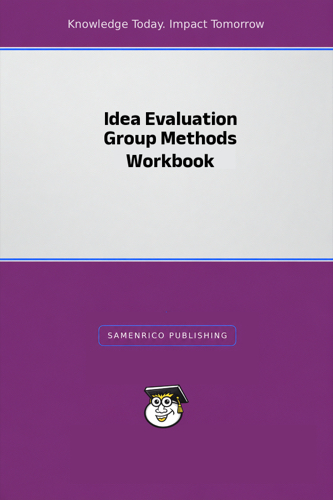
Non-FictionSelf-HelpDecision Making
Idea Evaluation Group Methods Workbook eBook
Teaches democratic and expert-based methods for se
by Post Nenita
Teaches democratic and expert-based methods for selecting best ideas from group sessions.
Formats
Free sample
Chapter 1: The Erosion Effect...--It was 2:47 PM on a Tuesday when Sarah watched her best idea die.She had spent three weeks preparing the proposal. The data was solid. The pilot study had shown a 23% efficiency gain. Two junior colleagues had independently validated her assumptions. And yet, when the senior vice president sighed—just a sigh, barely audible—and said, "That feels risky," the room shifted.
Three other executives nodded without speaking. A fourth said, "Let's stay with what's working." Within eight minutes, the group had voted unanimously for a safe, incremental option that no one was excited about.Sarah packed up her laptop, walked to the parking lot, and called her husband. "I don't know why I bother," she said. "They asked for innovation. They killed innovation."What Sarah experienced was not a failure of creativity.
She had generated a genuinely good idea. What she experienced was a failure of evaluation—the moment when groups move from "What might we do?" to "What will we do?" And it is in that moment that most organizations destroy their best thinking.This book exists because of Sarah. And because of the thousands of facilitators, managers, and team leaders who have watched promising ideas die not because they were bad, but because the process for evaluating them was broken.The Paradox of Group Evaluation Here is a truth that every experienced facilitator knows but few textbooks admit: the same group that enthusiastically generates one hundred creative ideas in a morning brainstorm will often leave the room in the afternoon having selected the safest, most politically palatable, or most senior-endorsed option. Not the best option. Not the most innovative option.
The option that offends the fewest people.This is not a failure of intelligence. It is not a failure of creativity. It is a failure of structure.Research spanning five decades—from Irving Janis's work on groupthink in the 1970s to Cass Sunstein's research on group polarization in the 2000s—has shown that groups are systematically worse at evaluation than individuals. Why? Because evaluation introduces social dynamics that generation avoids.
When you generate ideas, there are no wrong answers. When you evaluate ideas, there are winners and losers. And as soon as there are winners and losers, status, self-preservation, and politics enter the room.Let me give you a concrete example drawn from a study published in the journal Organizational Behavior and Human Decision Processes. Researchers gave identical problems to two types of groups: "real groups" that worked together face-to-face, and "nominal groups" of individuals who worked alone and whose answers were later aggregated. On creative problem-solving tasks, real groups produced fewer ideas than nominal groups.
On evaluation tasks—choosing which idea was best—real groups performed significantly worse than the mathematical average of their individual members.In other words, groups made their members dumber. Not individually. Not intentionally. But structurally.This is the paradox that Chapter 1 exists to diagnose. Until you understand why good ideas die, no method in this book—no dotmocracy, no Delphi survey, no multi-criteria decision analysis—will save you.
You will simply execute flawed methods more efficiently.Introducing the Erosion Effect I call this phenomenon the Erosion Effect: the systematic, predictable, and often invisible process by which promising ideas lose support during group evaluation due to social dynamics rather than merit.The Erosion Effect operates like water on stone. It does not kill ideas with a single dramatic blow. It wears them down, slowly, through repeated exposure to social pressure, status cues, and cognitive shortcuts. By the time the group votes, the bold idea that once inspired excitement has been eroded into a pale, safe, consensus-friendly shadow of itself.The Erosion Effect has five primary mechanisms. Understanding each one is the first step toward neutralizing it.Mechanism 1: Social Proof.
When group members see others rejecting an idea, they become more likely to reject it themselves—even if their independent judgment would have supported it. This is the "everyone else is doing it" bias, and it is amplified when the group includes high-status members.Mechanism 2: Status Dominance. High-status members (senior executives, recognized experts, confident extroverts) speak first, speak most, and are weighted more heavily in final decisions—regardless of the accuracy of their judgments. Research by Elizabeth Morrison has shown that junior employees are accurate in their assessments of organizational problems approximately 80% of the time, yet their input is systematically discounted.Mechanism 3: Evaluation Apprehension. Group members anticipate that supporting a risky or unconventional idea will make them look foolish if the idea fails.
So they self-censor, voting for safer options even when they privately believe the risky idea is superior. This is not cowardice; it is rational career management. But it kills innovation.Mechanism 4: Anchoring. The first idea evaluated becomes the reference point against which all subsequent ideas are compared. If the first idea is moderate, more radical ideas will be rejected as "too extreme." If the first idea is risky, safer ideas will be rejected as "too conservative." The anchor is almost always set by the first person to speak—often a high-status member.Mechanism 5: Information Cascades.
Once a few people express an opinion (especially if those people are high-status), subsequent speakers ignore their own private information and conform to the emerging consensus. This creates a cascade that looks like agreement but is actually compliance. By the time the fifth person says "I agree," they may genuinely believe they agree—memory biases rewrite their original judgment to match the group.Let me show you how these mechanisms interact in real time.Anatomy of a Failed Evaluation Consider a typical evaluation meeting. Twelve people sit around a conference table. They have generated forty ideas in the morning.
Now, at 1:00 PM, they must select three to pilot.The facilitator says, "Let's go around the room and share our thoughts."The senior vice president speaks first (Status Dominance). He says, "Idea 7 is interesting, but it feels operationally difficult. I like Idea 12—it's safe, we can execute it quickly." He has just set an Anchor.Three other executives nod (Social Proof). They have not yet spoken, but their nonverbal agreement signals the direction of the group.A mid-level manager privately prefers Idea 7 but thinks, "If the SVP doesn't like it, I don't want to be the one who fights for it" (Evaluation Apprehension). She says, "Idea 12 seems solid."A junior analyst has data showing that Idea 7 would actually be easier to implement than Idea 12, but she has been in her role for only six months.
She stays silent (Status Dominance again).By the time the facilitator reaches the twelfth person, the group has an apparent consensus around Idea 12. But is it genuine? No. It is an Information Cascade built on an Anchor set by Status Dominance, reinforced by Social Proof, and maintained by Evaluation Apprehension.This is not a conspiracy. No one is acting in bad faith.
The SVP genuinely prefers Idea 12. The executives genuinely agree. The mid-level manager is rationally protecting her career. The junior analyst is rationally learning the organizational culture. And yet, collectively, they have produced a worse decision than if each person had voted silently, independently, before hearing anyone else.The Erosion Effect has claimed another good idea.The…
This is the end of the free sample. Get the eBook to keep going. Buy now
About this book
Details
- Author
- Post Nenita
- Publisher
- SamEnrico
- Language
- English
- Genre
- Non-Fiction, Self-Help, Decision Making
- Released
- 2026-06-09
- Pages (approx.)
- 155
- Available as
- eBook, Audiobook

Read better in the ZLOADR app
Your eBooks on your phone or tablet. Sign in with your SamEnrico account and start reading.
More by Post Nenita
 New Zealand Warmer Kiwi HomesPost Nenita$11.99
 Gaming Dopamine DetoxPost Nenita$11.99
 Bodyweight 30 Day ChallengePost Nenita$11.99
 Workplace Stress Reduction for Physical TherapistsPost Nenita$11.99
 Codex of the Lost: The Forbidden Library of AlexandriaPost Nenita$11.99
 How to Become a Caddie SupervisorPost Nenita$11.99
 Canva Mockup Validation GuidePost Nenita$12.99
 Startup Funding Sources GuidePost Nenita$12.99
 Understanding Chromosome 5, Trisomy 5pPost Nenita$17.99
 Peanut HarvestingPost Nenita$11.99
You may also like
 Hong Kong Handover 1997Dunn Johnnie$11.99
 Zumba For Postnatal Recovery CourseNeal Christian$11.99
 Zumba for BeginnersLadner Nikia$11.99
 YouTube Comment Mining GuideHumes Pandora$12.99
 Worry Box MeditationCarlin Rudy$11.99
 Workplace Stress MeditationNguyen Lynn$11.99
 Workplace Stress and Sleep RepairHawley Ivory$11.99
 Workplace Perfectionism CureDelaney Jeffry$11.99
 Workplace Injustice Anger GuideWallen Isabelle$11.99
 Work Addiction and Burnout LinkGreenwood Ester$11.99
 Women in Yoga and WellnessBeattie Galina$11.99
 Women in Stand Up ComedyChun Evangeline$11.99