
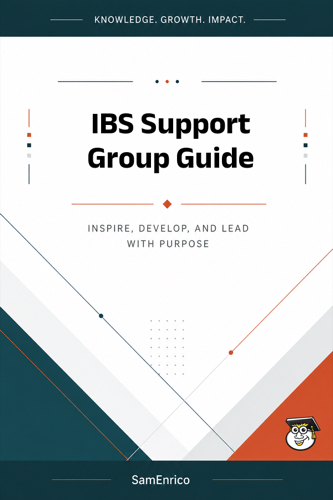
Non-FictionHealth & WellnessSupport Groups
IBS Support Group Guide eBook
Find community with others who understand the dail
Find community with others who understand the daily challenges of living with IBS.
Formats
Free sample
Chapter 1: The Loneliest Bathroom--The first time it happened, you probably thought it was food poisoning. A bad shrimp. A questionable gas station sandwich. You told yourself it would pass by morning. You apologized to the friend whose dinner you abandoned, whose bathroom you borrowed for forty-five minutes while they scrolled Tik Tok on the other side of the door, pretending not to hear.
You laughed it off. "Something didn't agree with me," you said, and you both moved on.Except it didn't pass by morning. And it happened again the next week. And the week after that. And suddenly you were building a mental map of every public restroom within a three-mile radius of your office, your gym, your mother's house.
You started arriving at parties twenty minutes early—not to help set up, but to claim the bathroom before anyone else needed it, to case the layout, to identify the lock on the door (deadbolt good, sliding latch bad, gap at the bottom of the stall door unacceptable). You began calculating the fiber content of a banana like a forensic accountant. You said no to camping trips, to road trips, to weddings in venues you hadn't personally vetted. You stopped saying "I have IBS" and started saying "I'm not feeling great" and then just "I can't" and then nothing at all, because explaining had become its own kind of exhaustion.This is not a book about what causes IBS. Other books will give you the clinical breakdown—the FODMAPs, the gut-brain axis, the role of SIBO and bile acid malabsorption and visceral hypersensitivity.
Those books are useful. They belong on your shelf. But they miss something fundamental. They treat IBS as a mechanical problem: faulty wiring, imbalanced chemistry, a plumbing issue in need of a plumber. And while that's not wrong, it's incomplete.
Because the deepest wound of IBS is not physical. It is the soul-crushing feeling that no one truly gets it. It is the slow, creeping conviction that you are the only person in the world whose body has turned against them in this particular, humiliating, impossible-to-explain way.This chapter is about that wound. It is about the isolation of an invisible illness, the specific grief of losing spontaneity, and the first step toward something better: admitting that you cannot do this alone. Not because you are weak.
Because you are human.The Visceral Isolation of an Invisible Illness Let us be precise about what isolation means for someone with IBS. It is not loneliness in the ordinary sense—the temporary ache of a Saturday night with no plans, the quiet after a friendship fades. It is a structural, architectural, day-by-day dismantling of your ability to show up for your own life.Consider the math. A person with well-managed IBS might have two "bad days" a week. That is roughly one hundred four days a year.
One hundred four days of canceled plans, of leaving early, of arriving late, of standing in a crowded room and thinking only about the location of the nearest exit. One hundred four days of performing normalcy while your gut churns like a washing machine full of rocks. One hundred four days of smiling through the gurgles, praying no one hears, inventing excuses that grow thinner and more shameful with each repetition.Now consider that most people with IBS do not have well-managed symptoms. They have unpredictable, swinging, betrayal-at-any-moment symptoms. They have the kind of day that starts fine and ends with them curled on a bathroom floor at a stranger's house, inventing a lie about a phone call from a sick relative, because "my body is expelling everything I've eaten in the last eighteen hours" is not a sentence you can say to a person whose name you learned twenty minutes ago.This is the math of isolation.
Every "yes" carries a hidden risk. Every "no" carries a hidden cost. Over time, the calculation shifts. You stop asking yourself "Do I want to go?" and start asking "Can I go?" And more and more often, the answer is no.The clinical literature calls this "avoidance behavior." It sounds so tidy. So behavioral.
So fixable with a spreadsheet and a little willpower. But avoidance behavior for IBS is not like avoiding spiders or avoiding public speaking. It is avoidance rooted in a body that has, without warning and without mercy, demonstrated that it cannot be trusted. You are not avoiding the party. You are avoiding the moment at the party when your body decides to betray you.
And that moment—that catastrophic, unpredictable, unstoppable moment—has happened enough times that your brain has learned a perfectly rational lesson: The only way to guarantee you won't need a bathroom in a place without one is to not go to the place at all.This is not irrational. This is not anxiety disorder. This is a sane response to an unreliable body. And it is the primary driver of the isolation that defines life with IBS.The Grief of What You Have Lost There is a kind of grief that comes with chronic illness that no one warns you about. It is not the grief of death, sharp and finite, with rituals and condolences and a clear before-and-after.
It is the grief of slow subtraction. The grief of waking up one day and realizing you cannot remember the last time you ate a meal without mentally calculating its consequences. The grief of realizing your friends have stopped inviting you to dinner—not because they don't love you, but because they have learned, unconsciously, that you will say no. The grief of watching your partner eat a bowl of spicy noodles without a second thought, and feeling something that is not quite jealousy and not quite resentment, but some third emotion for which the English language has no word.Let us name some of the things you may have lost.Spontaneity. The ability to say yes to an after-work drink.
The ability to take a day trip without mapping rest stops. The ability to kiss someone without wondering if your breath smells like a gut in distress. The ability to laugh without fear—because laughter, for some of us, triggers the vagus nerve, which triggers the gut, which triggers the urgent need to find a bathroom right now.Food as pleasure. Remember when eating was simple? When you ordered what sounded good, not what was safe?
When you didn't know what FODMAP stood for, when you had never heard of inulin or chicory root or sorbitol, when a salad was just a salad and not a potential landmine of raw garlic and undigestible fiber? That world is gone. In its place is a world of labels and substitutions and apologetic conversations with waiters. You have become a person who asks "Is there onion powder in the marinade?" and watches the waiter's eyes glaze over. You have become a person who brings your own food to parties and watches other people pretend not to notice.The ability to travel.
Not just international travel, with its unfamiliar foods and uncertain bathrooms and hours-long bus rides between rest stops. But local travel. Driving to a friend's house across…
This is the end of the free sample. Get the eBook to keep going. Buy now
About this book
Details
- Author
- Jacoby Cherelle
- Publisher
- SamEnrico
- Language
- English
- Genre
- Non-Fiction, Health & Wellness, Support Groups
- Released
- 2026-06-10
- Pages (approx.)
- 117
- Available as
- eBook, Audiobook

Read better in the ZLOADR app
Your eBooks on your phone or tablet. Sign in with your SamEnrico account and start reading.
More by Jacoby Cherelle
 The Freelance Skill Crossover GuideJacoby Cherelle$11.99
 First Week After Job Loss GuideJacoby Cherelle$11.99
 Conner Peterson Legal LegacyJacoby Cherelle$11.99
 Assertiveness in Text MessagesJacoby Cherelle$11.99
 The Distraction Free Phone Setup WorkbookJacoby Cherelle$11.99
 Scripting RecordingsJacoby Cherelle$11.99Scripting RecordingsJacoby Cherelle$11.99
 Cervical Radiculopathy Pain ExercisesJacoby Cherelle$11.99
 Buffett PartnershipJacoby Cherelle$11.99
 Hellfighters' Last Stand: The Forgotten Battle of Chateau-ThierryJacoby Cherelle$11.99
 The Silent Coup: How a 1973 Typo Changed the WorldJacoby Cherelle$11.99
 The Bloodhound and the Billionaire: How a Dog Solved the Case of the Missing MasterpieceJacoby Cherelle$11.99
You may also like
 Hong Kong Handover 1997Dunn Johnnie$11.99
 Zumba For Postnatal Recovery CourseNeal Christian$11.99
 Zumba for BeginnersLadner Nikia$11.99
 YouTube Comment Mining GuideHumes Pandora$12.99
 Worry Box MeditationCarlin Rudy$11.99
 Workplace Stress MeditationNguyen Lynn$11.99
 Workplace Stress and Sleep RepairHawley Ivory$11.99
 Workplace Perfectionism CureDelaney Jeffry$11.99
 Workplace Injustice Anger GuideWallen Isabelle$11.99
 Work Addiction and Burnout LinkGreenwood Ester$11.99
 Women in Yoga and WellnessBeattie Galina$11.99
 Women in Stand Up ComedyChun Evangeline$11.99