
Non-FictionHealth & WellnessConstipation
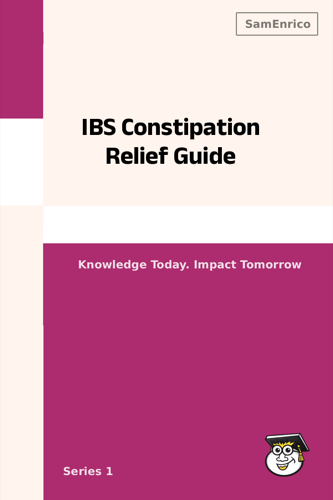
IBS Constipation Relief Guide eBook
Increase fiber and hydration to ease difficult bow
Increase fiber and hydration to ease difficult bowel movements.
Formats
Free sample
Chapter 1: The Three Faces--–- Picture this: You are sitting on the toilet for the third time today. Your legs are falling asleep. A small bead of sweat rolls down your temple from the effort. You feel pressure—immense, uncomfortable pressure—deep in your pelvis, but when you bear down, nothing happens. Or, worse, you pass a few small, hard pellets that feel like rocks, and you know with absolute certainty that there is more inside.
You can feel it. But your body refuses to cooperate. You wipe, stand up, wash your hands, and go about your day. But the sensation never leaves—a dull, dragging fullness in your lower belly that makes you feel heavy, sluggish, and secretly desperate. You have just experienced what I call the “evacuation gap”: the difference between the stool you know is in your colon and the stool you are actually able to pass.If this scene feels familiar, you are not alone.
An estimated 12 to 19 percent of the North American population suffers from chronic constipation, and of those, roughly one-third meet the diagnostic criteria for Irritable Bowel Syndrome with Constipation predominance, or IBS-C. But here is the problem that most doctors never tell you: “constipation” is not one thing. It is not even two things. It is three fundamentally different problems that happen to share the same bathroom experience. And if you treat all three the same way—if you blindly add fiber, chug water, and take the same laxative your grandmother used—you will not only fail to get relief.
You will very likely make yourself worse.I learned this the hard way. For seven years, I was told I had “slow transit constipation.” I loaded up on bran muffins, raw kale salads, and flaxseed smoothies. I drank three liters of water a day. And every single morning, I woke up more bloated than the day before. My stool went from Type 2 on the Bristol scale (lumpy and sausage-shaped) to Type 1 (separate hard lumps like nuts).
I had turned my constipation into a concrete blockage because I was using the wrong tool for the wrong problem. It was only when a gastroenterologist finally performed an anorectal manometry (a test I will explain later) that I learned the truth: I did not have slow transit at all. I had pelvic floor dyssynergia. My muscles were clenching when they should have been relaxing. And every “healthy” fiber bomb I had thrown at my gut was making the clenching worse.This chapter exists to ensure you do not waste seven years of your life.
By the end of these pages, you will be able to identify which of the three faces of constipation you are dealing with. You will understand why your previous attempts at relief may have failed. And you will know exactly which chapters of this book to prioritize based on your specific subtype. Because relief is not about trying harder. It is about trying smarter.The Great Misdiagnosis: Why Your Doctor Probably Got It Wrong Let me start with a uncomfortable truth: most primary care physicians receive less than ten hours of nutrition training in medical school and fewer than five hours on disorders of defecation.
Constipation is not sexy. It does not fund research grants. And the standard medical response—“eat more fiber, drink more water, exercise”—has been repeated so often that it has achieved the status of dogma, despite being flat-out wrong for a large subset of patients.In 2018, a landmark study published in the American Journal of Gastroenterology followed 638 patients with chronic constipation. The researchers found that nearly 40 percent of patients who had been diagnosed with “simple constipation” actually had pelvic floor dyssynergia, a condition that fiber worsens. Another 25 percent had slow transit constipation, which fiber can help but only if delivered in the right form and with the right hydration protocol.
The remaining 35 percent had a mix of both or outlet obstruction. In other words, if you are reading this book, there is roughly a one-in-three chance that the standard advice you have been given is actively harming you.Why does this misdiagnosis happen? Because most doctors do not ask the right questions. They ask, “How often do you go?” But they do not ask, “Do you feel like you empty completely?” They ask, “Is your stool hard?” But they do not ask, “Do you feel a blockage or a sensation of something stopping you?” They prescribe laxatives based on the color of the stool chart rather than the mechanics of your evacuation. And you, the patient, assume that because they are the expert, they must be right.You are about to become your own expert.The Three Faces of Constipation: A Clinical Framework Before we dive into the specifics of each type, let me give you a bird’s-eye view.
The three subtypes of IBS-C are distinguished not by the stool itself but by where the problem occurs along the pathway from ingestion to elimination.Slow Transit Constipation is a problem of speed. The colon’s smooth muscle or its nerve supply (the enteric nervous system) contracts too weakly or too infrequently. Stool lingers in the colon for days, sometimes weeks, and during that time, the colon does what it is designed to do: it absorbs water. The result is stool that becomes progressively harder, drier, and more difficult to pass. The sensation is one of general sluggishness—you simply do not feel the urge to go very often, and when you do, the stool is already rock-hard.Pelvic Floor Dyssynergia is a problem of coordination.
The pelvic floor muscles (including the puborectalis, which we will explore in Chapter 3) are supposed to relax during defecation, allowing the rectum to straighten and stool to pass. In dyssynergia, these muscles paradoxically contract when you bear down. Imagine trying to open a door by pushing on it while simultaneously pulling the handle shut. That is what your body is doing. The sensation is often described as “a ball blocking the exit” or “clenching when I try to push.” Many patients with dyssynergia have daily urges to go, sometimes multiple times a day, but each attempt yields only a small amount of stool or nothing at all.Outlet Obstruction is a problem of anatomy.
Something structural is physically blocking or trapping stool. The most common cause in women is a rectocele—a herniation of the rectal wall into the posterior vaginal wall, creating a pouch where stool collects instead of moving toward the anus. Other causes include rectal intussusception (the rectum folds in on itself like a telescope), enterocele (small intestine herniating into the rectal space), and large internal hemorrhoids. The sensation is one of incomplete evacuation, often described as “needing to go again immediately after going,” along with the need for manual maneuvers (splinting, rocking, or even digital disimpaction) to empty.Here is what makes this framework so powerful: the treatments for these three conditions are radically different. Slow transit responds to soluble fiber, osmotic hydration, and prokinetic agents.
Pelvic floor dyssynergia requires biofeedback retraining (Chapter 10) and specific posture work (Chapter 9)—fiber is mostly irrelevant here. Outlet obstruction may require pelvic floor physical therapy, pessaries, or surgery; fiber…
This is the end of the free sample. Get the eBook to keep going. Buy now
About this book
Details
- Author
- Strand Penney
- Publisher
- SamEnrico
- Language
- English
- Genre
- Non-Fiction, Health & Wellness, Constipation
- Released
- 2026-06-08
- Pages (approx.)
- 148
- Available as
- eBook, Audiobook

Read better in the ZLOADR app
Your eBooks on your phone or tablet. Sign in with your SamEnrico account and start reading.
More by Strand Penney
 Debt Buyback DatabaseStrand Penney$11.99
 The Food Cravings Decoding GuideStrand Penney$11.99
 Shopping Addiction and BankruptcyStrand Penney$11.99
 The Symposium: Plato’s Feast of IdeasStrand Penney$11.99
 Technology Sales SupervisorStrand Penney$11.99
 How to Start a Discount Company (e.g. Debt Factoring) Business (Beginners Guide)Strand Penney$11.99
 WhatsApp Marketing for DropshippersStrand Penney$12.99
You may also like
 Hong Kong Handover 1997Dunn Johnnie$11.99
 Zumba For Postnatal Recovery CourseNeal Christian$11.99
 Zumba for BeginnersLadner Nikia$11.99
 YouTube Comment Mining GuideHumes Pandora$12.99
 Worry Box MeditationCarlin Rudy$11.99
 Workplace Stress MeditationNguyen Lynn$11.99
 Workplace Stress and Sleep RepairHawley Ivory$11.99
 Workplace Perfectionism CureDelaney Jeffry$11.99
 Workplace Injustice Anger GuideWallen Isabelle$11.99
 Work Addiction and Burnout LinkGreenwood Ester$11.99
 Women in Yoga and WellnessBeattie Galina$11.99
 Women in Stand Up ComedyChun Evangeline$11.99