
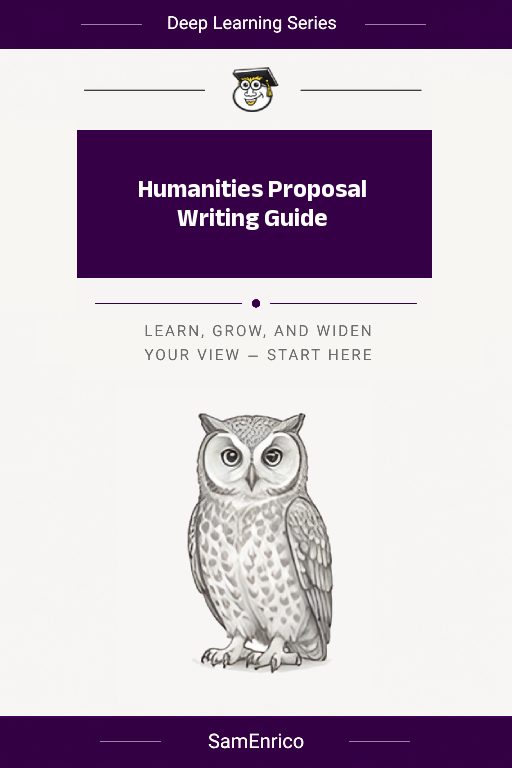
Non-FictionStudent's ShortcutHumanities Research
Humanities Proposal Writing Guide eBook
Frame interpretive research questions, archival pl
by Tan Tonette
Frame interpretive research questions, archival plans, and theoretical contributions for history and literature proposals.
Formats
Free sample
Chapter 1: The Question Knot...--Every failed humanities proposal begins with a question that was never truly asked. You might think you have a question. You have a topic, certainly. You have a stack of books, a folder of PDFs, a half-formed notion that something interesting is happening in the archive you just discovered. But a topic is not a question.
An interest is not an argument. And a genuine interpretive question—the kind that funds projects, launches careers, and changes how we read the past—is one of the hardest things to craft in academic writing. Harder than the archival hunt. Harder than the theoretical framework. Harder, sometimes, than writing the book itself.This chapter exists because most proposal writers get the question wrong.
They ask questions that are too broad ("How did gender work in the Renaissance?"), too narrow ("What color was the dress in line 47?"), too obvious ("Did Shakespeare write plays?"), or simply unanswerable with the evidence they have ("What was the author's true intention?"). And then they wonder why reviewers set their proposal aside after thirty seconds.We are going to solve that problem. By the end of this chapter, you will know how to distinguish a genuine interpretive research question from a pseudo-question. You will understand why humanistic questions differ fundamentally from scientific hypotheses—and when you can borrow causal logics anyway. You will apply the two-stage urgency framework to your own draft questions.
And you will leave with a diagnostic checklist that turns vague curiosity into a fundable claim.Let us begin with the most common mistake.The Topic Trap Imagine you are a reviewer. You have forty proposals to read this weekend. You pour a cup of coffee, open the first file, and read this:"My project examines gender in the plays of William Shakespeare."What do you think? If you are honest, you think: So what? Every undergraduate has written that paper.
Every Shakespeare scholar has read that argument. There is no question here at all—only a domain. A topic.Now imagine you read this instead:"How does The Taming of the Shrew use theatrical metafiction to expose the performance of patriarchal authority, rather than simply endorsing it?"That is different. That is arguable. That implies a stakes-driven answer.
And that reviewer—tired, overworked, sixty proposals to go—pauses. They think: I have not seen that reading before. I want to know how the argument plays out.The difference between these two formulations is the difference between a topic and a question. A topic names an area of inquiry. A question proposes a tension, a puzzle, a genuine uncertainty that your research will resolve.
And here is the hard truth: reviewers do not fund topics. They fund answers to questions they did not know they had.Throughout this book, we will write in first-person. We will address you directly. We do this because we believe academic writing—even a guidebook—should model the voice we are advocating: curious, engaged, unafraid of "I" and "you." So let us say plainly: you need a question that matters to someone other than you.The Interpretive Question Defined What makes a research question interpretive rather than, say, scientific or journalistic?A scientific hypothesis is falsifiable and predictive. "If X, then Y, all else being equal." You test it, and the evidence either supports or refutes it.
A journalistic question seeks factual answers: "Who won the election? When did the fire start?" These are important, but they are not interpretive.An interpretive research question, as we define it in this book, seeks meaning, significance, and contingency. Let us unpack each term.Meaning means you are asking what a text, event, or practice signifies to the people who produced it, received it, or were affected by it. You are not asking for a single, objective fact. You are asking for an interpretation that must be argued for with evidence.Significance means you are asking why this meaning matters—to the historical moment, to the literary tradition, to our own understanding of power, culture, or identity.
Significance is the "so what?" that transforms a curious observation into a scholarly contribution.Contingency means you are asking how things could have been otherwise. The scientific worldview often seeks laws or regularities. The humanistic worldview, at its best, seeks the spaces where human choice, accident, and resistance made one future happen instead of another. A great interpretive question always implies an alternative: Why this meaning, and not another?Here is an example. A non-interpretive question: "What did Victorian women write in their diaries?" That is a factual inventory.
An interpretive question: "How did evangelical women in industrial Manchester use the private diary form to negotiate a public moral authority normally denied them?" That question seeks meaning (negotiation of authority), significance (public moral authority), and contingency (the diary as a tool for doing something otherwise impossible).A Note on Causality: When You Can Ask "Why?"Some readers will protest. "But my project is causal," you might say. "I want to know what caused the rise of the novel. I want to trace the economic conditions that made the epistolary form possible. Is that not a legitimate humanistic question?"Yes, it is.
But with an important qualification.Causal questions—what we call multivariate questions in Chapter 2—are legitimate in humanities-adjacent fields: historical sociology, certain kinds of economic history, some branches of book history. However, they require a different evidentiary logic than interpretive questions. A causal claim demands comparison: cases that had the cause and cases that did not, or a timeline showing change before and after. Most purely humanistic proposals (close reading, archival recovery, theoretical intervention) do not have the evidence structure to support causal claims.Our rule is simple and will guide you throughout this book: Causal questions are permissible only when (a) your evidence allows for counterfactual comparison, and (b) your reviewer pool expects multivariate methods. For the vast majority of history and literature proposals, contingency-seeking questions—how something came to be rather than what caused it—are the appropriate default.If you are unsure, ask yourself: "Could I rewrite my question using 'How did X come to mean Y?' rather than 'What caused X?'" If yes, you are likely in interpretive territory.
If no, and you genuinely need causality, turn to Chapter 2 for guidance on designing a multivariate evidentiary logic.The Two-Stage Urgency Framework (Stage 1)Now we arrive at the first major tool of this book. Every strong proposal must establish urgency at two different moments: when you pose the question, and when you state the contribution. We call this the Two-Stage Urgency Framework.Stage 1: Question-Level Urgency. After drafting your research question, you must be able to answer: "Why does anyone need an answer to this question?" Note the phrasing. Not "Why do I find it interesting?" Not "Why has no one asked it before?" But: why does a reasonable, educated, possibly skeptical reviewer need to know the answer?Stage 1 answers the need.
Stage 2 (which we cover in Chapter 10) answers the loss: what specific understanding disappears if your project is never done?For now, focus on Stage 1. We will teach you a simple self-interrogation technique. Take your…
This is the end of the free sample. Get the eBook to keep going. Buy now
About this book
Details
- Author
- Tan Tonette
- Publisher
- SamEnrico
- Language
- English
- Genre
- Non-Fiction, Student's Shortcut, Humanities Research
- Released
- 2026-06-02
- Pages (approx.)
- 153
- Available as
- eBook, Audiobook

Read better in the ZLOADR app
Your eBooks on your phone or tablet. Sign in with your SamEnrico account and start reading.
More by Tan Tonette
 Solar Temple Late Joiners WorkbookTan Tonette$11.99
 Morning Emotional RoutineTan Tonette$11.99
 Pain Journaling MeditationTan Tonette$11.99
 Mindfulness for High Conflict DivorceTan Tonette$11.99
 Dietary Causes Low TestosteroneTan Tonette$11.99
 The Last Voyage of the SS Great Britain: How a Victorian Ship Defied the AgesTan Tonette$11.99
 Ghost Notes: The Silent Revolution of Blind Willie JohnsonTan Tonette$11.99
 10 Ways to Use Chaat Masala (Recipe Book)Tan Tonette$11.99
 Returning Home After Dubai StudiesTan Tonette$12.99
 Understanding Ceroid Lipofuscinois, Neuronal 4, Adult TypeTan Tonette$17.99
 Content Syndication Without DilutionTan Tonette$11.99
You may also like
 Hong Kong Handover 1997Dunn Johnnie$11.99
 Zumba For Postnatal Recovery CourseNeal Christian$11.99
 Zumba for BeginnersLadner Nikia$11.99
 YouTube Comment Mining GuideHumes Pandora$12.99
 Worry Box MeditationCarlin Rudy$11.99
 Workplace Stress MeditationNguyen Lynn$11.99
 Workplace Stress and Sleep RepairHawley Ivory$11.99
 Workplace Perfectionism CureDelaney Jeffry$11.99
 Workplace Injustice Anger GuideWallen Isabelle$11.99
 Work Addiction and Burnout LinkGreenwood Ester$11.99
 Women in Yoga and WellnessBeattie Galina$11.99
 Women in Stand Up ComedyChun Evangeline$11.99