
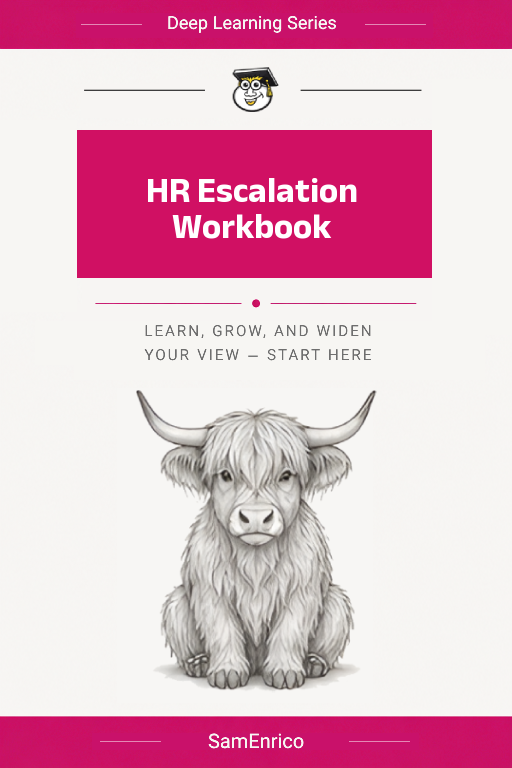
Non-FictionProfessional's Cheat SheetHR
HR Escalation Workbook eBook
Know when and how to involve HR regarding a diffic
Know when and how to involve HR regarding a difficult boss without career damage.
Formats
Free sample
Below is the in-depth summary of each chapter for The HR Escalation Workbook, following the outline you provided. Each summary expands the original bullet points into a full narrative of what the reader learns, does, and produces.Phase 1: The Triage(Differentiating Grievance from Grime)Chapter 1: The "Career Damage" Risk Calculator Core Question: Should I even go to HR at all?This chapter opens with a hard truth: going to HR with the wrong type of complaint doesn't just fail—it actively damages your career. Many employees are fired, marginalized, or labeled "difficult" after raising issues that HR categorizes as personality conflicts rather than policy violations.The chapter introduces the Grievance vs. Grime Matrix:Grievance (low-stakes, high-risk to escalate): Personality clashes, poor communication, unfair but legal treatment, general incivility.Grime (high-stakes, dangerous not to escalate): Harassment based on protected class (race, gender, age, etc.), retaliation, safety violations, wage theft, discrimination.Readers complete a 10-question Risk Calculator that scores their situation from 1 to 10. The score determines which gate they enter:1–3 (Do Not Escalate): Manage directly with the boss or transfer internally.
HR will not help.4–6 (Document & Wait): Pattern is unclear. Log for 30–60 days before reconsidering.7–10 (Escalate Now): Legal or policy violation is probable. HR is obligated to act.The chapter closes with a warning: If you cannot check at least one box under "Grime," you are gambling your career on a complaint HR is legally allowed to ignore.Deliverable: A completed Risk Calculator score and a Go/No-Go decision for escalation.Chapter 2: Mapping the Boss Archetype (The Diagnosis)Core Question: What kind of difficult boss am I dealing with?Generic labels like "toxic" or "mean" are useless in an HR conversation. This chapter teaches readers to diagnose their boss with clinical precision using a visual Boss Archetype Wheel.Synthesizing archetypes from bestsellers (Charran's nine types, Impossible Bosses, and Toxic Leaders), the chapter presents six common archetypes relevant to HR escalation:Archetype Signature Behavior HR Language Trap The Credit Stealer Takes credit for your work in meetings with leadership"He's unfair" → HR hears "personality clash"The Gaslighter Denies previous conversations, rewrites history"He lies" → HR hears "he said/she said"The Borderline Bully Yells or humiliates you, but only when no witnesses are present"He's hostile" → HR asks for proof The Attack Sub Charming in public, undermines you in private (emails, 1:1s)"He's two-faced" → HR sees no pattern The Firefighter Creates chaos or urgency, then "rescues" the situation to look heroic"He's disorganized" → HR sees a busy manager The Retaliator Only becomes hostile after you've raised a concern (a post-escalation archetype)Covered in Chapter 10For each archetype, the chapter provides a customized opening script for HR. Example for Gaslighter: "I am experiencing a pattern where critical decisions are being verbally changed without documentation, making it impossible for me to execute reliably.
Can you help me establish a written confirmation process?"Deliverable: A completed archetype diagnosis with a tailored HR script.Chapter 3: The Mirror Test (Managing Self-Sabotage)Core Question: Are you the real problem?This uncomfortable chapter forces readers to look inward before pointing outward. Drawing from HBR's Guide to Dealing with Conflict, it argues that emotional escalation is the #1 reason valid complaints get dismissed.The 48-Hour Cool Down Checklist requires readers to delay any HR contact for two full days, during which they complete:Sleep two nights – fatigue amplifies perceived threat.Write the unsendable letter – vent every raw emotion on paper, then destroy it.Answer three questions honestly:Am I physically or psychologically safe right now? (If no, escalate immediately regardless of this chapter.)*Is this a pattern (3+ instances) or a single event?*What specific business impact has occurred? (Lost revenue, delayed project, resigned team member.)Roleplay the HR meeting with a trusted friend who is instructed to play a skeptical HRBP.The chapter includes a Self-Sabotage Audit – a checklist of behaviors that ruin credibility: crying, raising voice, using absolute language ("always/never"), threatening legal action, demanding the boss be fired, naming other victims without their consent.Deliverable: A signed self-certification that the reader has completed the 48-hour cooldown and is entering HR as a "business problem presenter," not an "emotional victim."Phase 2: The Evidence Chain(Building the Case)Chapter 4: Fact-Based Notetaking (The Log)Core Question: How do I turn my memory into evidence?Most people keep terrible logs. They write: "Boss was rude again on Tuesday." This is useless to HR.
This chapter provides the BI Log framework (Behavior, Impact, Witness), adapted from Conflict Sparks Change.The BI Log has four required columns:Date & Time Behavior (verbatim quote or observable action)Business Impact Witnesses3/15, 2:30 PMSaid: "This is amateur work. Do it again." (no specific feedback)Delayed client deck by 2 days; missed internal deadline J. Chen (present), Slack timestamp Rules of the BI Log:No adjectives (mean, rude, aggressive, unfair)No feelings (I felt humiliated)No interpretations (He was trying to undermine me)Only: What was said? What was done? Who saw it?
What business result followed?The chapter provides three reusable log templates (printable or digital) and a practice exercise: readers convert five "bad" log entries into "admissible" ones.Deliverable: At least 3 completed BI Log entries from the past 30 days, plus a blank template for ongoing use.Chapter 5: The "Why This Matters" Translation Core Question: How do I make HR care about what I'm saying?HR professionals do not think about your feelings. They think about risk (lawsuits, regulatory fines) and retention (cost of replacing you). This chapter teaches readers to translate emotional complaints into HR's native language.The Translation Table provides direct mappings:What you want to say What HR needs to hear"My boss yells at me.""Verbal aggression creates a hostile work environment, increasing turnover risk and potential liability under workplace violence policies.""He takes credit for my work.""Misattribution of work damages team morale and retention. SHRM estimates replacement cost at 6–9 months of salary.""I'm afraid to speak up.""Fear of retaliation is suppressing reporting, which creates undisclosed legal exposure for the company.""He treats me differently than others.""Disparate treatment based on [protected characteristic] is a prima facie discrimination claim."The chapter cites the $44.6B annual cost of workplace toxicity (from Teresa Daniel's research) to underscore why HR should care.Deliverable: A "Complaint Rewrite Worksheet" where readers transform their raw complaint (left column) into HR-translated language (right column). Readers also draft the first two sentences they will speak in an HR meeting.Chapter 6: The Witness Matrix Core Question: Who else sees what I see, and how do I talk to them?HR operates on a simple rule: one complaint is an outlier; three complaints are a pattern.
But approaching coworkers is risky—you can be accused of conspiracy or poisoning the team.This chapter introduces the Witness Matrix, a 2x2 grid for categorizing colleagues:Low Risk to Approach High Risk to Approach Sees the behavior Allies (have already complained to you)Observers (were present but silent)Does not see the behavior Friendly Witnesses (will confirm if HR asks)Hostile Witnesses (loyal to boss—do not approach)The Rule of Three: Do not escalate to HR unless you can identify at least two other people (Allies or Observers) who have independently witnessed the same behavior on different occasions.The chapter provides safe conversation openers that are neutral…
This is the end of the free sample. Get the eBook to keep going. Buy now
About this book
Details
- Author
- Mabry Rosette
- Publisher
- SamEnrico
- Language
- English
- Genre
- Non-Fiction, Professional's Cheat Sheet, HR
- Released
- 2026-05-29
- Pages (approx.)
- 147
- Available as
- eBook, Audiobook

Read better in the ZLOADR app
Your eBooks on your phone or tablet. Sign in with your SamEnrico account and start reading.
More by Mabry Rosette
 The Confidence Body Language WorkbookMabry Rosette$11.99
 Arms Manufacturer WhistleblowerMabry Rosette$11.99
 Teamster Boss Last Days Deep DiveMabry Rosette$11.99
 Job Loss for AccountantsMabry Rosette$11.99
 Blue Light Filtering for SADMabry Rosette$11.99
 Medication Withdrawal AnxietyMabry Rosette$11.99
 Widow s Birthday Grief GuideMabry Rosette$11.99
 Natalie Portman HarvardMabry Rosette$11.99
 Sheikh Mohammed and the Birth of Modern Arabian Horse Racing: A Visionary's LegacyMabry Rosette$11.99
 The Oxford Lights: Beacons of Western KnowledgeMabry Rosette$11.99
 How to Produce Paper Product Making MachineryMabry Rosette$11.99
 How to Produce a MowerMabry Rosette$11.99
You may also like
 Hong Kong Handover 1997Dunn Johnnie$11.99
 Zumba For Postnatal Recovery CourseNeal Christian$11.99
 Zumba for BeginnersLadner Nikia$11.99
 YouTube Comment Mining GuideHumes Pandora$12.99
 Worry Box MeditationCarlin Rudy$11.99
 Workplace Stress MeditationNguyen Lynn$11.99
 Workplace Stress and Sleep RepairHawley Ivory$11.99
 Workplace Perfectionism CureDelaney Jeffry$11.99
 Workplace Injustice Anger GuideWallen Isabelle$11.99
 Work Addiction and Burnout LinkGreenwood Ester$11.99
 Women in Yoga and WellnessBeattie Galina$11.99
 Women in Stand Up ComedyChun Evangeline$11.99