
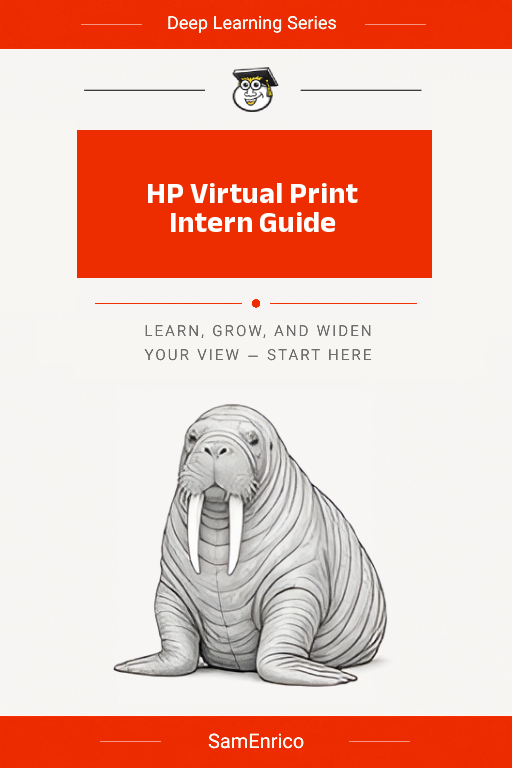
Non-FictionStudent's ShortcutPrinting Tech InternshipHP Careers
HP Virtual Print Intern Guide eBook
Secure a remote internship at HP for printing tech
Secure a remote internship at HP for printing technology 3D manufacturing or sustainability initiatives with global teams.
Formats
Free sample
--Chapter 1: The Singapore Surprise–- In a brightly lit conference room on the thirty-second floor of HP’s Singapore campus, a twenty-two-year-old intern from Nebraska just solved a thermal uniformity problem that had stumped three full-time engineers for two weeks. She did it without ever touching a 3D printer, without stepping foot inside a lab, and while wearing sweatpants in her parents’ basement. The only tool she used was a remote desktop connection to a workstation six thousand miles away, a digital twin of a Multi Jet Fusion machine, and a single line of Python code that recalibrated a thermal sensor array. When her manager in Barcelona watched the simulation run successfully at 3:00 a.m. his time, he sent her a single message: “You just earned your return offer.”This story is not an exaggeration.
It is not a marketing pitch from HP’s recruitment team. It is the new reality of virtual internships in advanced manufacturing, and it is happening right now across HP’s global print and 3D printing divisions. The interns who succeed in this environment are not necessarily the ones with the highest GPAs or the most prestigious university names on their resumes. They are the ones who understand a fundamental truth that this book will drill into you from this page forward: HP does not need another generalist. HP needs specialized remote operators who can navigate the intersection of additive manufacturing, data analytics, and sustainability without ever shaking a manager’s hand in person.This chapter will shatter every assumption you have about applying for a remote internship at a Fortune 500 hardware company.
You will learn why HP’s virtual internship program is fundamentally different from the remote work experiments launched during the pandemic. You will discover the three technological pillars that define HP’s printing and 3D manufacturing ecosystem, and you will take a self-assessment that will determine which of those pillars you should target. Most importantly, you will understand why applying as a “Software Engineer” or “Business Analyst” is a guaranteed path to rejection, while positioning yourself as a “3D Printing Application Developer” or “Sustainable Materials Analyst” opens doors you did not know existed.The Great Misunderstanding: Why Most Applicants Fail Before They Start Let us begin with a hard truth. Every year, HP receives tens of thousands of applications for remote internships in its printing, 3D manufacturing, and sustainability divisions. The vast majority of those applications are deleted within ten seconds of being opened.
Not because the applicants are unqualified, but because they are unspecific. They apply to a generic “Software Engineering Intern” posting when HP actually needs someone who can optimize printhead calibration algorithms. They apply to a “Data Science Intern” role when HP needs someone who can calculate the carbon footprint reduction of switching from PA-12 to PA-11 material. They apply to a “Project Management Intern” position when HP needs someone who can update a Process Failure Mode Effects Analysis for a digital press assembly line in Barcelona.The root of this problem is simple: most applicants do not understand what HP actually does. They see “HP” on a job posting and think of the inkjet printer sitting in their parents’ home office.
They do not realize that HP is one of the world’s largest manufacturers of industrial 3D printers, that its Multi Jet Fusion technology is used by automotive and aerospace companies to produce end-use parts, or that its sustainability initiatives have diverted over one hundred million pounds of ocean-bound plastic from entering the environment. They certainly do not realize that HP has been quietly building a “digital factory” model for remote engineering work since long before the pandemic forced every other company to scramble for Zoom licenses.HP’s virtual internship program is not a pandemic-era adaptation. It is a deliberate strategy that leverages the company’s HP ZCentral Remote Boost technology, which allows engineers to manipulate massive 3D CAD files from a laptop anywhere in the world with near-zero latency. This system was developed years before COVID-19, specifically to enable global collaboration across HP’s research and development hubs in Singapore, Boise, and Barcelona. When the pandemic hit, HP did not need to invent remote work.
It simply scaled what it had already built.Yet despite this sophisticated infrastructure, the vast majority of applicants approach HP internships as if they were applying to a generic tech company. They highlight their general coding skills, their broad business acumen, or their passion for “sustainability” without any specific technical grounding. They do not realize that HP’s hiring managers are not looking for passion. They are looking for proof that you can operate within HP’s specific technological stack: Multi Jet Fusion for 3D printing, Thermal Ink Jet for industrial digital print, and circular economy metrics for sustainability.The applicants who succeed are the ones who walk into the interview already speaking HP’s language. They know what “voxel-level control” means.
They can explain the difference between PA-11 and PA-12 materials. They have built a Power BI dashboard that tracks material usage efficiency. They have a Git Hub repository containing simulation files, not just photos of physical prints. They have written a one-page project pitch proposing a specific sustainability improvement for the MJF powder recycling process. In short, they have already done the work of becoming a specialized remote operator before they ever hit “submit” on their application.This book will teach you how to become that applicant.
But first, you must understand the landscape you are entering.The Three Pillars of HP’s Virtual Internship Ecosystem HP’s printing and 3D manufacturing divisions are organized around three interconnected technological pillars. Every remote internship falls into one of these pillars, and your success depends on identifying which pillar aligns with your existing skills and then aggressively specializing within that pillar.Pillar One: Additive Manufacturing (Multi Jet Fusion)Multi Jet Fusion, or MJF, is HP’s proprietary 3D printing technology. Unlike traditional 3D printers that extrude plastic layer by layer, MJF uses inkjet arrays to deposit fusing and detailing agents onto a bed of nylon powder, which is then fused by infrared light. This process allows for voxel-level control—meaning each microscopic volume of the printed part can have different mechanical properties. The result is production-grade parts that are indistinguishable from injection-molded components.Remote internships in additive manufacturing typically focus on one of three areas: process optimization (reducing print time or material waste), application development (designing parts specifically for MJF’s capabilities), or digital twin simulation (using software to model and predict print outcomes before a single powder particle is fused).
These roles require familiarity with CAD software like Solid Works or Fusion 360, basic scripting skills in Python for data analysis, and a willingness to learn HP’s proprietary simulation tools.The typical intern in this pillar is a mechanical engineering student, though materials science and manufacturing engineering backgrounds are also common. What sets successful applicants apart is not just their CAD proficiency but their ability to think in terms of “design for additive manufacturing”—designing parts that take advantage of MJF’s unique capabilities rather than simply adapting designs meant for traditional machining.Pillar Two: Industrial Digital Print While MJF gets most of…
This is the end of the free sample. Get the eBook to keep going. Buy now
About this book
Details
- Author
- Gordon Stella
- Publisher
- SamEnrico
- Language
- English
- Genre
- Non-Fiction, Student's Shortcut, Printing Tech Internship, HP Careers
- Released
- 2026-05-30
- Pages (approx.)
- 146
- Available as
- eBook, Audiobook

Read better in the ZLOADR app
Your eBooks on your phone or tablet. Sign in with your SamEnrico account and start reading.
More by Gordon Stella
 The Sfas Emes CommentatorGordon Stella$11.99
 Peptides for Growth Hormone ReleaseGordon Stella$11.99
 Panic Disorder Interoceptive Exposure CourseGordon Stella$11.99
 Construction Worker CaptiveGordon Stella$11.99
 AI Upscaling for Archival FootageGordon Stella$11.99
 The Gold of the Sun King: How a 17th-Century Scandal Forged Modern FinanceGordon Stella$11.99
 The Last Voyage of the MV Wilfred: The Ship That Outsmarted the PiratesGordon Stella$11.99
 Understanding Brachydactyly ClinodactylyGordon Stella$17.99
 Deputy Head of BoutiqueGordon Stella$11.99
 Executive Summary Confidence BoosterGordon Stella$12.99
 How to Start a Hobby in InternetGordon Stella$11.99
You may also like
 Hong Kong Handover 1997Dunn Johnnie$11.99
 Zumba For Postnatal Recovery CourseNeal Christian$11.99
 Zumba for BeginnersLadner Nikia$11.99
 YouTube Comment Mining GuideHumes Pandora$12.99
 Worry Box MeditationCarlin Rudy$11.99
 Workplace Stress MeditationNguyen Lynn$11.99
 Workplace Stress and Sleep RepairHawley Ivory$11.99
 Workplace Perfectionism CureDelaney Jeffry$11.99
 Workplace Injustice Anger GuideWallen Isabelle$11.99
 Work Addiction and Burnout LinkGreenwood Ester$11.99
 Women in Yoga and WellnessBeattie Galina$11.99
 Women in Stand Up ComedyChun Evangeline$11.99