
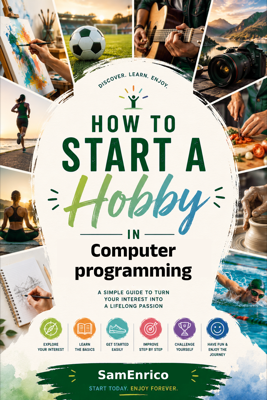
Non-FictionInformativeEducational
How to Start a Hobby in Computer programming eBook
How to Start a Hobby in Computer programming
by Hunt Clayton
How to Start a Hobby in Computer programming
Formats
Free sample
Chapter 1: The Bootcamp Lie--You have probably been told, directly or indirectly, that learning to code is a career move. That you need a twelve-week bootcamp, a computer science degree, or at the very least a six-figure salary waiting at the end of the tunnel to make programming worth your time. Maybe you have seen the ads on social media: a smiling person in a hoodie types furiously on a laptop, and the text overlay reads "Learn to Code – Change Your Life." Maybe you have heard the statistic that software developers make twice the national average, or that there are millions of unfilled programming jobs. All of this is technically true. And all of this is completely irrelevant to you right now.Here is what those ads do not tell you.
The majority of people who enroll in coding bootcamps already have college degrees. The majority of computer science students spend their first two semesters failing at least one programming course before something clicks. And the majority of professional programmers will tell you, if they are honest, that they did not fall in love with coding because of a salary spreadsheet. They fell in love because they built something stupid and silly and utterly useless – a text-based adventure game where the dragon always wins, a script that renamed their poorly labeled vacation photos, a program that printed insulting Shakespearean couplets every time the computer booted up – and that stupid, silly thing worked. The computer did exactly what they told it to do.
That rush of control, that moment of creating something from nothing, that is the hobbyist's first hit. Everything else comes later or not at all.This book is not about getting a job. This book is not about passing an exam. This book is not about becoming a "full-stack engineer" or a "data scientist" or any other job title that requires a Linked In profile and a firm handshake. This book is about learning to code the way you might learn to play the guitar – for the joy of making sounds, for the satisfaction of your own progress, for the ability to sit alone in a room and build something that did not exist an hour ago.
If you accidentally acquire a marketable skill along the way, wonderful. But that is not the point. The point is the hobby itself.Why Hobby Coding Is Fundamentally Different Let us define what we mean by "hobby coding" because the term gets thrown around loosely, and the distinction matters more than you might think.Professional coding – the kind taught in bootcamps and used in offices – is judged by external metrics. Does the code run fast enough? Is it secure?
Can six other people understand and modify it? Does it meet the client's requirements? These are valid questions for someone who is paid to write software. But they are also the fastest way to kill the enjoyment of a beginner. When every line of code is judged against professional standards, you learn to be afraid.
You learn to second-guess. You learn that mistakes are failures rather than discoveries.Academic coding – the kind taught in university courses – is judged by correctness and efficiency. Did you implement quicksort exactly as specified? Did you handle the edge case where the array is empty? Did you optimize your memory usage?
These are important concepts for someone who wants to understand computer science deeply. But they are also boring as watching concrete dry when you just want to make a game that says funny things when you lose.Hobby coding has only one metric: does this make you smile? That is not a joke. That is the actual standard. If you write a ten-line script that prints a random insult every time you open your terminal, and that makes you laugh, that script is a success regardless of whether a professional would call it "elegant" or "maintainable" or "scalable." If you build a habit tracker that only works for you and crashes whenever someone else touches it, but it helps you remember to drink water, that is a triumph.
Hobby coding is the art of building things for yourself, by yourself, with no audience except the person in the mirror.This changes everything about how you learn. When you are not afraid of being judged, you experiment more. When you are not racing against a deadline or a grade, you take the time to understand why something broke. When you are not trying to impress a hiring manager, you build the weird projects that actually interest you – the automatic cat gif downloader, the script that texts you when your favorite band announces a tour, the program that generates fake motivational posters for your desk. These projects are not resumes.
They are playgrounds.The Tinkerer's Mindset There is a word for people who learn by breaking things and putting them back together: tinkerers. This word will appear throughout this book because it is the single most important concept in hobby coding. Professional programmers call themselves engineers. Academic programmers call themselves computer scientists. Hobby programmers call themselves tinkerers, and they mean it as a compliment.Tinkering is what you did as a child when you took apart a remote control to see how the buttons worked.
Tinkering is what you do when you try a new recipe and add extra garlic because you suspect it will taste better. Tinkering is the opposite of following instructions perfectly. It is the willingness to say "I wonder what happens if I change this number" and then running the code to find out.Here is the secret that professional programmers do not advertise: they tinker too. They just call it "testing" or "debugging" or "prototyping." But the activity is identical. You write something.
You run it. It breaks. You change one thing. You run it again. It breaks differently.
You laugh or curse or take a walk. You come back. You try again. Eventually, it works. That process – break, adjust, retry, repeat – is not a bug in the learning system.
It is the system.The only difference between a beginner and an expert is that the expert has broken more things. That is not a metaphor. A senior software engineer has seen thousands of error messages. They have made every possible mistake at least once. They have spent entire days debugging a single missing comma.
And because they have done all of that, they can recognize patterns. "Ah," they say when they see a Name Error, "I have misspelled a variable name again." That is not genius. That is repetition.Your goal for the next thirty days is not to avoid errors. Your goal is to collect as many errors as possible, understand each one, and add it to your mental library. By the end of this book, you will have seen Syntax Error, Name Error, Type Error, Index Error, Key Error, Value Error, and Indentation Error more times than you can count.
And each time, you will panic a little less. That is progress. That is the tinkerer's path.What You Actually Need to Start Before we write a single line of code, let us clear away the obstacles that stop most people before…
This is the end of the free sample. Get the eBook to keep going. Buy now
About this book
Details
- Author
- Hunt Clayton
- Publisher
- SamEnrico
- Language
- English
- ISBN
- 9781506113296
- Genre
- Non-Fiction, Informative, Educational
- Released
- 2026-06-02
- Pages (approx.)
- 145
- Available as
- eBook, Paperback, Audiobook

Read better in the ZLOADR app
Your eBooks on your phone or tablet. Sign in with your SamEnrico account and start reading.
More by Hunt Clayton
 Rugby Player's Hypnosis GuideHunt Clayton$11.99
 Perimenopause Nutrition PlanHunt Clayton$11.99
 Stress Gallbladder AttacksHunt Clayton$11.99
 Caregiver Stress PartnershipHunt Clayton$11.99
 Self Talk for CouplesHunt Clayton$11.99
 The Deep Work Hope GuideHunt Clayton$11.99
 Eisenhower Matrix for Event PlannersHunt Clayton$11.99
 Mars Desert Calm GuideHunt Clayton$11.99
 The Hidden Brushstrokes: Trailblazing Women Artists of the Golden AgeHunt Clayton$11.99
 The Great Fire That Never Was: The 1992 Windsor Arson ConspiracyHunt Clayton$11.99
 Zebus: Humped CattleHunt Clayton$11.99
 How to Produce Disc Golf EquipmentHunt Clayton$11.99
You may also like
 Hong Kong Handover 1997Dunn Johnnie$11.99
 Zumba For Postnatal Recovery CourseNeal Christian$11.99
 Zumba for BeginnersLadner Nikia$11.99
 YouTube Comment Mining GuideHumes Pandora$12.99
 Worry Box MeditationCarlin Rudy$11.99
 Workplace Stress MeditationNguyen Lynn$11.99
 Workplace Stress and Sleep RepairHawley Ivory$11.99
 Workplace Perfectionism CureDelaney Jeffry$11.99
 Workplace Injustice Anger GuideWallen Isabelle$11.99
 Work Addiction and Burnout LinkGreenwood Ester$11.99
 Women in Yoga and WellnessBeattie Galina$11.99
 Women in Stand Up ComedyChun Evangeline$11.99