
Non-FictionInformativeEducational
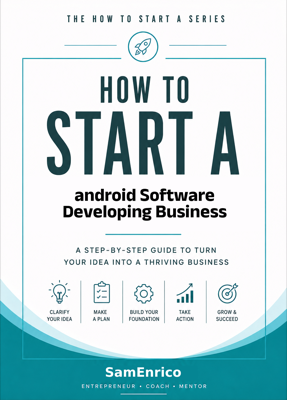
How to Start a android Software Developing Business (Beginners Guide) eBook
How to Start a android Software Developing Busines
How to Start a android Software Developing Business (Beginners Guide)
Formats
Free sample
Chapter 1: The $25 Door–– Every year, over 200,000 people pay the $25 fee to become Google Play developers. Most of them will never make a single dollar. Not because they aren't smart. Not because they can't learn to code. But because they are asking the wrong question.The question most beginners ask is: "How do I build an app?"The question they should be asking is: "What business am I actually entering?"This chapter is not about code.
You will not write a single line of code in this chapter. Instead, you will learn something far more valuable before you spend a single hour learning syntax or debugging a layout. You will learn the strategic landscape of the Android software development business—who wins, who loses, and why the door is wider open than you think.The Great Misconception: i OS Makes More Money Walk into any coffee shop filled with tech workers. Mention you want to build apps. Someone will inevitably say, "Why Android?
You should build for i Phone. That's where the money is."This advice is not wrong. But it is incomplete.It is true that the average i OS user spends more money per app than the average Android user. According to industry data spanning the last several years, the Apple App Store generates approximately twice the revenue of the Google Play Store despite having roughly half the number of users. On the surface, this seems like a slam dunk for i OS.But here is what that advice misses.The "average" includes thousands of games, social media apps, and lifestyle tools that compete for the same saturated US audience.
The average i OS user in the United States has hundreds of apps to choose from and very high expectations. The average Android user in Indonesia, Brazil, or Nigeria has far fewer apps tailored to their local language, local payment methods, and local problems.The question is not which platform has the highest average revenue. The question is which platform has the largest opportunity for you—a solo beginner with no team, no budget, and no reputation.The Global Majority: Where Android Actually Wins Let's look at the numbers that matter for a beginner.In the United States, i OS and Android split the market roughly 50-50, with i OS slightly ahead among younger users. But the United States is not the world. It is less than five percent of the global population.In India, Android holds over 95 percent market share.
In Brazil, approximately 85 percent. In Indonesia, over 90 percent. In Nigeria, Kenya, and South Africa, Android dominates with shares between 80 and 90 percent. In China—where Google Play is blocked but Android still runs on every phone not made by Apple—the ecosystem is effectively Android-only.This matters for one simple reason: distribution.When you publish an app on Google Play, it is available in over 190 countries by default. Your app can be downloaded by a farmer in rural India, a student in São Paulo, and a grandmother in Jakarta on the same day.
Apple's App Store reaches many of these countries, but the device cost is prohibitive. An i Phone costs many months of wages in emerging economies. An Android phone can cost less than one hundred dollars.This is not charity work. This is a business strategy called the "Blue Ocean."Blue Ocean Strategy for Solo Developers A "red ocean" is a crowded market where everyone fights over the same customers, turning the water red with competition. The US app market for i OS is a red ocean.
You will compete with billion-dollar companies and thousands of skilled indie developers.A "blue ocean" is an uncontested market space where you have no competition. In the Android ecosystem, blue oceans exist in every country where local problems remain unsolved by local apps.Consider these examples:A weather app in English is worthless to a farmer who speaks Telugu. A calorie tracker that assumes access to a grocery store is useless to someone who shops at an open-air market. A ride-sharing app that requires a credit card cannot serve a population that pays with cash or mobile money.Every one of these gaps is an opportunity. And because most Western developers ignore these markets, the competition is often zero.The chapter's action step at the end will ask you to research your own country's Android market share.
But before you do that, you need to understand the practical mechanics of getting through the door.The $25 Door: Comparing the Two Gates The title of this chapter refers to the one-time fee Google charges to become a registered developer. This fee is the single cheapest barrier to entry in any software business. To understand why this matters, compare the two gates side by side.Apple's Gate:$99 annual fee (renews every year whether you sell anything or not)A Mac computer (minimum $600 used, $1,000+ new)Xcode software (Mac-only, requires regular updates)Manual review process (days to weeks, unpredictable rejections)Strict design guidelines (your app must look and behave like an Apple app)Google's Gate:$25 one-time fee (pay once, developer account lasts indefinitely)Any computer (Windows, Mac, Linux—whatever you already own)Android Studio (free, runs on everything)Automated review process (hours, predictable)Flexible design guidelines (your app can look unique)The difference is not subtle. Apple's gate requires an ongoing financial commitment and specific hardware. Google's gate requires a single payment and whatever computer you already have.This is why this book exists.
If you needed a thousand-dollar computer and a hundred-dollar annual fee just to start, this would not be a beginner-friendly business. The $25 door is open to almost anyone in almost any country.But a cheap door also means a crowded room. Lower barriers to entry mean more competitors. That is the trade-off. You will have more company in the Android ecosystem than you would in i OS.
However, you also have more freedom to differentiate yourself.Niche Targeting: How to Win Without Being the Best If you cannot beat the big players on features or budget, you must beat them on focus.The most successful solo Android developers do not build apps for "everyone." They build apps for a very specific person with a very specific problem. This is called niche targeting.Here is how it works in practice.A general fitness app competes with Google Fit, Samsung Health, and hundreds of other free options. You will not win there. But an app that tracks exactly one thing—say, water intake for kidney dialysis patients—has no competition. There might only be ten thousand dialysis patients in your country who need this app.
That is enough. Ten thousand users paying two dollars per month is two hundred forty thousand dollars per year.A general note-taking app competes with Evernote, Notion, and Google Keep. You will not win there. But an app that takes notes specifically for Dungeons & Dragons players—tracking character stats, dice rolls, and campaign notes—has a small but passionate audience. They will pay for a tool designed exactly for their hobby.A general language learning app competes with Duolingo, Babbel, and Rosetta Stone.
You will not win there. But an app that teaches English specifically to truck drivers in Brazil—using vocabulary related to…
This is the end of the free sample. Get the eBook to keep going. Buy now
About this book
Details
- Author
- Creech Stormy
- Publisher
- SamEnrico
- Language
- English
- ISBN
- 9781506033716
- Genre
- Non-Fiction, Informative, Educational
- Released
- 2026-06-02
- Pages (approx.)
- 128
- Available as
- eBook, Paperback, Audiobook

Read better in the ZLOADR app
Your eBooks on your phone or tablet. Sign in with your SamEnrico account and start reading.
More by Creech Stormy
 Burnout Prevention for NonprofitsCreech Stormy$11.99
 Retail Dividend Investing GuideCreech Stormy$11.99
 Procrastination For New ParentsCreech Stormy$11.99
 Focus Music for Distraction ProneCreech Stormy$11.99
 Grief and Therapy After Child LossCreech Stormy$11.99
 Public Speaking Self Talk RewiringCreech Stormy$11.99
 Goal Deconstruction MethodCreech Stormy$11.99Burnout Prevention For NonprofitsCreech Stormy$11.99
 Benzo Interdose WithdrawalCreech Stormy$11.99
 The Secret Songs of the North StarCreech Stormy$11.99
 The Pill Factory: How a Small Town Became Ground Zero for America's Opioid CrisisCreech Stormy$11.99
 How to Produce Wires, Cables and Cable AssembliesCreech Stormy$11.99
You may also like
 Hong Kong Handover 1997Dunn Johnnie$11.99
 Zumba For Postnatal Recovery CourseNeal Christian$11.99
 Zumba for BeginnersLadner Nikia$11.99
 YouTube Comment Mining GuideHumes Pandora$12.99
 Worry Box MeditationCarlin Rudy$11.99
 Workplace Stress MeditationNguyen Lynn$11.99
 Workplace Stress and Sleep RepairHawley Ivory$11.99
 Workplace Perfectionism CureDelaney Jeffry$11.99
 Workplace Injustice Anger GuideWallen Isabelle$11.99
 Work Addiction and Burnout LinkGreenwood Ester$11.99
 Women in Yoga and WellnessBeattie Galina$11.99
 Women in Stand Up ComedyChun Evangeline$11.99