
Non-FictionInformativeEducational
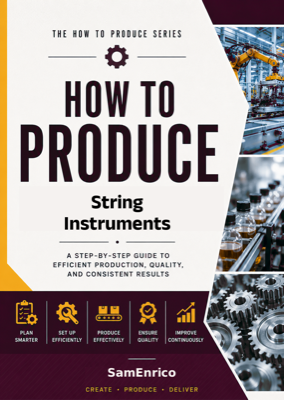
How to Produce String Instruments
This publication, published by SamEnrico, covers H
by Grady Jewel
This publication, published by SamEnrico, covers How to Produce String Instruments
Formats
About this book
Free sample
Chapter 1: The String’s Lie...--–- The first lie you will learn as a luthier is that the string makes the sound. It does not. The string makes a frequency—a raw, indifferent oscillation of metal or gut—but the sound, the voice, the thing that makes a violinist weep or a guitarist smile, that is entirely your doing. The string is the messenger. You are the mouth.This distinction is not academic pedantry.
It is the foundation upon which every instrument you will ever build rests. Confuse the messenger for the message, and you will spend years chasing the wrong variables—buying expensive strings, agonizing over brand names, adjusting tension up and down—while the real determinants of tone sit silently in your workshop, waiting for you to notice them. The wood, the graduation, the brace placement, the bridge mass, the soundpost (for the violin family), the air volume inside the box: these are the true architects of tone. The string merely knocks on the door. You design the room that answers.This chapter will teach you to see through the string’s lie.
We will trace the complete energy chain from the musician’s fingertip to the air moving past the f-holes or soundhole. You will learn the four critical transfer points where energy can be gained or lost. You will understand the Bridge Equation algebraically and intuitively. You will discover why a violin with f-holes sounds fundamentally different from a guitar with a round hole—even when both are playing the same pitch. And you will master the concept of nodes and antinodes, the invisible architecture of vibration that separates a living instrument from a firewood-grade box.By the end of this chapter, you will never look at a top plate the same way again.
You will see it not as a flat surface but as a controlled membrane, designed to move maximally where it should and not at all where it should not. That is the luthier’s art: not carpentry, but acoustic sculpting.The Energy Chain: From Fingertip to Ear Before you cut a single piece…
This is the end of the free sample. Get the eBook to keep going. Buy now
Contents
- Chapter 1
- Chapter 2
- Chapter 3
- Chapter 4
- Chapter 5
- Chapter 6
- Chapter 7
- Chapter 8
- Chapter 9
- Chapter 10
- Chapter 11
- Chapter 12
Details
- Author
- Grady Jewel
- Publisher
- SamEnrico
- Language
- English
- Genre
- Non-Fiction, Informative, Educational
- Released
- 2026-06-02
- Pages (approx.)
- 136
- Available as
- eBook, Audiobook

Read better in the ZLOADR app
Your eBooks on your phone or tablet. Sign in with your SamEnrico account and start reading.
More by Grady Jewel
 The ADHD Priority GuideGrady Jewel$11.99
 DBT For Loneliness GuideGrady Jewel$11.99
 The Volunteer Who Built a ParkGrady Jewel$11.99
 Pelvic Floor for Martial ArtsGrady Jewel$11.99
 Antwerp Heist MemesGrady Jewel$11.99
 Inner Child Self Worth RepairGrady Jewel$11.99
 Breath Meditation For ExecutivesGrady Jewel$11.99
 Pomodoro For Sales CallsGrady Jewel$11.99
 The Phantom of Paddington: A Wrongful Imprisonment in Prohibition BritainGrady Jewel$11.99
 The Beasts of Saint George: A Knight’s Forgotten QuestGrady Jewel$11.99
 A Collector's Handbook to the Fairthorpe SGrady Jewel$11.99
 Mastering The Art of Krav MagaGrady Jewel$11.99
You may also like
 Hong Kong Handover 1997Dunn Johnnie$11.99
 Zumba For Postnatal Recovery CourseNeal Christian$11.99
 Zumba for BeginnersLadner Nikia$11.99
 YouTube Comment Mining GuideHumes Pandora$12.99
 Worry Box MeditationCarlin Rudy$11.99
 Workplace Stress MeditationNguyen Lynn$11.99
 Workplace Stress and Sleep RepairHawley Ivory$11.99
 Workplace Perfectionism CureDelaney Jeffry$11.99
 Workplace Injustice Anger GuideWallen Isabelle$11.99
 Work Addiction and Burnout LinkGreenwood Ester$11.99
 Women in Yoga and WellnessBeattie Galina$11.99
 Women in Stand Up ComedyChun Evangeline$11.99