
Non-FictionInformativeEducational
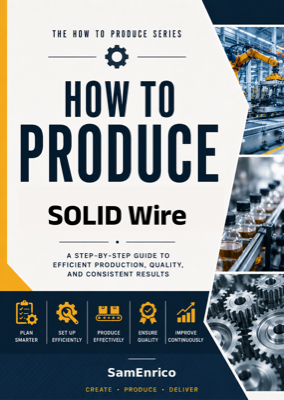
How to Produce SOLID Wire eBook
This publication, published by SamEnrico, covers H
This publication, published by SamEnrico, covers How to Produce SOLID Wire
Formats
Free sample
Chapter 1: The Rod Reality...--At 7:43 on a Tuesday morning, a 2,000-kilogram coil of hot-rolled steel rod arrives on a flatbed truck. The coil is still warm from the mill that produced it three days ago and 400 kilometers away. To the untrained eye, it looks like a perfect spiral of dark, scaly metal—ordinary, unremarkable, industrial. To the wire producer who just paid $1,200 per ton for it, this coil is either the foundation of a profitable day or the beginning of a very expensive mistake.The difference between profit and loss—between wire that draws perfectly and wire that snaps every seventeen meters—is invisible to that untrained eye. It hides in the metallurgical history of the rod: the temperature at which it was cast, the speed at which it cooled, the condition of the rolls that shaped it, and a hundred other variables that left their mark in ways no casual inspection can detect.Welcome to the reality of raw material selection.
If you produce solid wire, you do not manufacture wire. You reveal it. The rod you buy already contains nearly all the properties your finished wire will possess. Your drawing process can only make those properties worse—it cannot make them better. A perfect rod can become mediocre wire through poor processing.
But a flawed rod can never become perfect wire, no matter how skilled the operator or how expensive the dies.This chapter is about seeing what the naked eye cannot. It is about understanding the language of steel, copper, aluminum, and every other metal that becomes wire. And it is about the single most important rule in wire production: garbage in, garbage out—except that in wire drawing, garbage in guarantees garbage out, and even premium material can be ruined if you don't know what you're looking at.The Hidden Cost of a Bad Coil Before we examine specific defects, let us understand the economics of rod quality. A wire mill processing ten tons per day might spend 2millionannuallyonrawrod.Thedifferencebetweenapremiumrod(2 million annually on raw rod. The difference between a premium rod (2millionannuallyonrawrod.Thedifferencebetweenapremiumrod(1,200/ton) and a discount rod (1,100/ton)is1,100/ton) is 1,100/ton)is100 per ton, or $200,000 per year.
That sounds like meaningful savings.But one bad coil—one coil containing a seam that runs for 200 meters—can break thirty times during drawing. Each break costs five minutes of downtime, plus the labor to re-thread the wire, plus the scrap from the broken ends, plus the die wear from the abrasive break surface being pulled through. A single catastrophic seam can cost 2,000inlostproduction.Tensuchcoilsperyearandthe2,000 in lost production. Ten such coils per year and the 2,000inlostproduction.Tensuchcoilsperyearandthe200,000 "savings" vanishes. Twenty coils and you are losing money hand over fist.The mathematics get worse for high-carbon or alloy wires.
A broken wire in a multi-wire drawing machine (discussed in Chapter 5) stops all strands simultaneously. One bad seam can idle a $2 million machine for an hour while operators untangle the mess.This is why the most successful wire producers do not shop on price alone. They qualify suppliers rigorously, test every coil on arrival, and reject material that does not meet specification. They understand that the rod is not a commodity—it is a manufacturing input with enormous leverage over final profitability.The Defects You Must Recognize Wire rod defects fall into three families: surface defects (visible on the outside of the rod), internal defects (hidden within the cross-section), and dimensional defects (variations in size or shape). Each family has specific origins at the rolling mill, specific behaviors during drawing, and specific detection methods.Surface Defects: The Visible Enemies Seams are the most common and most dangerous surface defect.
A seam is a longitudinal line of entrapped oxide—essentially, a crack that formed during hot rolling and then became filled with iron oxide scale. Seams look like fine, dark lines running parallel to the wire axis. They may be continuous for hundreds of meters or appear intermittently.The mechanical problem with seams is geometric: they act as stress risers. When you draw a rod containing a seam, the tensile stress concentrates at the tip of the seam. Instead of distributing evenly across the wire cross-section, the stress multiplies locally.
A seam that is 0.1 millimeters deep on a 5.5 millimeter rod can produce a local stress concentration factor of 5 to 10 times the nominal stress.What does this mean in practice? If your drawing stress is 400 megapascals (a typical value for medium-carbon steel), the material at the seam tip experiences 2,000 to 4,000 megapascals—far exceeding the wire's fracture strength. The result is a break, usually at or just after the die exit.Seams originate from several upstream problems: billet surface cracks that were not ground out before rolling, improper rolling temperature that created tears, or worn roll passes that squeezed metal into crevices. Steel mills with older equipment or poor quality control produce seam-prone rod. Reputable mills use eddy current testing (Chapter 10) to detect and mark seams, but some still ship marginal material.Slivers are similar to seams but with a different morphology.
A sliver is a loose flap of metal that has been peeled away from the rod surface but remains attached at one end. Slivers look like shiny, irregular patches that catch the light differently than the surrounding rod.During drawing, slivers are particularly nasty because they can fold over, creating a double layer of metal that enters the die. The die attempts to reduce both layers simultaneously, which requires double the force. The result is either a break or a surface lap—a folded-over defect that becomes embedded in the finished wire. Slivers often come from re-heating cracks: the billet was heated too quickly, creating thermal stresses that cracked the surface, and the rolls then smeared the crack closed without welding it.Scratches and digs are mechanical damage from handling.
Unlike seams and slivers, which are mill defects, scratches are often the wire producer's own fault. They occur when the rod contacts sharp edges on payoff equipment, when coils rub against each other during storage, or when lifting magnets drag across the surface.A scratch might seem trivial compared to a metallurgical defect, but it is still a stress riser. A scratch 0.05 millimeters deep is enough to initiate a break in high-carbon wire. The solution is careful handling: padded payoff arms, protected coil storage, and non-marring lifting equipment.Scale is not a defect per se—it is a normal byproduct of hot rolling. When steel cools from rolling temperature (typically 1,050°C down to 800°C), iron combines with oxygen to form a layer of iron oxides: primarily wüstite (Fe O), with some magnetite (Fe₃O₄) and hematite (Fe₂O₃).
Scale is brittle and abrasive. It does not cause breaks directly, but it destroys dies and lubricants if not removed before drawing.Scale becomes a problem when it adheres too strongly. Low-carbon steel scale typically cracks and falls off during mechanical descaling (Chapter 8). High-carbon steel scale, especially from controlled-cooling mills, can be tenacious. The solution is chemical pickling—but pickling adds cost and environmental compliance burden.Internal Defects: The Hidden Saboteurs Centerline porosity is a void or chain of voids along the center of the rod.
It originates during continuous casting when the liquid core of the billet solidifies last and shrinks, leaving microscopic cavities. Some…
This is the end of the free sample. Get the eBook to keep going. Buy now
About this book
Details
- Author
- Sumpter Kenia
- Publisher
- SamEnrico
- Language
- English
- Genre
- Non-Fiction, Informative, Educational
- Released
- 2026-05-11
- Pages (approx.)
- 159
- Available as
- eBook, Audiobook

Read better in the ZLOADR app
Your eBooks on your phone or tablet. Sign in with your SamEnrico account and start reading.
More by Sumpter Kenia
 Donating Business Interest GuideSumpter Kenia$11.99
 Meeting Room PersuasionSumpter Kenia$11.99
 Gacy Murder House DemolitionSumpter Kenia$11.99
 Wedding Purchase StudySumpter Kenia$11.99
 Quit Smoking for COPD GuideSumpter Kenia$11.99
 Night Stalker Appeal LawyersSumpter Kenia$11.99
 Loot Box Gambling RecoverySumpter Kenia$11.99
 Molybdenum Detox GuideSumpter Kenia$11.99
 The Timbuktu Codebreakers: The Heist of the Lost Mathematical ManuscriptsSumpter Kenia$11.99
 Red Star Over the Volga: The Siege of Tsaritsyn and the Birth of a LegendSumpter Kenia$11.99
 A Collector's Handbook to the Colt SigmaSumpter Kenia$11.99
 Understanding Ramsay Hunt Syndrome Type ISumpter Kenia$11.99
You may also like
 Hong Kong Handover 1997Dunn Johnnie$11.99
 Zumba For Postnatal Recovery CourseNeal Christian$11.99
 Zumba for BeginnersLadner Nikia$11.99
 YouTube Comment Mining GuideHumes Pandora$12.99
 Worry Box MeditationCarlin Rudy$11.99
 Workplace Stress MeditationNguyen Lynn$11.99
 Workplace Stress and Sleep RepairHawley Ivory$11.99
 Workplace Perfectionism CureDelaney Jeffry$11.99
 Workplace Injustice Anger GuideWallen Isabelle$11.99
 Work Addiction and Burnout LinkGreenwood Ester$11.99
 Women in Yoga and WellnessBeattie Galina$11.99
 Women in Stand Up ComedyChun Evangeline$11.99