
Non-FictionInformativeEducational
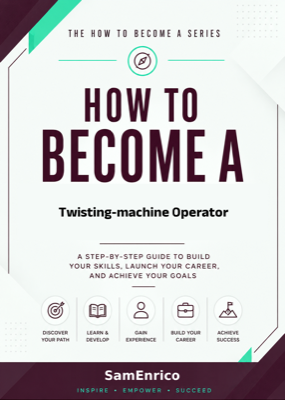
How to Become a Twisting-machine Operator
How to Become a Twisting-machine Operator
by Harman Zana
How to Become a Twisting-machine Operator
Formats
About this book
Free sample
Below is an in-depth summary of each chapter for the book "How to Become a Twisting-machine Operator" (working title: The Twisting Operator's Handbook), based strictly on the outline and source material you provided.Introduction The introduction positions the twisting-machine operator as the unsung hero of the textile industry. It explains that while spinning creates single strands of yarn, twisting combines them into stronger, more uniform, and more usable products—everything from durable denim to fine sewing thread. The reader is given a brief overview of the journey from raw fiber (cotton, wool, polyester) to finished fabric, highlighting the critical, often overlooked role of the twisting step. Finally, the introduction outlines the career opportunities available in modern manufacturing, from entry-level operator to quality control specialist or shift supervisor, setting an aspirational tone for the book.Part I: The Foundation of Twisting Chapter 1: A Textile World Overview – From Fiber to Finished Yarn This chapter provides the necessary industry context. It begins with a brief history of textile manufacturing, from hand spinning to the Industrial Revolution to modern automated mills.
It then introduces the major fiber types: natural (cotton, wool, linen, hemp, jute) and synthetic (polyester, nylon). The reader learns the sequential stages of yarn production: blowing (cleaning), carding (aligning), drawing (blending and straightening), roving (lightly twisting into a manageable strand), spinning (creating single yarn), and finally twisting (combining multiple single yarns into plied yarn or adding extra twist for strength). The chapter concludes by explaining why twisting is essential—it improves tensile strength, abrasion resistance, smoothness, and uniformity, directly affecting fabric quality.Chapter 2: Understanding the Twisting Machine This chapter is a mechanical deep dive. It breaks down the three primary types of twisting machines:Ring Twisters: Traditional, using rings and travelers to insert twist.Two-for-One (TFO) Twisters: High-efficiency machines that insert two twists per spindle revolution.Up-Twisters: Used for coarse or specialty yarns.A detailed diagram (described in text) labels key parts: spindles, rings, travelers, yarn balloons (the flaring shape of yarn as it twists), tensioners, yarn guides, and take-up packages (bobbins or tubes). The chapter then explains the principles of twist: S-twist vs.…
This is the end of the free sample. Get the eBook to keep going. Buy now
Contents
- Chapter 1
- Chapter 2
- Chapter 3
- Chapter 4
- Chapter 5
- Chapter 6
- Chapter 7
- Chapter 8
- Chapter 9
- Chapter 10
- Chapter 11
- Chapter 12
Details
- Author
- Harman Zana
- Publisher
- SamEnrico
- Language
- English
- ISBN
- 9781506061832
- Genre
- Non-Fiction, Informative, Educational
- Released
- 2026-06-02
- Pages (approx.)
- 148
- Available as
- eBook, Paperback, Audiobook

Read better in the ZLOADR app
Your eBooks on your phone or tablet. Sign in with your SamEnrico account and start reading.
More by Harman Zana
 North America Consumer ForecastHarman Zana$11.99
 Treasure Chest Visualization GuideHarman Zana$11.99
 MBSR For Overwhelm CourseHarman Zana$11.99
 Trauma Response Types HandbookHarman Zana$11.99
 The Authority Persuasion FrameworkHarman Zana$11.99
 Starlight and Stardust: The Celestial Love of Hatshepsut and SenenmutHarman Zana$11.99
 Affiliate Terms of Service GuideHarman Zana$12.99
 Online Tutoring Contract and PoliciesHarman Zana$12.99
 WaltzHarman Zana$11.99
 Understanding Osteoporosis Macrocephaly Mental Retardation BlindnessHarman Zana$17.99
You may also like
 Hong Kong Handover 1997Dunn Johnnie$11.99
 Zumba For Postnatal Recovery CourseNeal Christian$11.99
 Zumba for BeginnersLadner Nikia$11.99
 YouTube Comment Mining GuideHumes Pandora$12.99
 Worry Box MeditationCarlin Rudy$11.99
 Workplace Stress MeditationNguyen Lynn$11.99
 Workplace Stress and Sleep RepairHawley Ivory$11.99
 Workplace Perfectionism CureDelaney Jeffry$11.99
 Workplace Injustice Anger GuideWallen Isabelle$11.99
 Work Addiction and Burnout LinkGreenwood Ester$11.99
 Women in Yoga and WellnessBeattie Galina$11.99
 Women in Stand Up ComedyChun Evangeline$11.99