
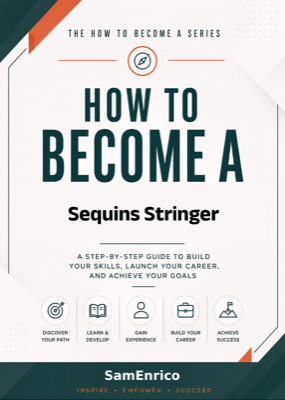
Non-FictionInformativeEducational
How to Become a Sequins Stringer eBook
How to Become a Sequins Stringer
by Cintron Kory
How to Become a Sequins Stringer
Formats
Free sample
Chapter 1: The Sparkle Secret...--For three centuries, the world’s most glamorous garments—the gowns worn by royalty at coronations, the dresses that swept across Oscar red carpets, the jackets that defined rock and roll—have shared a hidden thread. That thread connects not just sequins but secrets. The ateliers of Paris, the costume departments of Broadway, and the workrooms of London’s Savile Row have guarded their embellishment techniques like alchemists protecting the formula for gold. They understood something that the average craft book has never dared to admit: sequins are not decoration. Sequins are power.If you are holding this book, you have likely felt that power without being able to name it.
Perhaps you saw a vintage jacket at a thrift store—the kind with hundreds of tiny mirrors catching the fluorescent light—and you ran your fingers over its surface, wondering how anyone could have spent so many hours creating something so utterly unnecessary and yet so completely magnetic. Perhaps you watched a music video where the performer’s costume seemed to explode with every movement, and you thought, “I want to make something that does that.” Or perhaps you simply opened your closet one morning, looked at a plain black dress, and imagined it transformed.Here is the truth that the fashion industry has spent generations obscuring: stringing sequins is not difficult. It requires patience, yes. It requires attention to detail, absolutely. But the core techniques can be learned by anyone with working hands and the willingness to sit still for an hour.
The real barrier has never been skill. The barrier has been access to the secret.This chapter will tear down that barrier. By the time you finish reading, you will understand not just the history of sequined embellishment but why that history has been deliberately hidden from home crafters. You will learn how a single garment made of beetle wings from ancient Egypt connects to a custom denim jacket you could sell on Etsy next week. And you will discover the one truth that every successful sequins stringer knows but almost never shares: the craft is far easier than it looks, and the only thing standing between you and your first finished piece is the belief that you need permission to start.The Conspiracy of the Couture Houses Let us begin with a scandal.
In 1950, the French fashion house of Christian Dior employed nearly one thousand artisans in its ateliers. Among them were fewer than fifty sequins stringers, known in French as piqueurs de sequins. These women—and they were almost exclusively women—worked in a locked room on the top floor of the Avenue Montaigne headquarters. They were paid by the hour, not by the piece, which was unusual for the garment trade. When asked why, Dior’s production manager explained that the stringers were not allowed to take their work home, not allowed to discuss their techniques with other employees, and not allowed to keep any materials—not even broken sequins—after their shifts ended.Why such secrecy?
Because Dior understood that the sequined evening gown was his most profitable product line. A plain wool dress might sell for fifty dollars in 1950s currency. A sequined version of that same dress could sell for five hundred dollars or more. The only difference was the labor of a few stringers working behind a locked door. If those techniques became widely known, if department stores could train their own in-house embroiderers, Dior’s margin would collapse.This pattern repeated across the fashion capitals of the world.
In New York, the garment district’s sequin specialists worked in union shops with strict rules against moonlighting or teaching outsiders. In London, the Royal School of Needlework trained sequin artists for the crown but refused to publish its instructional materials until 1992. In Milan, the maestri del riccio (masters of the curl) passed their techniques from parent to child, never to paper. For three hundred years, sequin stringing was a closed craft, accessible only to those born into it or apprenticed into silence.The result is that the average person today knows less about how to attach a sequin than a medieval peasant knew about brewing ale. Ale recipes were shared freely in taverns and households.
Sequin techniques were hoarded like state secrets. And the consequence of that hoarding is that you, the reader, have likely spent years believing that embellishment is too hard, too slow, or too expensive to learn.It is not. The only expensive thing about sequin stringing is ignorance of how simple it truly is.The Three-Thousand-Year Head Start Before we dismantle the myth of difficulty, we must honor the craft’s actual origins. Sequin-like embellishment predates written history. The earliest known examples come from the Indus Valley civilization, circa 2500 BCE, where gold discs no larger than a lentil were stitched onto ceremonial burial clothes.
These were not sequins as we know them—they were hammered metal, each one unique—but the principle was identical: small, flat, reflective objects attached in patterns to catch the light of torches and, later, the sun.The ancient Egyptians perfected the technique around 1500 BCE. Howard Carter’s excavation of King Tutankhamun’s tomb in 1922 revealed hundreds of garments covered in tiny gold discs and, more surprisingly, beetle wings. The wings of the Sternocera aequisignata beetle, native to Southeast Asia, have a natural iridescence that rivals any synthetic sequin. Egyptian embalmers and tailers imported these beetles by the thousands, removed the wings by hand, and stitched them onto linen using thread made from flax. When Carter held one of these garments up to the light of his lantern, the wings still shimmered.
They had been buried for thirty-three centuries.The Mughal Empire of India (1526–1857) elevated sequin work to an art form that has never been surpassed. Mughal zardozi embroidery used real gold and silver thread to attach sequins made from the same precious metals. A single court jacket might take five years to complete and require the labor of two hundred artisans. The sequins were not uniform—each was hammered individually, then polished with agate stones, then pierced with a steel needle heated red-hot to melt a clean hole. Mughal sequin work was so valuable that garments were often dismantled and the materials reused across multiple generations.
A mother’s wedding jacket became a daughter’s ceremonial shawl, its sequins transferred one by one.The transition to mass production began in France in the 1820s, when a metallurgist named Jean-Baptiste Cartier (no relation to the jeweler) developed a die-casting method for creating identical metal sequins by the thousands. For the first time, sequins were no longer reserved for royalty. The middle classes could afford jackets and reticules (small handbags) adorned with machine-stamped metal discs. By the 1850s, the French town of Saint-Étienne had become the world capital of sequin manufacturing, producing more than fifty tons of metal sequins annually.The modern plastic sequin was born in 1933, when a Du Pont chemist named Wallace Carothers (the same man who invented nylon) discovered that cellulose acetate could be stamped into thin, lightweight discs that cost a fraction of metal sequins. The timing was perfect for Hollywood’s golden age.…
This is the end of the free sample. Get the eBook to keep going. Buy now
About this book
Details
- Author
- Cintron Kory
- Publisher
- SamEnrico
- Language
- English
- ISBN
- 9781506059280
- Genre
- Non-Fiction, Informative, Educational
- Released
- 2026-05-11
- Pages (approx.)
- 145
- Available as
- eBook, Paperback, Audiobook

Read better in the ZLOADR app
Your eBooks on your phone or tablet. Sign in with your SamEnrico account and start reading.
More by Cintron Kory
 Child Star Co-Star RelationshipsCintron Kory$11.99
 Breath Rhythm StabilizationCintron Kory$11.99
 Elon Musk Flamethrower MarketingCintron Kory$11.99
 The Betrayal Stress After Affair GuideCintron Kory$11.99
 PNE for Accident VictimsCintron Kory$11.99
 The Kegworth Air Disaster: A Trial That Redefined Aviation SafetyCintron Kory$11.99
 Event Tent SetupCintron Kory$11.99
 Wyoming LLC Foreign Owner WorkbookCintron Kory$12.99
 Digital Divide in ConsumptionCintron Kory$12.99
 Understanding Listeria InfectionCintron Kory$17.99
You may also like
 Hong Kong Handover 1997Dunn Johnnie$11.99
 Zumba For Postnatal Recovery CourseNeal Christian$11.99
 Zumba for BeginnersLadner Nikia$11.99
 YouTube Comment Mining GuideHumes Pandora$12.99
 Worry Box MeditationCarlin Rudy$11.99
 Workplace Stress MeditationNguyen Lynn$11.99
 Workplace Stress and Sleep RepairHawley Ivory$11.99
 Workplace Perfectionism CureDelaney Jeffry$11.99
 Workplace Injustice Anger GuideWallen Isabelle$11.99
 Work Addiction and Burnout LinkGreenwood Ester$11.99
 Women in Yoga and WellnessBeattie Galina$11.99
 Women in Stand Up ComedyChun Evangeline$11.99