
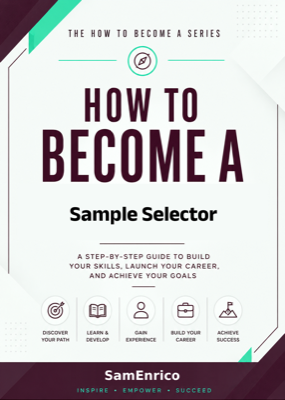
Non-FictionInformativeEducational
How to Become a Sample Selector eBook
How to Become a Sample Selector
How to Become a Sample Selector
Formats
Free sample
Chapter 1: The Picker’s Gift...–- Maya’s hands hovered over the cardboard box like a safecracker hesitating before the final tumbler. The box was unmarked, coffee-stained, and had been sitting in the corner of her friend’s garage for three years. Inside, according to rumor, were forty-seven forgotten vinyl records—soundtracks to Italian horror films, private press funk 45s, and at least one library music record that had never been digitized. Maya wasn’t a DJ. She wasn’t a musician, not in the traditional sense.
She couldn’t read sheet music, and her attempts at playing keyboard usually ended with her watching You Tube tutorials instead of practicing. But she had something else. Something she had never been able to name.She pulled out the first record. The sleeve was water-damaged, the vinyl itself coated in a fine layer of garage dust. She blew on it gently, then held it up to the single bare bulb hanging from the ceiling.
No deep scratches. Good. She placed it on the portable turntable she had brought, dropped the needle on the first track, and listened.The first thirty seconds were nothing—a cheesy orchestral swell, the kind of thing you would hear in a 1970s travel commercial. But at thirty-one seconds, something shifted. A drum break.
Four bars. Snare, kick, hi-hat, then a ghost note on the two-and-a-half that made her chest tighten. The drummer had hit the snare slightly behind the beat, dragging it just enough to feel human, tired, real. Maya rewound. Listened again.
Rewound. Listened again. She pulled out her phone and recorded fifteen seconds of audio. Then she sent it to a producer friend with a single message: Is this usable?The friend replied within two minutes: Where did you find this? This break is insane.Maya smiled.
She had just done something she had done a thousand times before, but for the first time, she understood what it meant. She hadn’t created that drum break. She hadn’t written it, performed it, or mixed it. But she had found it. In a box of forty-seven records, most of which were unlistenable schlock, she had pulled out the one that mattered.
She had selected.And that, she would later learn, was a skill worth more than she ever imagined.The Invisible Job You Already Know How to Do Here is a strange truth about the twenty-first century: we are drowning in abundance and starving for discernment. Every day, humanity generates 2.5 quintillion bytes of data. Streaming platforms add forty thousand new tracks to their libraries every twenty-four hours. The global fashion industry produces more than one hundred billion garments annually, most of which are never sold. There is too much music, too much fabric, too much stuff, too much noise.
And yet, the people who can look at the too-much and pull out the just-right—those people are more valuable than ever.They just don’t have a good name.In the music industry, they are called beatmakers, crate diggers, or sample flippers. In manufacturing, they are called quality control clerks, sample coordinators, or fabric inspectors. In technology, they are called data curators, annotation specialists, or feature selectors. These jobs exist in different buildings, use different tools, and pay different salaries. But they are the same job.
Every single one of them is asking the same question: Of everything in front of me, what is worth keeping?This book calls that person a Sample Selector. It is not a job title you will find on Linked In. Not yet. But it is a role that exists in every industry that touches physical goods, creative media, or digital information. And the people who do it well share a set of invisible skills that no one ever taught them—skills they usually discovered by accident, often while being told they were being "too picky."This chapter is about that moment of discovery.
It is about understanding that your pickiness, your attention to tiny differences, your inability to ignore the snare hit that sits slightly behind the beat—these are not personality flaws. They are the raw materials of a professional skill set. This chapter will help you recognize whether you already have The Picker’s Gift and, if you do, how to stop apologizing for it and start building a career around it.The Curse of Being "Too Picky"Before we talk about careers, we need to talk about shame. Because most Sample Selectors arrive at this skill backward. They spend years being told that they are difficult, demanding, or obsessive.Think about your own life.
Have you ever been in a group of people listening to music, and someone puts on a song that makes everyone else nod along, but you feel a physical discomfort because the snare sound is wrong? Have you ever been shopping for clothes, and you rejected seven nearly identical black t-shirts because the stitching on the collar was uneven, while your friend grabbed the first one and said, "It’s fine"? Have you ever looked at a spreadsheet and felt a crawling sense of wrongness because the formatting was inconsistent, even though the numbers were correct?If you answered yes to any of those questions, you have experienced The Curse of the Selector. It feels like a curse because other people do not see what you see. They think you are being difficult.
They say things like "It’s close enough" or "Nobody will notice" or "You’re overthinking it." And over time, you might have started to believe them. You might have learned to suppress your instincts, to swallow your objections, to tell yourself that being picky is a liability.Here is the reframe: you were right. They were wrong. And the reason they were wrong is that they were not accountable for the outcome.When someone says "It’s close enough," what they are really saying is "I am not responsible for what happens next." But the Sample Selector is responsible. If you are selecting a drum break for a producer, and you choose the wrong one, the producer wastes hours trying to make it work.
If you are selecting fabric for a clothing line, and you approve a batch with inconsistent dye, the factory sews thousands of garments that will be returned. If you are selecting data for a machine learning model, and you include noisy or mislabeled examples, the AI learns the wrong patterns and fails in production."Close enough" is not a standard. It is an abdication. And the people who refuse to abdicate—the ones who keep looking, keep listening, keep comparing until they find the right sample—those are the people who get trusted with important work.The Archivist and the Arbiter: Two Halves of the Same Gift Let us get more specific about what The Picker’s Gift actually is. It is not one skill.
It is two skills that work together, and most people lean too heavily on one or the other.The first half is the Archivist. The Archivist preserves things. The Archivist loves the dusty crate, the forgotten folder, the overlooked album track that never got radio play. The Archivist says, "This…
This is the end of the free sample. Get the eBook to keep going. Buy now
About this book
Details
- Author
- Chamberlain Barrie
- Publisher
- SamEnrico
- Language
- English
- ISBN
- 9781506044156
- Genre
- Non-Fiction, Informative, Educational
- Released
- 2026-05-09
- Pages (approx.)
- 149
- Available as
- eBook, Paperback, Audiobook

Read better in the ZLOADR app
Your eBooks on your phone or tablet. Sign in with your SamEnrico account and start reading.
More by Chamberlain Barrie
 Team Creative Pause GuideChamberlain Barrie$11.99
 Mindfulness for Healthcare WorkersChamberlain Barrie$11.99
 College Student Growth GuideChamberlain Barrie$11.99
 Morning Commute Calm GuideChamberlain Barrie$11.99
 Ho oponopono HealingChamberlain Barrie$11.99
 The Leadership OKR GuideChamberlain Barrie$11.99
 Borneo Jungle SurvivorChamberlain Barrie$11.99
 Outsourcing for PhotographersChamberlain Barrie$11.99
 The Oracle of Delphi: AI’s Ancient PredecessorChamberlain Barrie$11.99
 The Ballad of the Last Buffalo Soldiers: A Forgotten Cavalry’s StandChamberlain Barrie$11.99
 The Essential Guide to Christmas: ClassicChamberlain Barrie$11.99
 How to Produce Embroidery CraftsChamberlain Barrie$11.99
You may also like
 Hong Kong Handover 1997Dunn Johnnie$11.99
 Zumba For Postnatal Recovery CourseNeal Christian$11.99
 Zumba for BeginnersLadner Nikia$11.99
 YouTube Comment Mining GuideHumes Pandora$12.99
 Worry Box MeditationCarlin Rudy$11.99
 Workplace Stress MeditationNguyen Lynn$11.99
 Workplace Stress and Sleep RepairHawley Ivory$11.99
 Workplace Perfectionism CureDelaney Jeffry$11.99
 Workplace Injustice Anger GuideWallen Isabelle$11.99
 Work Addiction and Burnout LinkGreenwood Ester$11.99
 Women in Yoga and WellnessBeattie Galina$11.99
 Women in Stand Up ComedyChun Evangeline$11.99