
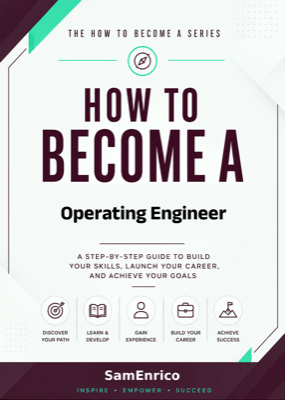
Non-FictionInformativeEducational
How to Become a Operating Engineer Paperback
How to Become a Operating Engineer
How to Become a Operating Engineer
Formats
Free sample
Chapter 1: Beyond the Levers...--Every year, thousands of ambitious men and women climb into the cab of a bulldozer, a crane, or a boiler room chair, convinced they know what an operating engineer does. Most of them are wrong. They imagine a career defined by brute force—pulling levers, pushing dirt, and collecting a paycheck. But that image, while not entirely false, misses the essence of one of the most misunderstood and financially rewarding blue-collar professions in North America. The truth is that an operating engineer is not merely a machine operator.
You are a master of systems—whether mechanical, hydraulic, pneumatic, or digital—and your judgment can mean the difference between a building rising safely to the sky or collapsing into a heap of twisted steel and litigation.This book exists to correct the record. It is not a romanticized collection of war stories from the job site, nor is it a dry, impenetrable textbook full of equations you will never use. Instead, it is a practical, boots-on-the-ground roadmap designed to take you from complete novice to certified professional, whether you end up running a 100-ton excavator on a highway expansion or managing a bank of high-pressure boilers in a downtown hospital. But before you can study load charts or memorize steam tables, you need to understand the fundamental question: What, exactly, is an operating engineer in the twenty-first century?The Two Pillars of a Hidden Profession Most people outside the trade believe that "operating engineer" is just a fancy title for a heavy equipment operator. That is only half the story.
In reality, the profession splits into two distinct but equally vital pillars. The first, and more widely recognized, is the Construction Operating Engineer. These are the men and women you see on road crews, building sites, and mining operations, commanding machines like bulldozers, excavators, motor graders, scrapers, backhoes, endloaders, skid steers, and—most famously—cranes of every size, from telescopic boom truck cranes to towering lattice boom crawlers that can lift bridge beams like toothpicks.The second pillar is the Stationary Operating Engineer. You will never see them on a highway billboard or in a viral video of a dramatic lift. They work inside buildings: power plants, hospitals, university campuses, data centers, large commercial high-rises, manufacturing facilities, and district energy plants.
Their tools are not tracks and buckets but boilers, steam turbines, chillers, cooling towers, air handlers, pumps, compressors, and the increasingly sophisticated building automation systems (BAS) that tie everything together. While the construction engineer shapes the land, the stationary engineer conditions the indoor environment and generates the power that makes modern life possible.Why does this distinction matter? Because the two paths require different temperaments, different training, and different certifications. A construction engineer must love the outdoors, tolerate extreme weather, travel from site to site, and develop an almost instinctive feel for how soil behaves under tracks and blades. A stationary engineer works shift schedules indoors, often in windowless control rooms, and must develop a deep analytical understanding of thermodynamics, fluid dynamics, and electrical control systems.
One is not better than the other. They are simply different. And this book will guide you through both, helping you decide which path fits your personality and goals.Debunking the Myth: Why "Engineer" Is Not a Lie If you do not have a four-year engineering degree, can you legally call yourself an engineer? In most other professions, the answer would be no. But operating engineering is different, and the reason is rooted in history, law, and liability.
Unlike the term "architect" or "professional engineer" (P.E.), which are strictly regulated in all fifty states, the title "operating engineer"…
This is the end of the free sample. Get the Paperback to keep going. Buy now
About this book
Details
- Author
- Hadley Kimber
- Publisher
- SamEnrico
- Language
- English
- ISBN
- 9781505757255
- Genre
- Non-Fiction, Informative, Educational
- Released
- 2026-05-11
- Pages (approx.)
- 145
- Available as
- eBook, Paperback, Audiobook

Read better in the ZLOADR app
Your eBooks on your phone or tablet. Sign in with your SamEnrico account and start reading.
More by Hadley Kimber
 Freedom Riders StoryHadley Kimber$11.99
 Emotional Dependency RecoveryHadley Kimber$11.99
 Body Scan Meditation For BeginnersHadley Kimber$11.99
 The Cash Only Spending SystemHadley Kimber$11.99
 Nairobi Media Production HubHadley Kimber$11.99
 The Duke Who Dared: The Secret Diplomatic Coup of 1815Hadley Kimber$11.99
 Understanding Pseudoaminopterin SyndromeHadley Kimber$17.99
 Director of Software EngineeringHadley Kimber$11.99
 Excel Solver Comparative StaticsHadley Kimber$12.99
 Employee Monitoring Legal TrapHadley Kimber$12.99
You may also like
 Hong Kong Handover 1997Dunn Johnnie$11.99
 Zumba For Postnatal Recovery CourseNeal Christian$11.99
 Zumba for BeginnersLadner Nikia$11.99
 YouTube Comment Mining GuideHumes Pandora$12.99
 Worry Box MeditationCarlin Rudy$11.99
 Workplace Stress MeditationNguyen Lynn$11.99
 Workplace Stress and Sleep RepairHawley Ivory$11.99
 Workplace Perfectionism CureDelaney Jeffry$11.99
 Workplace Injustice Anger GuideWallen Isabelle$11.99
 Work Addiction and Burnout LinkGreenwood Ester$11.99
 Women in Yoga and WellnessBeattie Galina$11.99
 Women in Stand Up ComedyChun Evangeline$11.99