
Non-FictionInformativeEducational
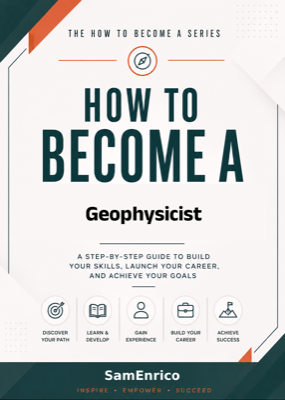
How to Become a Geophysicist eBook
How to Become a Geophysicist
How to Become a Geophysicist
Formats
Free sample
Chapter 1: The Invisible Frontier...–- Every day, you walk across a hidden world. Beneath your feet—whether you are standing on a city sidewalk, a grassy field, or the deck of a ship—lies a realm of immense complexity, violent energy, and staggering resources. Mountains of molten iron churn thousands of kilometers below. Ancient seabeds, compressed into stone, hold the fossilized remains of creatures that died before trees evolved. Water that fell as rain during the last ice age flows through cracks in bedrock invisible to any satellite.
And somewhere in that darkness, a geophysicist is reading its secrets.This book is not a dry textbook. It is not a collection of equations to memorize or a historical catalog of famous scientists. It is a roadmap. A strategic, practical, and occasionally awe-inspiring guide to becoming a geophysicist in the twenty-first century. If you have ever wondered how prospectors find gold buried under a kilometer of rock, how engineers know where it is safe to build a skyscraper, or how scientists detected a marsquake on a planet 200 million kilometers away, you are already thinking like a geophysicist.
You just have not learned the language yet.What This Chapter Will Do For You By the end of this chapter, you will understand exactly what geophysics is and why it matters more today than at any point in its history. You will be able to distinguish between the major branches of the field—global, exploration, and environmental geophysics—and see how they overlap in unexpected ways. You will have a clear map of the industries, government agencies, research institutions, and non-traditional career paths that hire geophysicists. More importantly, you will know which sectors are growing, which are shrinking, and where the exciting frontiers lie. Finally, you will confront an honest answer to a question most career guides avoid: Is geophysics a good career choice for you?Let us begin by dispelling the most common myth about this field.The Great Misconception: Geophysicists Just Study Rocks If you tell someone you are studying to become a geophysicist, prepare for blank stares.
“So… you like, look at rocks?” or “Isn’t that just geology with extra steps?” The confusion is understandable. The word “geophysics” combines “geo” (Earth) and “physics” (the laws of matter, energy, motion, and fields). But the simplest definition is also the most powerful: Geophysics is the application of physical principles to see the invisible.Consider what a geologist does. A geologist can walk up to an outcrop, examine the layers of rock, identify fossils, measure the orientation of folds and faults, and make a remarkable map of what is visible at the surface. That is essential work.
But what lies underneath? What is the shape of a granite intrusion five hundred meters below a forest? Is there a fault hidden beneath a suburb? Where does the groundwater flow? A geologist cannot answer these questions with a hand lens and a rock hammer alone.A geophysicist can.By measuring tiny variations in gravity, the faint whisper of Earth’s magnetic field, the speed of seismic waves generated by a controlled explosion or a distant earthquake, and the way electrical currents flow through the ground, geophysicists build pictures of the subsurface without ever digging a hole.
In fact, the deepest hole ever drilled—the Kola Superdeep Borehole in Russia—reaches only 12.2 kilometers. Earth’s radius is 6,371 kilometers. We have scratched less than 0.2% of the way to the center. Everything we know about the deep Earth—the molten core, the churning mantle, the strange structures at the core-mantle boundary—comes not from drilling, but from geophysics.So when someone asks what a geophysicist does, you can answer: “We listen to earthquakes. We weigh mountains.
We sense the magnetic ghosts of ancient volcanoes. We see the invisible.”The Three Pillars of Geophysics To organize this vast field, geophysicists typically divide their work into three broad categories. These categories overlap constantly—a mineral exploration project might use global geophysics to understand regional tectonics, exploration methods to find the ore body, and environmental methods to assess groundwater contamination from the mine. But understanding the distinctions will help you navigate your education and career choices.Pillar One: Global Geophysics Global geophysics asks the biggest questions. How did Earth form?
What drives the motion of tectonic plates? Why does Earth have a magnetic field, and why does it reverse direction every few hundred thousand years? What is happening in the deep mantle, 2,900 kilometers below our feet, where pressures are 1.4 million times atmospheric pressure and temperatures rival the surface of the Sun?This is the realm of earthquake seismology (using waves from distant quakes to probe the interior), geomagnetism (studying Earth’s protective magnetic shield and its chaotic reversals), geodesy (measuring the precise shape of Earth and how it changes over time), and heat flow physics (understanding how the planet cools). Global geophysicists work primarily in academia, government research laboratories (like the U.S. Geological Survey or the British Geological Survey), and space agencies (NASA, ESA, JAXA).
Their tools include satellite data, networks of seismic stations, supercomputers that simulate mantle convection over billions of years, and occasionally—in the case of planetary geophysicists—landers on Mars.Pillar Two: Exploration Geophysics Exploration geophysics is the most commercially driven branch. Its goal is simple: find valuable stuff underground. That includes oil and natural gas (still the economic engine of the field, despite the energy transition), geothermal reservoirs (hot water and steam that can generate clean electricity), groundwater (increasingly precious as climate change intensifies droughts), and minerals—copper for wiring, lithium for electric vehicle batteries, rare earth elements for wind turbines and defense technology, gold for electronics and investment, and uranium for nuclear power.Exploration geophysicists use many of the same methods as global geophysicists—seismic waves, gravity, magnetics, electromagnetics—but at shallower depths and higher resolution. Instead of imaging the entire mantle, they might image a sedimentary basin down to five kilometers to find an oil trap. Instead of mapping the core-mantle boundary, they might map a buried river channel that hosts gold-bearing gravels.
The work is project-based, often conducted by private companies (oil majors, mining corporations, geophysical contracting firms), and it pays well—but it also comes with boom-and-bust cycles tied to commodity prices.Pillar Three: Environmental and Engineering Geophysics This is the smallest branch in terms of revenue but arguably the most directly useful to society. Environmental and engineering geophysics tackles problems close to the surface—usually within the first few hundred meters. Where is the water table? Is there a cavity beneath a planned highway interchange? Where did that underground storage tank leak, and how far has the contamination spread?
Can we find buried archaeological structures without digging? Is a hillside stable, or is it slowly creeping toward a landslide?The methods are similar to exploration geophysics but scaled down. Instead of dynamite, you might use a small sledgehammer on a metal plate to generate seismic waves. Instead of an airplane carrying a magnetometer, you might drag a ground-based sensor across a field. The clients are engineering firms, environmental consultants, government agencies (departments of transportation, environmental protection agencies), and archaeologists.
The work is steadier than exploration, with fewer layoffs during downturns, but it rarely makes headlines or generates massive bonuses.Why…
This is the end of the free sample. Get the eBook to keep going. Buy now
About this book
Details
- Author
- Willett Annita
- Publisher
- SamEnrico
- Language
- English
- ISBN
- 9781505764840
- Genre
- Non-Fiction, Informative, Educational
- Released
- 2026-05-09
- Pages (approx.)
- 151
- Available as
- eBook, Paperback, Audiobook

Read better in the ZLOADR app
Your eBooks on your phone or tablet. Sign in with your SamEnrico account and start reading.
More by Willett Annita
 Twelve Step Sponsorship PrimerWillett Annita$11.99
 Emotional Validation Phrases GuideWillett Annita$11.99
 HIIT Hydration Strategy GuideWillett Annita$11.99
 Touring Cellist Suitcase SonatasWillett Annita$11.99
 The Oxford Star: How a University Launched the Space AgeWillett Annita$11.99
 The Breeder's Guide to Houdan ChickensWillett Annita$11.99
 Project Management Free to PaidWillett Annita$12.99
 Community Retention GuideWillett Annita$12.99
 Hardware System ArchitectWillett Annita$11.99
You may also like
 Hong Kong Handover 1997Dunn Johnnie$11.99
 Zumba For Postnatal Recovery CourseNeal Christian$11.99
 Zumba for BeginnersLadner Nikia$11.99
 YouTube Comment Mining GuideHumes Pandora$12.99
 Worry Box MeditationCarlin Rudy$11.99
 Workplace Stress MeditationNguyen Lynn$11.99
 Workplace Stress and Sleep RepairHawley Ivory$11.99
 Workplace Perfectionism CureDelaney Jeffry$11.99
 Workplace Injustice Anger GuideWallen Isabelle$11.99
 Work Addiction and Burnout LinkGreenwood Ester$11.99
 Women in Yoga and WellnessBeattie Galina$11.99
 Women in Stand Up ComedyChun Evangeline$11.99