
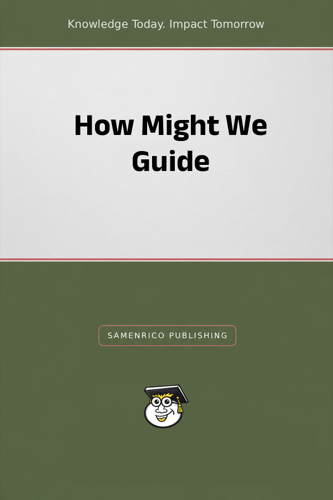
Non-FictionSelf-HelpDesign Thinking
How Might We Guide eBook
Frame challenges as opportunities using design thi
Frame challenges as opportunities using design thinking prompt language.
Formats
Free sample
Chapter 1: The Answer Trap...--We have been trained to believe that answers are valuable. From grade school pop quizzes to corporate boardrooms, the person with the fastest, most confident answer is rewarded. The raised hand. The decisive leader. The one who says, “I’ll solve that,” before anyone else has even finished describing the problem.
This is the cult of the answer, and you are likely a devoted member without even knowing it.Here is the uncomfortable truth that this entire book rests upon: Answers are the enemy of innovation. Every solution you rush to creates three new problems you did not see. Every time you congratulate yourself for “fixing” something quickly, you have almost certainly locked in a set of assumptions that will need to be undone later at十倍 the cost. The most dangerous person in any meeting is not the pessimist or the naysayer. It is the person with the immediate answer.This chapter is not an introduction.
It is an intervention. Before we talk about how to craft “How Might We” questions, before we discuss empathy maps or brainstorming techniques or organizational change, we must first diagnose your addiction to answers. Because if you skip this step, every tool in the remaining eleven chapters will fail. You will simply use better methods to arrive at worse solutions faster.Welcome to the Answer Trap.The Anatomy of the Answer Trap The Answer Trap is a cognitive and social pattern where individuals or teams prematurely commit to a solution before adequately understanding the problem they are trying to solve. It feels productive.
It feels decisive. It is almost always wrong.Let me give you a concrete example. A software team at a mid-sized retail company notices that customer support tickets have increased by 40% in three months. The product manager, under pressure from leadership, calls a meeting. Within twelve minutes, the team has decided to “add a FAQ section to the help center.” They assign tasks.
They set a deadline. Two weeks later, the FAQ goes live. Ticket volume does not change. The team is confused and demoralized. They did something.
Why didn’t it work?Because they never asked: Why are tickets increasing? Is it a confusing feature? A missing onboarding step? A pricing change that generated confusion? A seasonal spike?
A bug? Each of these root causes requires a completely different solution. The FAQ was a guess dressed up as a decision. The team fell into the Answer Trap.The trap has three visible signs. Learn to spot them in yourself and others.Sign One: The “We Should Just…” Statement.
This phrase is the universal entry point to the Answer Trap. When someone says “We should just…” what follows is almost always a solution that has not been tested against the actual problem. The shorter the sentence after “just,” the more dangerous it is. “We should just add a button.” “We should just send an email.” “We should just hire more people.” These are not strategies. They are reflexes.Sign Two: The First-Solution Lock-In.
Watch what happens in your next meeting. The first plausible solution someone offers will receive disproportionate attention. It will be debated, refined, and defended. Alternative solutions will be measured against it, not explored alongside it. This is called anchoring bias, and it is the silent killer of innovation.
The team that spends forty minutes debating the color of a button has already assumed the button is the right answer.Sign Three: Implementation Speed as a Virtue. When a team congratulates itself for moving fast, check what they are moving fast on. If the celebration is about shipping a feature, launching a campaign, or making a decision, but no one can articulate the question that decision was supposed to answer, you are watching the Answer Trap in motion. Speed without direction is just velocity toward the wrong destination.Why Your Brain Loves the Answer Trap You are not stupid for falling into the Answer Trap. You are human.
Your brain is wired for answers because, for most of human history, answers kept you alive.Consider the ancestral environment. A rustle in the bushes. The person who stops to ask, “What might be making that sound? Could it be wind? Or a predator?
Let me gather more data,” is eaten by the tiger. The person who runs first and asks questions later survives. Your brain is the product of a million years of selection for fast answers, not accurate questions. The cognitive bias toward action over reflection is not a bug. It was a feature for survival.The problem is that you no longer live in the savanna.
You live in organizations, markets, and systems where the causal chains are long, the feedback loops are slow, and the cost of being wrong is not death but wasted time, money, and morale. The brain that kept your ancestors alive is now sabotaging your innovation efforts. Every time you feel the urgent need to “just do something,” you are experiencing an evolutionary mismatch.There is a second force at work: social pressure. In most organizations, answers are status signals. The person who speaks first, who has a point of view, who seems certain—that person is perceived as a leader.
The person who pauses, who asks questions, who admits uncertainty—that person is perceived as weak, indecisive, or unprepared. We have built career incentives around the appearance of knowing, not the reality of discovering.This is why the Answer Trap is so hard to escape. It is not just a cognitive habit. It is a social performance. When you refuse to offer an answer, you are not just fighting your own brain.
You are fighting the expectations of everyone in the room.The Hidden Cost of Premature Answers Let me be precise about the damage the Answer Trap causes, because vague warnings about “innovation” will not change your behavior. The costs are concrete, measurable, and cumulative.Cost One: Solving the Wrong Problem. This is the most expensive failure mode in business. When you solve the wrong problem, you do not get zero value. You get negative value because you have consumed resources, created organizational debt, and delayed the discovery of the actual problem.
A study of 250 product teams found that teams who spent less than 20% of their time on problem definition were three times more likely to build features that were rarely or never used. They were busy. They were productive. They were wrong.Cost Two: Consensus Around Mediocrity. The Answer Trap produces the illusion of alignment.
When someone offers an early solution, the team often agrees to it not because it is the best idea but because agreeing is easier than exploring alternatives. This creates a false consensus that crumbles as soon as the solution hits reality. I have watched teams spend months building a feature that no one actually believed in, simply because no one wanted to be the person who said, “Wait, are we sure this is the right question?”Cost Three: The Erosion of Creative Confidence. When leaders consistently reward fast answers over good questions, team members learn to suppress their curiosity. The junior designer with a half-formed insight about user behavior learns to keep…
This is the end of the free sample. Get the eBook to keep going. Buy now
About this book
Details
- Author
- Hoyle Rosario
- Publisher
- SamEnrico
- Language
- English
- Genre
- Non-Fiction, Self-Help, Design Thinking
- Released
- 2026-06-10
- Pages (approx.)
- 130
- Available as
- eBook, Audiobook

Read better in the ZLOADR app
Your eBooks on your phone or tablet. Sign in with your SamEnrico account and start reading.
More by Hoyle Rosario
 Growth Mindset Role ModelsHoyle Rosario$11.99
 Letting Go of ComparisonHoyle Rosario$11.99
 The OKR for Remote TeamsHoyle Rosario$11.99
 Mindful Eating for BeginnersHoyle Rosario$11.99
 IoT Connected Logistics OutlookHoyle Rosario$11.99
 Delegation for HR DirectorsHoyle Rosario$11.99
 Aggressive Driver DefusingHoyle Rosario$11.99
 The Quiet Betrayal: How a Single Leak Toppled a Tech GiantHoyle Rosario$11.99
 The Golden Voice of the Orient: Teresa Teng and the Opera That Captivated AsiaHoyle Rosario$11.99
 How to Produce Push and Pull ToysHoyle Rosario$11.99
 The Essential Guide to Hardcore RapHoyle Rosario$11.99
 Mailchimp API First StepsHoyle Rosario$12.99
You may also like
 Hong Kong Handover 1997Dunn Johnnie$11.99
 Zumba For Postnatal Recovery CourseNeal Christian$11.99
 Zumba for BeginnersLadner Nikia$11.99
 YouTube Comment Mining GuideHumes Pandora$12.99
 Worry Box MeditationCarlin Rudy$11.99
 Workplace Stress MeditationNguyen Lynn$11.99
 Workplace Stress and Sleep RepairHawley Ivory$11.99
 Workplace Perfectionism CureDelaney Jeffry$11.99
 Workplace Injustice Anger GuideWallen Isabelle$11.99
 Work Addiction and Burnout LinkGreenwood Ester$11.99
 Women in Yoga and WellnessBeattie Galina$11.99
 Women in Stand Up ComedyChun Evangeline$11.99