
Non-FictionHistoryPolitical History
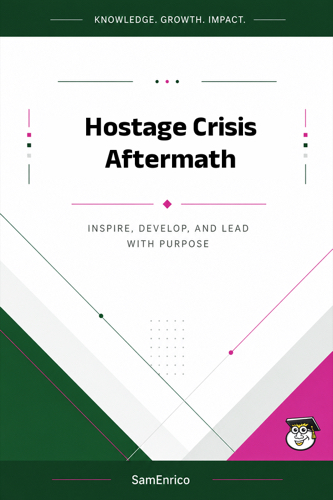
Hostage Crisis Aftermath
Examine how the 444 day siege affected US politics
Examine how the 444 day siege affected US politics and Middle East policy.
Formats
About this book
Free sample
Chapter 1: The Shah’s Shadow--The winter of 1978 found Washington, D.C., wrapped in an unusual silence regarding its most important ally in the Middle East. While American diplomats hosted receptions for the Shah of Iran’s sister at the Iranian embassy, and while National Security Adviser Zbigniew Brzezinski sent handwritten notes of encouragement to the ailing monarch, a very different reality was unfolding 6,000 miles away. In the holy city of Qom, tens of thousands of mourners had taken to the streets following the death of a revered cleric’s son. In Tehran, striking bazaar merchants were shutting their shops in a traditional act of protest that had, for centuries, signaled the collapse of political trust. And in Paris, an eighty-year-old man in a black turban and flowing robes was recording cassette tapes on a cheap reel-to-reel machine, tapes that would be smuggled into Iran and duplicated by the thousands, tapes that called for the overthrow of what he called “the American emperor’s puppet.”The American president, Jimmy Carter, had toasted the Shah at a New Year’s Eve gala in Tehran just one year earlier, calling Iran “an island of stability in one of the most troubled areas of the world.” Those words, intended as a diplomatic nicety, would become one of the most bitterly mocked presidential utterances of the twentieth century.
For the “island of stability” was, in fact, a volcano, and the United States had not only built its house on its slopes but had spent twenty-five years drilling ever deeper into its magma chamber.The Accidental Empire The relationship between Washington and Tehran began not with the Shah, but with his father, Reza Shah Pahlavi, an autocratic army officer who seized power in a 1921 coup. But the alliance that truly mattered—the one that would create the conditions for the 1979 hostage crisis—was forged in the crucible of the early Cold War. In 1953, when Iran’s democratically elected prime minister, Mohammad Mossadegh, nationalized the British-controlled Anglo-Iranian Oil Company, Washington faced a dilemma. The Eisenhower administration, fearing that Mossadegh’s left-leaning nationalism would open the door to Soviet influence…
This is the end of the free sample. Get the eBook to keep going. Buy now
Contents
- Chapter 1
- Chapter 2
- Chapter 3
- Chapter 4
- Chapter 5
- Chapter 6
- Chapter 7
- Chapter 8
- Chapter 9
- Chapter 10
- Chapter 11
- Chapter 12
Details
- Author
- Arellano Anamaria
- Publisher
- SamEnrico
- Language
- English
- Genre
- Non-Fiction, History, Political History
- Released
- 2026-06-09
- Pages (approx.)
- 131
- Available as
- eBook, Audiobook

Read better in the ZLOADR app
Your eBooks on your phone or tablet. Sign in with your SamEnrico account and start reading.
More by Arellano Anamaria
 Dreams After Racial Trauma GuideArellano Anamaria$11.99
 CSAT Therapy Approaches WorkbookArellano Anamaria$11.99
 Teen PMS School Survival GuideArellano Anamaria$11.99
 The Dragonmaster's Gambit: A Medieval Espionage TaleArellano Anamaria$11.99
 The Codebreakers' War: How Women Cracked the Nazi EnigmaArellano Anamaria$11.99
 How to Start a Brush Back Made of Wood Business (Beginners Guide)Arellano Anamaria$11.99
 Understanding Hearing LossArellano Anamaria$17.99
 Renewable Energy Investment ForecastArellano Anamaria$12.99
 Cheapest Master's Degrees In Europe PrimerArellano Anamaria$12.99
 Business Unit LeaderArellano Anamaria$11.99
You may also like
 Hong Kong Handover 1997Dunn Johnnie$11.99
 Zumba For Postnatal Recovery CourseNeal Christian$11.99
 Zumba for BeginnersLadner Nikia$11.99
 YouTube Comment Mining GuideHumes Pandora$12.99
 Worry Box MeditationCarlin Rudy$11.99
 Workplace Stress MeditationNguyen Lynn$11.99
 Workplace Stress and Sleep RepairHawley Ivory$11.99
 Workplace Perfectionism CureDelaney Jeffry$11.99
 Workplace Injustice Anger GuideWallen Isabelle$11.99
 Work Addiction and Burnout LinkGreenwood Ester$11.99
 Women in Yoga and WellnessBeattie Galina$11.99
 Women in Stand Up ComedyChun Evangeline$11.99