
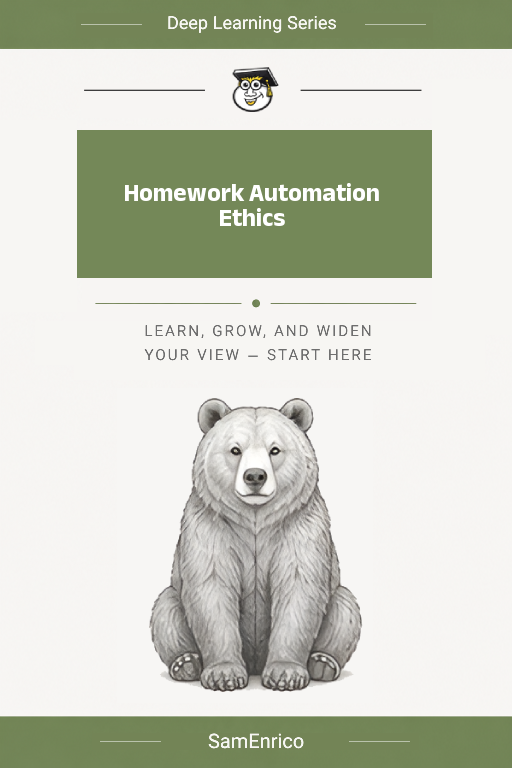
Non-FictionForecast & OutlookAI Ethics
Homework Automation Ethics eBook
Learn guidelines for AI-assisted assignments, prev
by Prince Ai
Learn guidelines for AI-assisted assignments, preventing misuse while teaching appropriate use.
Formats
Free sample
Chapter 1: The Mirror Test--The first time a student pastes a homework question into Chat GPT and copies the answer without reading it, something subtle but profound happens. It is not merely cheating in the traditional sense—not the hurried cribbing of a neighbor’s answer or the desperate purchase of a pre-written essay from an online mill. It is something quieter, more intimate, and ultimately more revealing. The student is not breaking a rule so much as taking a shortcut past the very purpose of the assignment. And in that moment, the student is also holding up a mirror.
The reflection shows not just a single act of expedience, but a set of assumptions about what education is for, what knowledge is worth, and what kind of thinker that student is becoming.This book begins with that mirror because the automation of homework is not, at its core, a technological problem. It is a human problem dressed in silicon and stochastic prediction. Generative AI—Chat GPT, Claude, Gemini, Copilot, and the dozens of other large language models now available to anyone with an internet connection—has arrived not as a villain burning down the cathedral of education, nor as a savior delivering us from the drudgery of grading five-paragraph essays. It has arrived as a test. And like any good test, it reveals what was already there: the values, pressures, and contradictions that have long haunted the relationship between teaching, learning, and assessment.The opening chapter of Homework Automation Ethics grounds the reader in the present reality that generative AI is not a future trend but a ubiquitous tool already embedded in students’ daily lives.
As of this writing, over eighty percent of college students report having used AI on at least one assignment, and more than half use it regularly. Among high school students, the numbers are lower but rising exponentially, driven not by any coordinated pedagogical movement but by the simple fact that AI is now built into the devices students already carry. Grammarly, which has evolved from a simple spell-checker into a full-sentence rewriter, is used by tens of millions of students daily. Microsoft has embedded Copilot into Word, Power Point, and Teams. Google has done the same with Gemini across its educational suite.
The question is no longer whether AI will enter the classroom. It is already there, logged in, and waiting for the next prompt.Beyond Moral Panic It would be easy, and perhaps emotionally satisfying, to treat this as a crisis. The headlines have certainly tried. “The End of the Essay,” declared one major publication. “Chat GPT Will Destroy Education,” warned another.
Professors have redesigned entire courses in panic, banning laptops, requiring handwritten exams, and threatening academic integrity proceedings for any student whose prose sounds too polished. School districts have blocked Chat GPT on their networks, only to watch students access it through their phones or home computers. Honor councils have been flooded with cases that no one quite knows how to adjudicate, because the line between “brainstorming with AI” and “having AI write the paper” is a blurry one that shifts with every new tool update.This book takes a different approach. It moves past moral panic—the fear that AI will destroy education—to a sober assessment of what these tools can and cannot do, and what they should and should not be used for. Moral panic, however satisfying in the moment, is a poor guide to policy.
It leads to bans that cannot be enforced, punishments that punish the wrong students, and a general atmosphere of surveillance and distrust that poisons the very relationships that make education possible. The students who are most harmed by panic-driven policies are not the sophisticated cheaters who will always find a way around any barrier. They are the honest students who follow the rules, the students without tech-savvy parents to help them navigate contradictory policies, the students for whom a single academic integrity violation—even an unintentional one—can derail a scholarship or a college application.Instead of panic, this book offers a framework. It begins with a simple but radical proposition: the goal of education in the age of AI is not to prevent students from using these tools, but to teach them how to use them well, ethically, and in ways that preserve—and even deepen—their own thinking. This proposition rests on a distinction that will recur throughout these pages: the difference between AI-assisted work and AI-generated work.AI-Assisted Versus AI-Generated: The Crucial Distinction AI-assisted work is work in which the student actively guides, edits, verifies, and takes responsibility for the final product.
In AI-assisted work, the student remains the author. The AI is a tool, like a calculator for a mathematician or a spell-checker for a writer. It handles routine tasks—generating a list of possible research questions, suggesting alternative phrasings, checking for consistency in argumentation—but the student makes the substantive decisions. The student decides which ideas to pursue, which evidence to include, which claims to defend. The student fact-checks the AI’s output, knowing that large language models are prone to “hallucinations” (confidently stated falsehoods).
The student adjusts for bias, recognizing that AI models trained on the public internet have absorbed and amplified the prejudices of that internet. And most importantly, the student documents what the AI contributed and what the student contributed, making the collaboration transparent.AI-generated work, by contrast, is work in which the student copies the AI’s output with minimal or no modification. The student may not even read the output carefully. The AI is not a tool but a substitute. The student has outsourced the thinking entirely, reducing themselves from a learner to a courier.
This is not always cheating in the narrow sense—if the assignment explicitly permits AI generation, and the student discloses that use, it may be technically allowed—but it is almost always a failure of learning. The student who copies an AI-generated solution to a calculus problem without understanding the steps has not learned calculus. The student who submits an AI-generated essay on The Great Gatsby without having read the novel has not engaged with Fitzgerald’s themes, language, or characters. They have simply added another entry to a database.The challenge, of course, is that the line between assistance and generation is not always bright. Is it assistance to ask the AI to rephrase a single awkward sentence?
Almost certainly yes. Is it assistance to ask the AI to rephrase every sentence in a paragraph? Possibly, but now the student’s voice is fading. Is it assistance to ask the AI to generate a paragraph from bullet points that the student provided? That depends on whether the student critically edits that paragraph, verifying its claims and adjusting its tone.
The AI Assessment Scale, introduced in detail in Chapter 4, provides a five-level taxonomy for navigating these gray areas. For now, the crucial point is that the distinction must be made, and made consciously, by both instructors and students.The AI Mirror: What Our Use Reveals About Us The concept of the “AI mirror” is introduced here as a foreshadowing of a theme that will be developed fully in the…
This is the end of the free sample. Get the eBook to keep going. Buy now
About this book
Details
- Author
- Prince Ai
- Publisher
- SamEnrico
- Language
- English
- Genre
- Non-Fiction, Forecast & Outlook, AI Ethics
- Released
- 2026-06-01
- Pages (approx.)
- 143
- Available as
- eBook, Audiobook

Read better in the ZLOADR app
Your eBooks on your phone or tablet. Sign in with your SamEnrico account and start reading.
More by Prince Ai
 Operation Car Wash Silenced WitnessesPrince Ai$11.99
 Argentine Renewable Energy LawPrince Ai$11.99
 Email Marketing For TravelPrince Ai$11.99
 Meth Skin Repair Dermatology PlanPrince Ai$11.99
 The Midnight Tunnel: The Great Escape of Frank Morris and the Alcatraz ThreePrince Ai$11.99
 When the Sky Split Open: The Maori Birth of the WorldPrince Ai$11.99
 How to Start a Pressure Switch (electronic) Business (Beginners Guide)Prince Ai$11.99
 Global BOI Compliance WorkbookPrince Ai$12.99
 Understanding Ichthyosis Deafness Mental Retardation Skeletal AnomalyPrince Ai$17.99
You may also like
 Hong Kong Handover 1997Dunn Johnnie$11.99
 Zumba For Postnatal Recovery CourseNeal Christian$11.99
 Zumba for BeginnersLadner Nikia$11.99
 YouTube Comment Mining GuideHumes Pandora$12.99
 Worry Box MeditationCarlin Rudy$11.99
 Workplace Stress MeditationNguyen Lynn$11.99
 Workplace Stress and Sleep RepairHawley Ivory$11.99
 Workplace Perfectionism CureDelaney Jeffry$11.99
 Workplace Injustice Anger GuideWallen Isabelle$11.99
 Work Addiction and Burnout LinkGreenwood Ester$11.99
 Women in Yoga and WellnessBeattie Galina$11.99
 Women in Stand Up ComedyChun Evangeline$11.99