
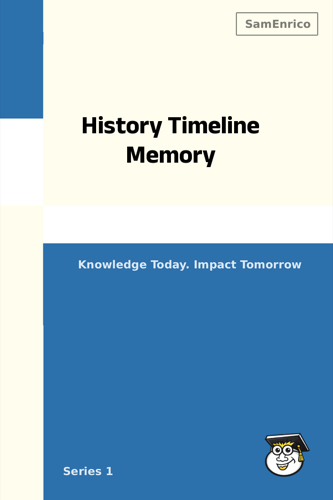
History Timeline Memory eBook
Remember chronological sequences using narrative m
by Lau Arianne
Remember chronological sequences using narrative methods.
Formats
Free sample
Chapter 1: The Great Paradox...--–- I remember the exact moment I realized my memory was broken. Not broken in the clinical sense—I could still find my car in a parking lot and recite the dialogue from The Princess Bride verbatim. But broken in a way that mattered to every classroom, every exam, and every conversation I had ever felt inadequate in. I was twenty-three years old, sitting in a graduate seminar on Cold War geopolitics, when my professor asked a seemingly simple question: "When did the Berlin Wall fall?"I knew this. Everyone knew this.
It was 1989. I could see the grainy footage in my mind—Germans standing on the wall, sledgehammers swinging, the sound of concrete cracking. I could tell you that it happened in November. I could tell you that it was autumn because people were wearing coats. I could describe the joy, the chaos, the historic weight of the moment.
But the year? 1989. Of course it was 1989. Except my mouth said "1987" and then "wait, no, 1991?" and then I just stopped talking while my face turned the color of Soviet-era propaganda posters.The professor nodded sympathetically and moved on. The student next to me, a twenty-two-year-old who had probably been born the year the wall fell, whispered "1989" without hesitation.
And I sat there, a master's student in history, defeated by a single four-digit number.Here is what is strange. That same week, I watched a three-hour documentary about the fall of the Berlin Wall. I could recount every scene. I could tell you about the East German press conference on November 9th when Günter Schabowski famously said travel restrictions were lifted "immediately, without delay." I could quote the journalist who asked "When does that take effect?" I could describe the confusion, the rush to the border crossings, the disbelief of the guards. I had absorbed the story completely.
But the date had bounced off my brain like a pea off a battleship.This is the Great Paradox. And this entire book is the solution.The Puzzle That Launched a Thousand Study Sessions You have experienced this paradox yourself, probably hundreds of times. You can remember the plot of a movie you saw once, ten years ago, on a Tuesday, in a theater with sticky floors and a broken speaker. You can remember the name of the villain, the love interest's quirky best friend, the twist at the end of the second act. But the date of the Emancipation Proclamation?
The year World War I began? The century of the Magna Carta? These float away like smoke.Consider the following experiment, which you can conduct on any friend or family member in under sixty seconds.Ask them: "Tell me the plot of Star Wars: A New Hope."They will deliver. They will describe a farm boy named Luke, a princess named Leia, a villain named Darth Vader. They will mention droids, a death star, a cantina, a trench run.
They will remember that Obi-Wan Kenobi dies and that Han Solo returns at the last moment. They might even quote lines. ("I have a bad feeling about this.") They will do all of this for a film released in 1977—nearly fifty years ago as of this writing.Now ask them: "Tell me the plot of the Peloponnesian War."Silence. Maybe a vague recollection about Athens and Sparta. Maybe the word "plague." Almost certainly no narrative.
No rising action, no climax, no resolution. Just a graveyard of forgotten facts.Here is the question that changed my professional life: Why? Why can we remember fictional stories from decades ago but not real stories that actually happened?The answer is not that you are lazy, or that you have a bad memory, or that history is inherently boring. The answer is that you have been trying to memorize history using the wrong part of your brain. You have been treating dates like items on a grocery list when you should have been treating them like scenes in a movie.The Two Memory Systems Living Inside Your Skull To understand the Great Paradox, you must first understand that your brain does not have one memory system.
It has two. And they are about as compatible as oil and water.The first is called Semantic Memory. This is your brain's filing cabinet for cold, context-free facts. The capital of North Dakota is Bismarck. Water freezes at thirty-two degrees Fahrenheit.
The Battle of Hastings was in 1066. Semantic memory is powerful and necessary—it allows you to function in the world without relearning everything every morning. But semantic memory has a critical weakness. It is disembodied. Facts in semantic memory float in a void, attached to nothing but other facts.
They have no sensory details, no emotional weight, no narrative thread. They are just... information.The second is called Episodic Memory. This is your brain's storytelling engine. Episodic memory stores events as they happened to you—or as you witnessed them in a story.
Every episode includes sensory data (what you saw, heard, felt), emotional context (how you felt then, how you feel now remembering it), and temporal sequence (this happened, then this, then this). Episodic memory is embodied. It lives in your senses and your emotions.Here is the cruel trick: history textbooks are written almost entirely for semantic memory. They present dates, names, and events as isolated facts. "In 1492, Columbus sailed the ocean blue." That is a semantic sentence.
It contains no sensory detail, no emotion, no narrative cause-and-effect. It is a fact floating in the void. And your brain, which evolved to prioritize episodic memories for survival, looks at that floating fact and shrugs. "Not important," your brain says. "No story here.
No danger. No reward. Delete."Meanwhile, a fictional movie—which is not real and never happened—gets stored in episodic memory with lavish attention. Your brain tags it with emotions, sequences, characters, and conflicts. It treats the fake story as more important than the real date.This is not a flaw in your brain.
This is a feature. Your brain is not a computer designed to store arbitrary data. Your brain is a survival machine designed to remember what happened, what caused it, and whether it will happen again. That is episodic memory. That is story.The Hijack: How to Trick Your Brain into Loving History If semantic memory is weak and episodic memory is strong, the solution is obvious: stop trying to memorize history semantically.
Start memorizing it episodically. Stop treating dates as facts. Start treating them as story beats.This is what I call The Narrative Hijack. You are going to hijack your brain's natural episodic architecture and force it to store chronological data as if it were a movie plot. You are not going to learn dates.
You are going to experience them.Let me show you the difference with the example that shamed me in that graduate seminar.Semantic approach: The Berlin Wall fell in November 1989. Repeat. Repeat. Repeat. Forget by Tuesday.Narrative hijack: Imagine you are an East Berliner named Klaus.
It is the evening of November 9, 1989. You are watching the evening news with your wife. The screen shows a flustered government…
This is the end of the free sample. Get the eBook to keep going. Buy now
About this book
Details
- Author
- Lau Arianne
- Publisher
- SamEnrico
- Language
- English
- Genre
- Non-Fiction, Self-Help, History
- Released
- 2026-06-10
- Pages (approx.)
- 146
- Available as
- eBook, Audiobook

Read better in the ZLOADR app
Your eBooks on your phone or tablet. Sign in with your SamEnrico account and start reading.
More by Lau Arianne
 The Father's Prison LettersLau Arianne$11.99
 Leptin Resistance GuideLau Arianne$11.99
 Atychiphobia Treatment WorkbookLau Arianne$11.99
 Light Exposure Therapy for Night ShiftLau Arianne$11.99
 CPR for Swimming PoolsLau Arianne$11.99
 Marathoner Self HypnosisLau Arianne$11.99
 Forgiveness Conversations GuideLau Arianne$11.99
 The Healers of Timbuktu: The Golden Script of Medical MasteryLau Arianne$11.99
 The Arsenic Inheritance: A Victorian Poisoning ScandalLau Arianne$11.99
 Onion: Bulb Onion HarvestingLau Arianne$11.99
 How to Produce Printer FiltersLau Arianne$11.99
 The Essential Guide to ClassicalLau Arianne$11.99
You may also like
 Hong Kong Handover 1997Dunn Johnnie$11.99
 Zumba For Postnatal Recovery CourseNeal Christian$11.99
 Zumba for BeginnersLadner Nikia$11.99
 YouTube Comment Mining GuideHumes Pandora$12.99
 Worry Box MeditationCarlin Rudy$11.99
 Workplace Stress MeditationNguyen Lynn$11.99
 Workplace Stress and Sleep RepairHawley Ivory$11.99
 Workplace Perfectionism CureDelaney Jeffry$11.99
 Workplace Injustice Anger GuideWallen Isabelle$11.99
 Work Addiction and Burnout LinkGreenwood Ester$11.99
 Women in Yoga and WellnessBeattie Galina$11.99
 Women in Stand Up ComedyChun Evangeline$11.99