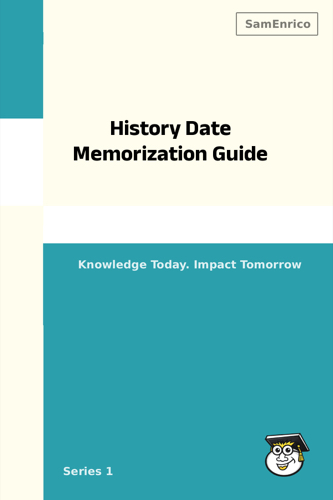
History Date Memorization Guide
Chronologically sequence events using timelines an
Chronologically sequence events using timelines and association techniques.
Formats
About this book
Free sample
Chapter 1: The Date Divide--–- The exam paper sat face down on the desk. Sixty minutes. Three essay questions. The student, a diligent junior named Marcus, had spent the last two weeks reading every chapter, highlighting every key term, and attending every review session. He knew that the Treaty of Versailles ended World War I.
He knew that the French Revolution overthrew the monarchy. He knew that the Magna Carta limited the power of the English king. He knew the stories. He knew the players. He knew the significance.The proctor said, "You may begin." Marcus flipped the paper over.Question one: "Analyze the causes of World War I, citing specific events and their chronological relationship to one another."He wrote: "The assassination of Archduke Franz Ferdinand triggered a chain reaction of alliances.
Austria-Hungary declared war on Serbia. Russia mobilized to defend Serbia. Germany declared war on Russia. France was drawn in. Germany invaded Belgium.
Great Britain declared war on Germany."His answer was correct in every detail except one. He could not remember the order. Did Austria-Hungary declare war before or after Russia mobilized? Did Germany declare war on France before or after invading Belgium? He knew the pieces.
He could not assemble them. He guessed wrong. He earned a C on an essay that should have been an A.This chapter is for Marcus. For the student who knows history but cannot sequence it. For the learner who understands the story but loses the timeline.
For anyone who has ever asked the question that haunts every history classroom: "Do I really need to memorize the exact year?"The answer is not simple yes or no. It depends entirely on what you want from history. And that is where the Date Divide begins.Two Kinds of Historical Knowledge Let us draw a distinction that will shape everything that follows. There are two ways to know history, and they serve two different purposes.The first way is narrative knowledge. This is the story of the past—the rise and fall of empires, the great movements of ideas, the arc of human progress.…
This is the end of the free sample. Get the eBook to keep going. Buy now
Contents
- Chapter 1
- Chapter 2
- Chapter 3
- Chapter 4
- Chapter 5
- Chapter 6
- Chapter 7
- Chapter 8
- Chapter 9
- Chapter 10
- Chapter 11
- Chapter 12
Details
- Author
- Allan Dorethea
- Publisher
- SamEnrico
- Language
- English
- Genre
- Non-Fiction, Self-Help, History Study
- Released
- 2026-06-09
- Pages (approx.)
- 102
- Available as
- eBook, Audiobook

Read better in the ZLOADR app
Your eBooks on your phone or tablet. Sign in with your SamEnrico account and start reading.
More by Allan Dorethea
 Etsy Digital Planner Customer InsightsAllan Dorethea$11.99
 Strategic Inflection Mapping CourseAllan Dorethea$11.99
 Sleep and ADHD MemoryAllan Dorethea$11.99
 Monk Mode Work StrategiesAllan Dorethea$11.99
 Nefertiti's Last Secret: The Pharaoh Who VanishedAllan Dorethea$11.99
 Understanding Cholestasis, Progressive Familial Intrahepatic 1Allan Dorethea$17.99
 Ultimate Handbook Guide to Papeete : (French Polynesia) Travel GuideAllan Dorethea$11.99
 Global Internal Comms ROIAllan Dorethea$12.99
 Life Coach on Mental BoardAllan Dorethea$12.99
 Licensed CounselorAllan Dorethea$11.99