
Non-FictionStudent's ShortcutHiring
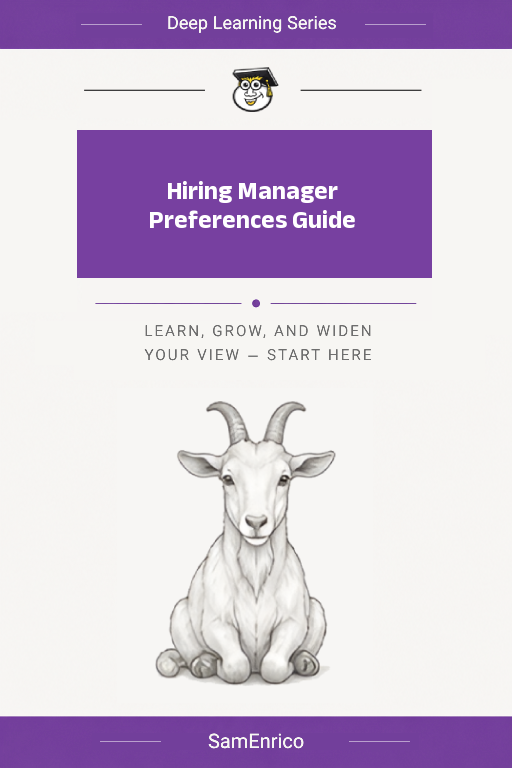
Hiring Manager Preferences Guide eBook
Survey of tech recruiters on bootcamp vs CS degree
Survey of tech recruiters on bootcamp vs CS degree preferences for entry-level roles.
Formats
Free sample
Chapter 1: The Applicant Calculus--The email arrives on a Tuesday morning, three weeks into your new role as a hiring manager. Subject line: “Urgent – Backfill Request.” You open it. Two junior developer positions. Forty-seven applicants in the first hour alone. Your recruiter has helpfully pre-screened them down to twelve “strong maybes.” Six have computer science degrees from respectable state schools.
Four are bootcamp graduates with polished Git Hub portfolios. Two are self-taught with no formal credentials but several shipped side projects. You stare at the list. Your VP has been clear: “We need people who can ship code, not theoretical debates about recursion.” But your senior engineer, the one who will have to mentor whoever you hire, has been equally clear: “Please God, no more bootcamp grads who can’t explain what a hash map is.”Welcome to the applicant calculus. You are not alone.
Every hiring manager in technology today faces the same equation, and most solve it wrong.This chapter is not another debate about whether bootcamps or degrees are “better.” That argument has been settled by the data: neither is universally superior. Instead, this chapter introduces the foundational framework that will guide every decision in this book—the Risk/Reward Matrix—and then provides the single most important tool you will ever use as a hiring manager: the ability to calculate the true cost of a candidate before you make an offer.Let us begin with a confession. For the past decade, the technology industry has been locked in a holy war. On one side stand the traditionalists, who believe that a four-year computer science degree is the only reliable signal of engineering capability. On the other side stand the disruptors, who argue that bootcamps have democratized access to the profession and that degrees are merely expensive hazing rituals.
Both sides are wrong, not because their claims lack merit, but because they ask the wrong question. They ask “Which is better?” when they should ask “Better for what, under what conditions, and at what total cost?”The Applicant Landscape of 2026Before you can evaluate any candidate, you must understand the terrain. The junior developer market today is not what it was five years ago. In 2021, during the Great Resignation, companies were desperate. Bootcamp graduates received multiple offers within weeks of graduation.
Degree requirements vanished from job descriptions almost overnight. Recruiters were told to “hire for attitude, train for skill.” Then came the layoffs of 2022 and 2023, and the pendulum swung violently back. Companies that had sworn off degree requirements suddenly demanded them again. “We need safer hires,” the logic went. “We can’t afford to train people anymore.”Today, in 2026, we have reached a strange equilibrium.
The data now shows a market split roughly into thirds: thirty-four percent of entry-level candidates hold traditional CS degrees from four-year programs; thirty-three percent are bootcamp graduates; and the remaining thirty-three percent are self-taught with some combination of online courses, open-source contributions, and freelance work. But these categories are not as clean as they appear. The “hybrid candidate” is now the norm, not the exception. CS graduates increasingly supplement their degrees with bootcamp-style certifications in practical frameworks like React or Django. Bootcamp graduates, in turn, enroll in online master’s programs from Georgia Tech or UT Austin to fill their theoretical gaps.
The pure specimen—the candidate who is entirely one thing or the other—is becoming rare.This blending of categories should make your job easier. It does not. It makes it harder, because the old signals have decayed. A degree from a top program still means something, but less than it did a decade ago. A bootcamp certificate from a reputable provider still means something, but less than it did in 2021.
You need a new calculus.The Risk/Reward Matrix (One Tool, One Name)Throughout this book, you will encounter a single, unified framework that never changes name or function. That framework is the Risk/Reward Matrix. It is a simple two-by-two grid, but simplicity is its strength. On the vertical axis, you plot Candidate Upside—the potential long-term value this person could bring to your organization. On the horizontal axis, you plot Onboarding Risk—the cost, time, and probability of failure required to make this candidate productive.Why these two axes?
Because every hiring decision is fundamentally a bet. You are wagering that the candidate’s future performance will exceed the cost of finding, hiring, and training them. The Risk/Reward Matrix makes that wager explicit. It forces you to ask two questions before you ever look at a resume: First, what is the best-case outcome if this candidate succeeds? Second, what is the worst-case cost if they fail or require extensive remediation?Let us populate the matrix with real numbers drawn from the survey data presented later in this book.
A candidate from a top-tier CS program (Stanford, MIT, Carnegie Mellon) might sit in the high-upside, moderate-risk quadrant. Their upside is senior engineer or architect within five to seven years. Their risk is not that they lack ability but that they may struggle with practical workflows, version control discipline, and the messy reality of production debugging. A candidate from a reputable bootcamp might sit in the moderate-upside, variable-risk quadrant. Their upside is rapid productivity in the first ninety days, potentially shipping features while the CS grad is still reading documentation.
Their risk is that they might introduce critical bugs—the kind that take down a payment system or corrupt a database—because they never studied memory management or algorithmic complexity.The matrix does not tell you which quadrant is better. It tells you which quadrant fits your current situation. If you are building a prototype for a venture-backed startup with three months of runway, you want the bootcamp grad in the low-upside, low-risk quadrant? No, you want the bootcamp grad who can ship today, even if that means refactoring later. If you are maintaining a healthcare platform where a single bug could violate HIPAA or harm a patient, you want the CS grad who understands systems architecture, even if that means waiting six months for full productivity.The matrix is a tool for matching, not ranking.
Keep it in your mind as you read every subsequent chapter. It will reappear in different forms—quantified in the Candidate Scorecard of Chapter 10, visualized in the Role Decision Table of Chapter 6—but it will always mean the same thing and serve the same function.Two Types of Risk, One Hierarchy Before we go further, we must resolve a confusion that has plagued hiring managers for years. The word “risk” means two different things in this conversation, and failing to distinguish them has led to terrible decisions. Let us name them clearly.Performance Risk is the chance that a candidate cannot do the job you hired them to do, or that they will require substantially more time, money, or management attention than you anticipated. This is the risk that keeps you up at night when you hire a bootcamp grad for a systems role.
Will they understand distributed consensus? Will they accidentally create a memory leak? Performance risk is real, measurable, and the primary subject of Chapters 2 through 8 of this book.Legal…
This is the end of the free sample. Get the eBook to keep going. Buy now
About this book
Details
- Author
- Swann Franklyn
- Publisher
- SamEnrico
- Language
- English
- Genre
- Non-Fiction, Student's Shortcut, Hiring
- Released
- 2026-06-01
- Pages (approx.)
- 147
- Available as
- eBook, Audiobook

Read better in the ZLOADR app
Your eBooks on your phone or tablet. Sign in with your SamEnrico account and start reading.
More by Swann Franklyn
 MBSR For Heart DiseaseSwann Franklyn$11.99
 Recurring Dreams of InfidelitySwann Franklyn$11.99
 Headache Chiropractic CareSwann Franklyn$11.99
 The EQ for Couples WorkbookSwann Franklyn$11.99
 Recovery from Political BurnoutSwann Franklyn$11.99
 Reagan Tear DownSwann Franklyn$11.99
 Progressive Relaxation TranceSwann Franklyn$11.99
 Corporate Venture Capital OutlookSwann Franklyn$11.99
 Waking Hypnosis PracticeSwann Franklyn$11.99
 Glass Eyes: The Unseen Watchers of the Cold WarSwann Franklyn$11.99
 The Oracle of Cos: Hippocrates and the Birth of MedicineSwann Franklyn$11.99
 Ragnarok’s Last Stand: The Unseen Battle of the Frost GiantsSwann Franklyn$11.99
You may also like
 Hong Kong Handover 1997Dunn Johnnie$11.99
 Zumba For Postnatal Recovery CourseNeal Christian$11.99
 Zumba for BeginnersLadner Nikia$11.99
 YouTube Comment Mining GuideHumes Pandora$12.99
 Worry Box MeditationCarlin Rudy$11.99
 Workplace Stress MeditationNguyen Lynn$11.99
 Workplace Stress and Sleep RepairHawley Ivory$11.99
 Workplace Perfectionism CureDelaney Jeffry$11.99
 Workplace Injustice Anger GuideWallen Isabelle$11.99
 Work Addiction and Burnout LinkGreenwood Ester$11.99
 Women in Yoga and WellnessBeattie Galina$11.99
 Women in Stand Up ComedyChun Evangeline$11.99