
Non-FictionCrisis ManagementHIPAA
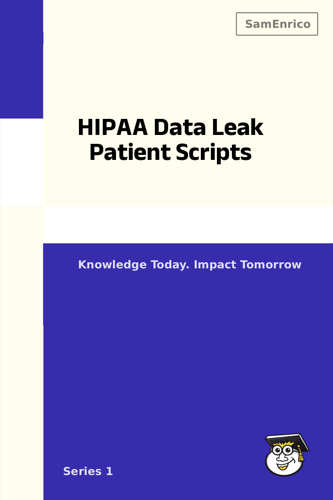
HIPAA Data Leak Patient Scripts eBook
Notifies healthcare patients of protected health i
Notifies healthcare patients of protected health information exposure.
Formats
Free sample
Chapter 1: The 3 AM Reckoning--The phone rings at 3:00 AM, and every possible bad outcome races through your mind before your hand even finds the receiver. On the other end is your overnight IT manager, and his voice carries that particular tremor that has nothing to do with the lateness of the hour. "We have a problem," he says. "A big one." Those five words mark the exact moment when your professional life splits into two distinct eras: everything that happened before the breach, and everything that will happen after.You are a privacy officer, a compliance director, a practice manager, or perhaps a solo practitioner who never imagined this would happen to you. You have read about breaches in the news.
You have attended the webinars. You have updated your policies. But nothing—absolutely nothing—prepared you for the sickening realization that protected health information belonging to real human beings, your patients, has left your control.This chapter is not about legal definitions or regulatory frameworks. Those will come in later chapters, and they are essential. This chapter is about something more immediate and more visceral: understanding what just happened so you can make the first set of decisions that will determine whether this breach becomes a footnote or a catastrophe.The First 60 Minutes: What You Must Know Before You Write a Single Word Before you even think about drafting a patient notification letter, before you call your attorney, before you do anything else, you need to answer one foundational question: What type of breach am I dealing with?
The answer to that question dictates everything that follows—the tone of your communication, the remediation steps you must offer, the legal deadlines that now govern your actions, and even the specific words you will use when you finally sit down to write.The decision matrix you are about to learn draws directly from the enforcement data compiled by the HHS Office for Civil Rights. Over the past decade, OCR has investigated tens of thousands of breaches, and from those investigations, seven distinct patterns have emerged. Your breach will almost certainly fall into one of these seven categories. Your job in the first hour is to figure out which one.The Seven Breach Vectors: A Diagnostic Guide Let us walk through each of the seven most common protected health information exposure vectors. As you read, keep a mental checklist of what you already know about your incident.
If you do not yet have answers to the diagnostic questions that accompany each vector, stop reading and go find those answers. Guessing will make everything worse.Vector One: Ransomware with Data Exfiltration This is the nightmare scenario that keeps chief information security officers awake at night. In this type of breach, an attacker gains access to your network, identifies where your most sensitive data resides, copies that data to a location under their control, and then—only after the exfiltration is complete—deploys ransomware that encrypts your files and demands payment for decryption.The diagnostic signature of this vector is the double extortion demand. The attacker will typically send a ransom note that includes proof of exfiltration, such as screenshots of patient records. If you see a demand that references specific files or includes a sample of stolen data, you are dealing with exfiltration.Forensic checklist questions for this vector: Do your logs show unauthorized access to file shares or databases?
Has there been unusual outbound data transfer at a scale inconsistent with normal operations? Is there a ransom note that explicitly claims data was stolen? Have you engaged a forensic firm to confirm whether exfiltration occurred?Critical distinction: Ransomware without exfiltration—where data was encrypted but not copied—operates under a completely different risk profile. In those cases, if you have backups and can restore without paying, the breach notification analysis may conclude that no PHI was actually acquired by an unauthorized person. But ransomware with exfiltration always, without exception, triggers full notification requirements.Vector Two: Lost or Stolen Unencrypted Devices This vector is the most common source of large-scale breaches, not because it happens more frequently than human error—it does not—but because a single lost laptop can expose tens of thousands of records at once.
The diagnostic signature is simple: a device that should have been encrypted was not, and that device is now missing.The psychology of this breach is distinct from other vectors. Patients do not primarily fear identity theft when they hear about a lost laptop. They feel anger. They ask, "Why was my data on a laptop in someone's car?" They perceive carelessness, and that perception of carelessness is often more damaging to your reputation than the actual risk of data misuse.Forensic checklist questions for this vector: Was the device encrypted according to NIST standards? If yes, stop—you likely have no notification obligation.
If no, continue. Does the device have tracking software? Has that software been activated? Has the device been powered on since the loss? Do access logs show any activity after the loss?
Could the device have been decrypted by a sophisticated attacker? (For most consumer-grade laptops, assume the answer is yes if there was no power-on password or full-disk encryption.)Vector Three: Misdirected Electronic Communications You have seen it happen a hundred times. An employee types "J" into an email address field, and autofillpopulates the wrong "John" from six years ago. A fax number is transposed by a single digit, and a patient's biopsy results go to a veterinary clinic. A reply-all sends a message containing PHI to an entire distribution list that includes external parties.This is the most frequent breach type by a wide margin.
The OCR's breach reports show that misdirected communications—email, fax, and mail combined—account for nearly forty percent of all reported incidents. The diagnostic signature is almost always an internal report from the employee who made the error or a call from the unintended recipient who received the misdirected information.Forensic checklist questions for this vector: Who sent the misdirected communication? To whom was it sent? Can you confirm whether the unintended recipient opened or read the communication? Has the unintended recipient confirmed deletion or destruction of the PHI?
Is the unintended recipient subject to HIPAA themselves (e.g., another covered entity) or a member of the general public? What specific PHI was included in the communication?Critical distinction: A misdirected fax or email that is immediately recognized, deleted, and never opened by the unintended recipient presents a very different risk profile than one that was viewed, saved, or forwarded. This distinction is central to your four-factor risk assessment, which we will cover in depth in Chapter 3.Vector Four: Paper Records Left in Unsecured Locations Paper remains a stubbornly persistent source of PHI breaches. A chart left on a cafeteria table. A printout of lab results accidentally discarded in an open trash bin rather than a secure shredding container.
A stack of intake forms left visible through the window of a parked car. These breaches feel almost embarrassingly low-tech, but they carry the same legal obligations as sophisticated cyberattacks.The diagnostic signature is almost always discovered by a patient or a bystander who reports finding…
This is the end of the free sample. Get the eBook to keep going. Buy now
About this book
Details
- Author
- Calderon Scarlett
- Publisher
- SamEnrico
- Language
- English
- Genre
- Non-Fiction, Crisis Management, HIPAA
- Released
- 2026-06-11
- Pages (approx.)
- 154
- Available as
- eBook, Audiobook

Read better in the ZLOADR app
Your eBooks on your phone or tablet. Sign in with your SamEnrico account and start reading.
More by Calderon Scarlett
 The Monk with One RobeCalderon Scarlett$11.99
 Acupuncture For UTI PreventionCalderon Scarlett$11.99
 Nightmare MythsCalderon Scarlett$11.99
 Feeling Trapped AngerCalderon Scarlett$11.99
 The Eyes Closed TM PostureCalderon Scarlett$11.99
 Strength Training Periodization GuideCalderon Scarlett$11.99
 DevOps On Call BurnoutCalderon Scarlett$11.99
 Elliot AbramsCalderon Scarlett$11.99
 The Maori Voyagers: Charting the Pacific with Western ScienceCalderon Scarlett$11.99
 Fenrir’s Bride: The Wolf and the ValkyrieCalderon Scarlett$11.99
 The Phantom Ledger: How a Small Town Accountant Outsmarted Wall StreetCalderon Scarlett$11.99
 Understanding Abdominal Aortic AneurysmCalderon Scarlett$17.99
You may also like
 Hong Kong Handover 1997Dunn Johnnie$11.99
 Zumba For Postnatal Recovery CourseNeal Christian$11.99
 Zumba for BeginnersLadner Nikia$11.99
 YouTube Comment Mining GuideHumes Pandora$12.99
 Worry Box MeditationCarlin Rudy$11.99
 Workplace Stress MeditationNguyen Lynn$11.99
 Workplace Stress and Sleep RepairHawley Ivory$11.99
 Workplace Perfectionism CureDelaney Jeffry$11.99
 Workplace Injustice Anger GuideWallen Isabelle$11.99
 Work Addiction and Burnout LinkGreenwood Ester$11.99
 Women in Yoga and WellnessBeattie Galina$11.99
 Women in Stand Up ComedyChun Evangeline$11.99