
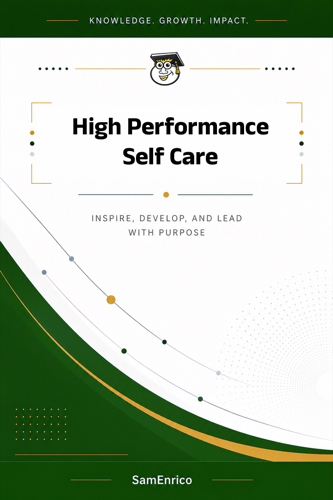
High Performance Self Care eBook
Reframes self care as a performance requirement, n
Reframes self care as a performance requirement, not an indulgence, for busy professionals.
Formats
Free sample
Chapter 1: The 77% Lie--–- The email arrived at 11:47 PM on a Tuesday. Sarah, a 34-year-old vice president at a financial services firm, had been working since 7:00 AM. She had skipped lunch—again. She had canceled her evening workout—again. She had promised her daughter she would be home for dinner—and she had broken that promise—again.
The email was from her boss, marked “urgent.” It contained a single sentence: “Need the Q3 projections on my desk by 8 AM tomorrow.” Sarah felt her chest tighten. Her vision blurred slightly. She typed “on it” and hit send, then opened the spreadsheet and worked until 2:30 AM. The next morning, she presented the projections. Her boss said “good work” and immediately assigned her four more tasks.
Sarah smiled, nodded, and thought: Is this what success feels like?Three months later, Sarah collapsed at her desk. Not metaphorically. Literally. A stress-induced tachycardia event. The paramedics found her on the floor of her corner office, surrounded by empty coffee cups and a half-finished slide deck.
In the emergency room, a doctor asked her a question that would change everything: “When was the last time you took a full hour for yourself—not sleeping, not working, not caring for someone else—just being?”Sarah could not answer.She is not alone.The Opening Gambit: Why This Book Exists If you are reading this, you are likely one of three people. First, you might be someone who is already successful by external metrics—promotions, salary, respect, responsibility—but you feel a quiet, persistent sense that something is wrong. You are tired in a way that sleep does not fix. You are successful in a way that does not feel good. Second, you might be someone who is climbing the ladder, chasing the next title or the next deal, and you have noticed that the people above you look exhausted, not exhilarated.
You are wondering if the destination is worth the damage. Third, you might be someone who has already experienced a collapse—a panic attack, a diagnosis, a divorce, a moment when the machine broke down—and you are desperate for a different way.This book is for all three of you.Here is the thesis, stated plainly and without apology: The dominant model of professional success—more hours, more caffeine, more grit, less sleep, less boundary, less self—is not only unsustainable. It is a lie. And it is a lie that has been sold to you by a culture that profits from your exhaustion.The evidence is overwhelming. In 2023, a global survey of 15,000 professionals across 15 countries found that 77% reported experiencing burnout symptoms at their current job.
Not “feeling a little tired.” Burnout: emotional exhaustion, depersonalization, and reduced personal accomplishment. Another study from Stanford University found that productivity per hour declines sharply after 50 hours of work per week, and that after 55 hours, the decline is so steep that additional hours produce negative returns—meaning you would accomplish more by working less and recovering more. A third study, this one from the World Health Organization, classified burnout as an “occupational phenomenon” directly linked to chronic workplace stress that has not been successfully managed.Let that sink in. The organizations that employ you, the bosses who demand more, the culture that glorifies the 80-hour week—none of them are benefiting from your collapse. They are benefiting from your willingness to believe that collapse is the price of admission.This chapter is called “The 77% Lie” because that statistic is not just a number.
It is a mirror. And the reflection shows a workforce that has been trained to mistake self-destruction for ambition.The Boxer’s Corner: A Metaphor That Will Change Your Week To understand why the 77% Lie is so seductive, and why it is so damaging, we need to look at a group of people who cannot afford to fall for it: professional fighters.Consider a championship boxing match. Two athletes enter the ring. They are at the peak of physical conditioning. They have trained for months.
Their entire careers depend on the next 36 minutes of combat. How do they structure that time?The answer: three-minute rounds, followed by one-minute breaks in the corner.In that one minute, the boxer does not scroll through social media. He does not answer emails. He does not plan his next fight. He sits on a stool.
His trainer wipes sweat from his face. He drinks water. He breathes. His heart rate drops from 180 beats per minute to 120. His muscles clear lactate.
His brain resets its attentional circuits. Then, sixty seconds later, he stands up and fights again.That one minute is not a luxury. It is not “self-indulgence.” It is not a sign of weakness. It is the strategic recovery period that enables the next three minutes of explosive performance. Without it, the boxer would be knocked out in the second round—not because he is less skilled, but because his biology would fail him.Now, contrast this with the typical professional’s workday.
You arrive at 8:00 AM. You sit at your desk. You open your laptop. You begin a cascade of meetings, emails, deadlines, and interruptions. You might take a 20-minute lunch at your desk—if you take lunch at all.
You do not take a “corner break.” You do not step away to reset. You push through the 3:00 PM fog with caffeine. You push through the 6:00 PM fatigue with guilt. You push through the 9:00 PM exhaustion with adrenaline and spite.You are trying to stay in the ring for 10 consecutive rounds without a corner. No fighter would survive that.
Neither will you.The boxer’s corner is not a break from performance. It is performance. It is the hidden practice that separates champions from amateurs. And the first and most important reframe of this book is this: Self-care is not what you do when you are finished working. It is what you do so you can work at all.The Law of Ultradian Rhythms: Your Brain’s Hidden Schedule The boxer’s corner is not a metaphor invented by a self-help author.
It is a direct reflection of human biology. Specifically, it reflects the Law of Ultradian Rhythms.Here is the science. The human brain does not operate on a flat, continuous line of focus. It operates in cycles. These cycles are called ultradian rhythms, and they last between 90 and 120 minutes.
During the first 20–30 minutes of a cycle, your brain is warming up—building neural connections, activating relevant networks, and suppressing distractions. Then, for the next 60–90 minutes, you enter a state of high focus, sometimes called “flow” or “deep work.” During this window, your brain is maximally efficient. You solve problems faster. You write more clearly. You make better decisions.Then, inevitably, the cycle ends.
Your brain signals fatigue. Your attention wanders. Your reaction time slows. Your working memory capacity drops. This is not a failure of willpower.
It is a biological fact, as predictable as the sunrise. Your brain is telling you: The cycle is complete. Rest now, or I will force you to rest later—with errors, forgetfulness, or a full cognitive crash.What do most professionals do at this moment? They fight it. They reach for coffee.…
This is the end of the free sample. Get the eBook to keep going. Buy now
About this book
Details
- Author
- Hinojosa Annmarie
- Publisher
- SamEnrico
- Language
- English
- Genre
- Non-Fiction, Self-Help, Self Care
- Released
- 2026-06-09
- Pages (approx.)
- 145
- Available as
- eBook, Audiobook

Read better in the ZLOADR app
Your eBooks on your phone or tablet. Sign in with your SamEnrico account and start reading.
More by Hinojosa Annmarie
 Short Interest SentimentHinojosa Annmarie$11.99
 Caregiver Stress and Respite FundingHinojosa Annmarie$11.99
 Resentment About LuckHinojosa Annmarie$11.99
 Stonewall Jackson's Valley Campaign: The Phantom General Who Defied OddsHinojosa Annmarie$11.99
 How to Become a Lumber SorterHinojosa Annmarie$11.99
 Scrum Master Bootstrapping GuideHinojosa Annmarie$12.99
 How to Produce Baby and Toddler SwimwearHinojosa Annmarie$11.99
 Privacy by Design AdvocateHinojosa Annmarie$11.99
You may also like
 Hong Kong Handover 1997Dunn Johnnie$11.99
 Zumba For Postnatal Recovery CourseNeal Christian$11.99
 Zumba for BeginnersLadner Nikia$11.99
 YouTube Comment Mining GuideHumes Pandora$12.99
 Worry Box MeditationCarlin Rudy$11.99
 Workplace Stress MeditationNguyen Lynn$11.99
 Workplace Stress and Sleep RepairHawley Ivory$11.99
 Workplace Perfectionism CureDelaney Jeffry$11.99
 Workplace Injustice Anger GuideWallen Isabelle$11.99
 Work Addiction and Burnout LinkGreenwood Ester$11.99
 Women in Yoga and WellnessBeattie Galina$11.99
 Women in Stand Up ComedyChun Evangeline$11.99