
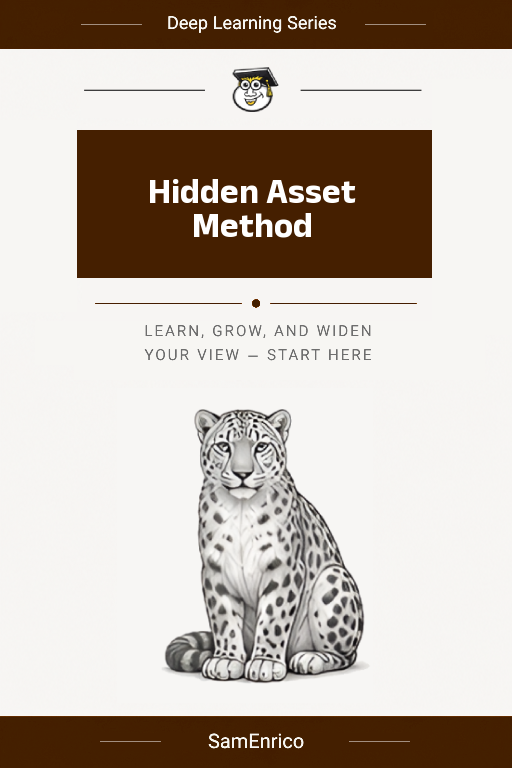
Hidden Asset Method eBook
Rediscover strengths from a low-money childhood—re
by Labbe Denna
Rediscover strengths from a low-money childhood—resourcefulness, creativity—and translate them into adult financial advantages.
Formats
Free sample
Chapter 1: The Inheritance You Already Own...--–- I want you to imagine two boxes. The first box is made of polished mahogany, sealed with a brass lock, and engraved with a family crest. Inside are stock certificates, property deeds, and a letter from a grandfather you never met explaining how to manage your trust fund. This box represents inherited wealth. The second box is made of cracked plastic, the kind that comes from a discount store.
It's held together with duct tape and a rubber band. Inside are the following items: a bent sewing needle, a stub of candle wax, a shoelace tied in a knot, a handwritten list of phone numbers with no names attached, a pocketknife with a broken blade, and a folded note that says, "Figure it out." This box represents what you actually inherited.If you grew up with low money, you did not receive the first box. You received the second box. And for most of your life, you have been told that the second box is worthless. You have been told that the only inheritance that matters is the one with the brass lock and the family crest.
You have been told that your cracked plastic box is evidence of lack, of disadvantage, of something to overcome or hide. You have been told that the goal is to forget the second box ever existed and try, desperately, to pretend you came from the first.This book exists to tell you the exact opposite. The second box is not worthless. It is not evidence of lack. It is not something to hide.
The second box is a proprietary training system that cannot be bought, cannot be borrowed, and cannot be replicated by any amount of wealth. The items inside—the bent needle, the stub of candle, the knotted shoelace—are not symbols of poverty. They are tools of resourcefulness. And the people who learn to use them will always outperform the people who only know how to sign checks.Everything you need to become wealthy, you already learned before you turned twelve. You just didn't know that's what was happening.
This chapter will show you the inheritance you already own. And by the time you finish reading it, you will never apologize for your past again.The Two Scarcities That Shaped You Before we go any further, we need to clear something up. Because I know what some of you are thinking. You're thinking, "If scarcity is such a great teacher, why am I still struggling? Why did poverty leave scars instead of skills?
Why does this feel like a lecture from someone who doesn't understand real hunger, real fear, real trauma?"Those are fair questions. They deserve honest answers.The research on scarcity and human development reveals a critical distinction that most self-help books ignore. There are actually two different kinds of scarcity, and they produce opposite results. The first kind is called chronic traumatic scarcity. This is the scarcity of not having enough food, not having safe housing, not having medical care, not having stability.
This kind of scarcity triggers the body's stress response system in ways that can cause lasting damage. It shrinks cognitive bandwidth. It impairs decision-making. It creates patterns of fear and hoarding that can last a lifetime. If you experienced this kind of scarcity, I am not here to tell you it was good for you.
It wasn't. We will address the wounds of chronic scarcity directly in Chapter 7.The second kind is called intermittent creative scarcity. This is the scarcity of not having a new bicycle, not being able to eat at restaurants, not having the latest video game, not having a car, not having an allowance. This kind of scarcity forces something remarkable: it forces you to solve problems with what you have. It forces you to fix instead of replace.
It forces you to trade instead of buy. It forces you to create instead of consume. This kind of scarcity is not trauma. It is training.Here is the difficult truth that most people from low-money backgrounds have to face: most of us experienced both kinds of scarcity. We might have had chronic scarcity around housing or food, but intermittent scarcity around toys or clothes.
Or we might have had intermittent scarcity most of the time, with brief periods of chronic scarcity during a layoff or illness. Or we might have had chronic scarcity that we only later understood as traumatic, while the day-to-day experience was one of constant creative problem-solving.The goal of this book is not to tell you that your suffering was good for you. The goal is to help you extract the training from the intermittent scarcity while healing the wounds from the chronic scarcity. You get to keep the skills without keeping the pain. You get to honor the resourcefulness that emerged without pretending the struggle was a gift.Throughout this book, when I say "scarcity," I am primarily referring to intermittent creative scarcity.
When I warn about the "Poverty Tax" in Chapter 7, I am primarily referring to the lingering effects of chronic scarcity. You will learn to distinguish between the two. And you will learn to use one without being ruled by the other.What You Actually Learned Before Age Twelve Let me be specific. Let me name the skills that your childhood actually taught you. Not the vague character traits that motivational speakers talk about—grit, resilience, determination.
Those are real, but they're too fuzzy to use. I'm talking about concrete, measurable, monetizable skills that translate directly into business and financial success.If you ever had to entertain yourself with no money—no screens, no toys, no activities, just sticks and stones and imagination and maybe a deck of cards—you learned content creation. You learned how to generate value from nothing. You learned how to hold an audience (even if the audience was just your little sister). You learned narrative, suspense, humor, and improvisation.
These are the exact skills that fuel social media empires, You Tube channels, and billion-dollar entertainment franchises. You didn't have a budget. You had creativity. That is not a disadvantage. That is the purest form of content training available.If you ever had to fix something instead of replacing it—clothes with patches, bikes with scavenged parts, appliances with duct tape and prayer—you learned lean operations.
You learned that most problems have solutions that don't require new spending. You learned diagnosis, repair, and maintenance. You learned that "broken" is often just "temporarily non-functional with a creative solution waiting to be found." These are the exact skills that make entrepreneurs successful. They don't throw money at problems. They think their way through them.
They understand that capital efficiency is often more valuable than capital itself.If you ever had to negotiate for what you wanted—convincing a parent to advance allowance, talking a landlord into waiting on rent, bargaining at a garage sale, trading chores for privileges—you learned sales psychology. You learned that people say no by default, and that a no is just the beginning of a conversation. You learned to read people, to find leverage, to create urgency, to offer alternatives. You learned…
This is the end of the free sample. Get the eBook to keep going. Buy now
About this book
Details
- Author
- Labbe Denna
- Publisher
- SamEnrico
- Language
- English
- Genre
- Non-Fiction, Mental Wealth, Asset-Based Thinking
- Released
- 2026-05-30
- Pages (approx.)
- 155
- Available as
- eBook, Audiobook

Read better in the ZLOADR app
Your eBooks on your phone or tablet. Sign in with your SamEnrico account and start reading.
More by Labbe Denna
 Shopping Addiction Warning SignsLabbe Denna$11.99
 Filial Responsibility LawsLabbe Denna$11.99
 Bully Response AssertiveLabbe Denna$11.99
 Birth Control And Athletic PerformanceLabbe Denna$11.99
 Self Regulation Skills GuideLabbe Denna$11.99
 Shame in Addiction RecoveryLabbe Denna$11.99
 Difficult Conversations about ReligionLabbe Denna$11.99
 Self Hypnosis for GriefLabbe Denna$11.99
 The Skies of Zand: The Birth of Aerial Warfare in PersiaLabbe Denna$11.99
 The Navigators of the Indian Ocean: The Unsung Voyages of the Swahili MarinersLabbe Denna$11.99
 A Collector's Handbook to the Vauxhall Chevette HsrLabbe Denna$11.99
 How to Start a Collectors Stamps and Coins (wholesale) Business (Beginners Guide)Labbe Denna$11.99