
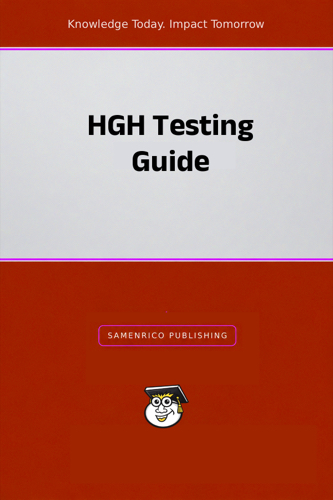
HGH Testing Guide Audiobook
Blood tests and stimulation tests for growth hormo
Blood tests and stimulation tests for growth hormone levels.
Formats
Free sample
Chapter 1: The Pulsatile Problem...--–- The emergency department physician stared at the lab result with growing confusion. His patient, a 45-year-old woman with profound fatigue, muscle wasting, and a body mass index of 32, had a random growth hormone level of 0.8 μg/L. The reference range on the report read 0.1–7.0 μg/L. By that measure, she was perfectly normal. Yet everything about her clinical presentation screamed hormonal deficiency.
He shrugged, discharged her with a diagnosis of depression, and never considered the possibility that the test he had ordered was fundamentally incapable of answering the question he was asking. Three years later, that same woman would be diagnosed with severe adult growth hormone deficiency following a proper stimulation test. By then, she had lost her job, her marriage had ended, and her bone density had fallen to osteoporotic levels. The random GH level that had seemed so reassuring was, in fact, a lie—not because the laboratory made an error, but because the very concept of a random GH level for diagnosing deficiency is physiologically nonsensical. This chapter exists to ensure that no clinician ever makes that mistake again.The Fundamental Flaw in Conventional Thinking Every medical student learns early in their training that laboratory testing follows a predictable pattern.
You draw blood, the machine measures a substance, and you compare the result to a reference range. If the result falls within the range, the patient is normal. If it falls outside, something is wrong. This paradigm works beautifully for stable analytes like sodium, creatinine, thyroid-stimulating hormone, and hemoglobin A1c. It works reasonably well for hormones with predictable diurnal rhythms like cortisol, provided you account for the time of day.
But it fails catastrophically for growth hormone because growth hormone does not obey the rules that make this paradigm possible.Growth hormone is secreted episodically. That single word—episodically—contains within it the entire reason why random testing is useless. Unlike thyroid hormone, which maintains relatively stable concentrations throughout the day, GH is released in brief, explosive bursts separated by long periods of secretory quiescence. A single blood draw has a high probability of capturing a trough between bursts, and that trough will be zero or near-zero regardless of whether the patient has a healthy GH axis or a completely deficient one. The reference range printed on the laboratory report, typically spanning from undetectable to 7 or 10 μg/L, creates a dangerous illusion…
This is the end of the free sample. Get the Audiobook to keep going. Buy now
About this book
Details
- Author
- Glymph Rosaura
- Publisher
- SamEnrico
- Language
- English
- Genre
- Non-Fiction, Health & Wellness, Diagnostic
- Released
- 2026-06-08
- Pages (approx.)
- 151
- Available as
- eBook, Audiobook

Listen in the VoxFlicks app
Audiobooks and audio dramas wherever you go. Sign in with your SamEnrico account and press play.
More by Glymph Rosaura
 Tlingit Raven Clan ShamanGlymph Rosaura$11.99
 Naturopathy for AsthmaGlymph Rosaura$11.99
 The Freudian Dream Symbol DictionaryGlymph Rosaura$11.99
 The Gavel That Shook the World: The Untold Story of Judge Constance Baker MotleyGlymph Rosaura$11.99
 Understanding Scoliosis With Unilateral Unsegmented BarGlymph Rosaura$17.99
 Franchise Marketing Global GuideGlymph Rosaura$12.99
 CSRankings AI Master's GuideGlymph Rosaura$12.99
 R/c CarsGlymph Rosaura$11.99
 Ultimate Handbook Guide to Barranquilla : (Colombia) Travel GuideGlymph Rosaura$11.99
You may also like
 Gluten Challenge ProtocolLiles Mckenzie$11.99
 IBS Breath Testing GuideNewell Kaitlyn$11.99
 Food Intolerance TestingHills Mitsue$11.99
 Bipolar I CriteriaWhitworth Jerrica$11.99
 The ED Nocturnal TestingStovall Wilfredo$11.99
 Endometriosis Differential DiagnosisRea Eugenio$11.99
 Panic Disorder DiagnosisMcnulty Magali$11.99
 SIBO Breath TestMcdaniels Foster$11.99
 SAD Diagnostic GuideFain Lyndsey$11.99
 Bipolar II CriteriaLima Manda$11.99
 Zonulin TestingBills Lorna$11.99
 Rome IV Criteria GuideStinson Jadwiga$11.99