
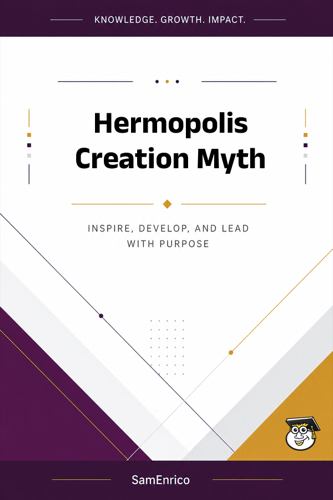
Hermopolis Creation Myth Audiobook
undefined
undefined
Formats
Free sample
Chapter 1: The Dormant Deep...--Before there was a sun to cast a shadow, before there was a sky to fall or an earth to rise, there was only water. Not the water of rivers or rains—those would come later, born from the tears of goddesses and the breath of gods—but a different kind of water altogether. This water had no surface, because there was no air above it. It had no bottom, because there was no stone beneath it. It had no temperature, no taste, no color, because there were no senses to perceive it, no tongue to name it, no mind to remember it.
This was the Nun: the Primeval Abyss, the Great Dormancy, the ocean that existed before existence itself became a verb.The ancient Egyptians of Hermopolis—the city they called Khmunu, the "City of the Eight"—did not believe that the universe was created out of nothing. That concept, creatio ex nihilo, would emerge much later in other traditions, in other deserts, under other gods. The Egyptians were too empirical for nothingness. They had watched the Nile flood every year, retreating to leave behind rich black mud, and they had seen frogs erupt from that mud as if the earth itself had decided to give birth. Nothing, they understood, does not produce something.
The Nun was not nothing. It was everything, but everything in a state of potential—unexpressed, unformed, undifferentiated, but present. The Nun was the cosmic womb, and like any womb, it contained the promise of birth without yet containing the child.This chapter introduces the foundational paradox of the Hermopolis Creation Myth: the problem of what existed "before" time, when "before" had no meaning. It defines the Nun as a state of dormancy rather than emptiness, a limitless ocean of inert potential rather than a void. It contrasts the Hermopolis model with its theological neighbors—Heliopolis and Memphis—to show what makes the Hermopolitan vision unique.
It explores the actual geography of Hermopolis (modern El-Ashmunein) and the local cult of Thoth, the divine registrar who will become the protagonist of our story. And it introduces three essential Egyptian concepts that will recur throughout this book: Zep Tepi (the First Time), heka (the magic of authoritative speech), and the relationship between the Ogdoad (eight gods) and the more famous Ennead (nine gods). Finally, it presents the Hermopolitan view of creation as a…
This is the end of the free sample. Get the Audiobook to keep going. Buy now
About this book
Details
- Author
- Montez Jeremy
- Publisher
- SamEnrico
- Language
- English
- Genre
- Non-Fiction, History / Religion
- Released
- 2026-06-06
- Pages (approx.)
- 149
- Available as
- eBook, Audiobook

Listen in the VoxFlicks app
Audiobooks and audio dramas wherever you go. Sign in with your SamEnrico account and press play.
More by Montez Jeremy
 Dream Recall PalaceMontez Jeremy$11.99
 Politics Emotion RegulationMontez Jeremy$11.99
 Mindful Breathing For AthletesMontez Jeremy$11.99
 Resident Doctor Sleep DeprivationMontez Jeremy$11.99
 Diver's Helmet Camera LogMontez Jeremy$11.99
 Anger Management for MicroaggressionsMontez Jeremy$11.99
 Palliative Care Stress GuideMontez Jeremy$11.99
 Affirmations For Parenting GuiltMontez Jeremy$11.99
 The Forgotten Automata of Baghdad: Mid-Century Robotics in the Middle EastMontez Jeremy$11.99
 The Crown’s Secret Split: How a Queen’s Divorce Rocked a NationMontez Jeremy$11.99
 Silent Witness: The Enigma of the Soho MurdersMontez Jeremy$11.99
 Indian Notice Period Buyout GuideMontez Jeremy$12.99
You may also like
 Hong Kong Handover 1997Dunn Johnnie$11.99
 Zumba For Postnatal Recovery CourseNeal Christian$11.99
 Zumba for BeginnersLadner Nikia$11.99
 YouTube Comment Mining GuideHumes Pandora$12.99
 Worry Box MeditationCarlin Rudy$11.99
 Workplace Stress MeditationNguyen Lynn$11.99
 Workplace Stress and Sleep RepairHawley Ivory$11.99
 Workplace Perfectionism CureDelaney Jeffry$11.99
 Workplace Injustice Anger GuideWallen Isabelle$11.99
 Work Addiction and Burnout LinkGreenwood Ester$11.99
 Women in Yoga and WellnessBeattie Galina$11.99
 Women in Stand Up ComedyChun Evangeline$11.99