
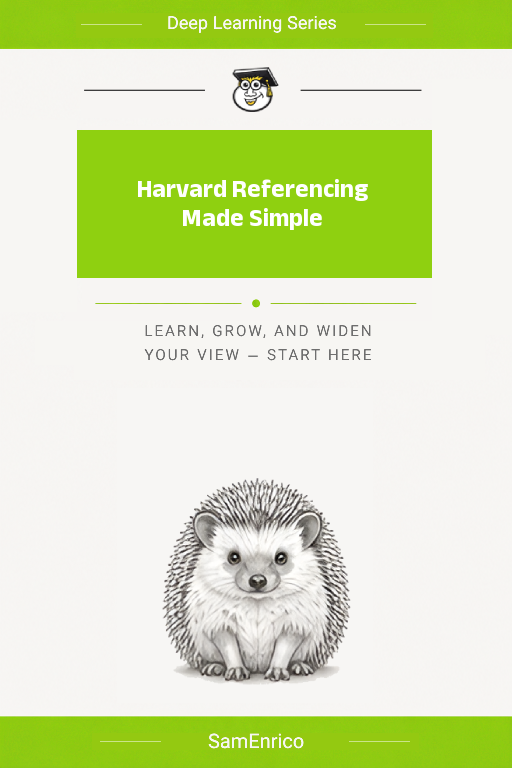
Harvard Referencing Made Simple eBook
Apply Harvard citation rules for books journals an
Apply Harvard citation rules for books journals and websites without confusion.
Formats
Free sample
Chapter 1: The Referencing Trap--Most students discover referencing the same way they discover quicksand in old movies – suddenly, unexpectedly, and with a rising sense of panic. You have written what you believe is a brilliant essay. The arguments are sharp. The evidence is compelling. The conclusion lands like a hammer.
You are proud. You are relieved. You are ready to submit.Then you glance at the marking rubric.Ten percent for referencing.Ten percent for the thing nobody explained properly. Ten percent for the commas and the italics and the mysterious sequence of words that appears at the bottom of the last page. Ten percent that separates an A from a B, a scholarship from a student loan, a graduation speech from a quiet walk home.You have fallen into the Referencing Trap.It is not your fault.
Most universities teach referencing the way they teach emergency evacuation procedures – as a list of rules to be followed only when something has already gone wrong. They hand you a fifty-page PDF called something like "Harvard Referencing Guide (Revised Edition, September 2023)" and expect you to be grateful. They tell you to "cite your sources" without explaining why anyone would want to. They mark you down for missing DOIs without ever telling you what a DOI is.This chapter is the shovel that digs you out of that trap.We are going to reframe everything you think you know about referencing. We are going to replace fear with curiosity, confusion with clarity, and panic with a simple, repeatable system.
By the end of this chapter, you will understand why referencing exists, why professors actually want you to do it, and how to fix 80% of your referencing errors in less time than it takes to brew a cup of coffee.Let us begin.The Great Misunderstanding Here is the first lie that universities accidentally tell: referencing is about punishment.Think about how referencing is usually introduced. The word "plagiarism" appears within the first three sentences. There is talk of academic misconduct, disciplinary committees, and the permanent stain that follows students who "fail to attribute sources correctly." The implication is clear – reference correctly or else.This framing is backwards.Referencing is not about avoiding punishment. It is about joining a conversation.Imagine walking into a room where twenty brilliant people are already talking. They are debating, disagreeing, building on each other's ideas, and citing evidence that you have not yet read.
You want to speak. You want to contribute. But if you just start talking without acknowledging what has already been said, you will look either ignorant (you did not do your homework) or arrogant (you think your voice matters more than theirs).A citation is the academic equivalent of saying, "As Sarah pointed out earlier, and I completely agree with her, here is where I would like to add something new."That is it. That is all referencing is.When you cite a source, you are not confessing to a crime. You are showing your work.
You are demonstrating that you have read widely, understood deeply, and are now ready to contribute something original to the conversation. Professors do not mark you down for referencing because they want to punish you. They mark you down because correct referencing proves you have done the reading. Incorrect referencing suggests you have not.Let me say that again, because it is the single most important sentence in this book:Correct referencing is evidence of hard work. Incorrect referencing is evidence of carelessness, not cheating.Most referencing errors are accidental.
You forgot a comma. You misplaced a full stop. You italicized the wrong word. These are not moral failures. They are mechanical errors, like misspelling a word or forgetting to add a page number.
They can be fixed. This book will show you how.The 5-Second Plagiarism Fix Before we go any further, I want to give you a tool you can use immediately. Right now. On the essay sitting open on your laptop.Here it is: before you submit anything, scan every paragraph and ask yourself one question.For every fact, quote, or idea that is not obviously common knowledge, is there a name and a year attached?If the answer is yes, you are probably fine. If the answer is no, you have found a vulnerability – a place where a professor might ask, "Where did you get this?"The fix takes five seconds.
Add the citation. Use one of these two formats:Narrative: "Smith (2020) argues that referencing is easy."Parenthetical: "Referencing is easier than students think (Smith, 2020)."That is it. You have just closed a plagiarism vulnerability. You have done more to protect your academic integrity than most students do in an entire semester.This simple habit – the 5-Second Plagiarism Fix – will eliminate roughly eighty percent of all academic integrity violations before they happen. The remaining twenty percent involve complicated edge cases (secondary sources, missing authors, artificial intelligence) that we will cover in later chapters.
For now, just practice asking the question: name and year?The Intellectual Handshake I want to introduce a metaphor that will stick with you throughout this book. Call it the Intellectual Handshake.Imagine you are at a conference. You meet a researcher whose work you admire. You introduce yourself. They extend their hand.
You shake it. In that two-second exchange, you have communicated: I see you. I respect you. I am ready to engage with you.A citation is the written version of that handshake.When you write "Smith (2020)", you are extending your hand to Smith. You are saying: I have read your work.
I am building on your ideas. I am not stealing from you; I am acknowledging you. Any reader who wants to find Smith's original work can do so, because you have provided the GPS coordinates – the author and the year.This is why the Author-Date system is so powerful. It turns every citation into a tracking device. The author tells you who.
The year tells you when. Together, they point the reader to the full address in the reference list at the back of your essay.Think of the in-text citation as a sneak peek. It is brief, unobtrusive, and designed not to interrupt the flow of your argument. It whispers to the reader: "Trust me, I have evidence for this."Think of the reference list entry as the full address. It contains everything someone would need to find the source themselves – the publisher, the journal, the DOI, the URL.
It is the difference between giving someone a business card (sneak peek) and giving them turn-by-turn directions to your office (full address).Together, these two parts form a system that is elegant, efficient, and – once you understand it – almost impossible to get wrong.Plagiarism vs. Poor Scholarship Let us clear up a confusion that causes more student anxiety than almost anything else.Plagiarism and poor scholarship are not the same thing. They are treated differently by universities. They should provoke different levels of concern in you.Plagiarism is intentional. It is copying a paragraph from a website and pasting it into your essay without quotation marks or a citation.
It is buying an essay from an online service. It is asking a friend to write your introduction. Plagiarism is…
This is the end of the free sample. Get the eBook to keep going. Buy now
About this book
Details
- Author
- Brunson Esmeralda
- Publisher
- SamEnrico
- Language
- English
- Genre
- Non-Fiction, Student's Shortcut
- Released
- 2026-05-30
- Pages (approx.)
- 137
- Available as
- eBook, Audiobook

Read better in the ZLOADR app
Your eBooks on your phone or tablet. Sign in with your SamEnrico account and start reading.
More by Brunson Esmeralda
 Social Media Listening ValidationBrunson Esmeralda$11.99
 Summer Break Stress GuideBrunson Esmeralda$11.99
 Fasting and InflammationBrunson Esmeralda$11.99
 Affirmations for Success MindsetBrunson Esmeralda$11.99
 Group Idea MashupBrunson Esmeralda$11.99
 Prime Time Performance AccelerationBrunson Esmeralda$11.99
 Slow Productivity Movement GuideBrunson Esmeralda$11.99
 Malaysian Green Tax CreditsBrunson Esmeralda$11.99
 Habit Stacking MethodBrunson Esmeralda$11.99
 The Djinn and the Scholar's Lamp: A Pact of KnowledgeBrunson Esmeralda$11.99
 Whispers of the First Fleet: The Untold Stories of Australia’s Forgotten ArrivalsBrunson Esmeralda$11.99
 The Dancer's Guide to Odissi AKA OrissiBrunson Esmeralda$11.99
You may also like
 Hong Kong Handover 1997Dunn Johnnie$11.99
 Zumba For Postnatal Recovery CourseNeal Christian$11.99
 Zumba for BeginnersLadner Nikia$11.99
 YouTube Comment Mining GuideHumes Pandora$12.99
 Worry Box MeditationCarlin Rudy$11.99
 Workplace Stress MeditationNguyen Lynn$11.99
 Workplace Stress and Sleep RepairHawley Ivory$11.99
 Workplace Perfectionism CureDelaney Jeffry$11.99
 Workplace Injustice Anger GuideWallen Isabelle$11.99
 Work Addiction and Burnout LinkGreenwood Ester$11.99
 Women in Yoga and WellnessBeattie Galina$11.99
 Women in Stand Up ComedyChun Evangeline$11.99