
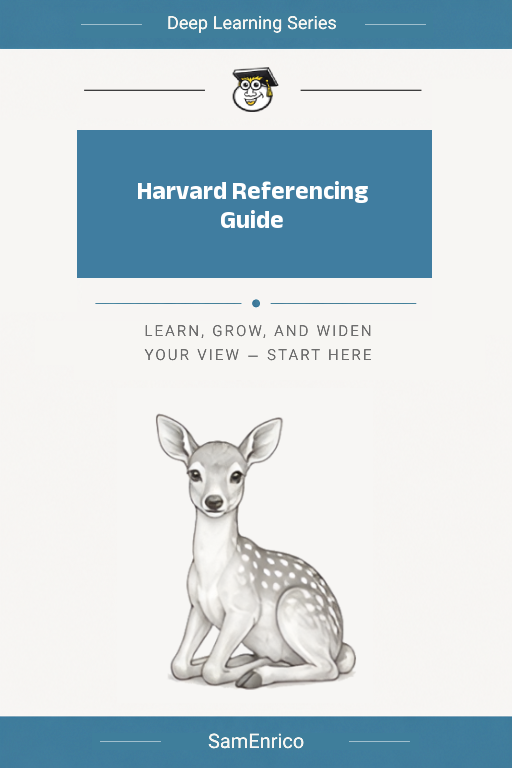
Non-FictionStudent's ShortcutHarvard Style
Harvard Referencing Guide Audiobook
Learn Harvard citation style for business and soci
Learn Harvard citation style for business and social sciences. Master author date in text citations and alphabetical reference lists.
Formats
Free sample
Chapter 1: The Citation Myth--Every year, millions of students lose marks on citations they thought were correct. They follow their university's style guide, copy examples from library handouts, and double-check every period and comma. Yet when their essays come back, the feedback reads the same: "Inconsistent referencing," "Check your citations," or simply "See me." The problem is rarely laziness or carelessness. The problem is that most students learn referencing backwards. They start with formats—books, journals, websites—before understanding the single question that every citation answers: Where did this idea come from, and how recent is it?This chapter dismantles the most dangerous myth in academic writing: that Harvard referencing is a arbitrary set of punctuation rules designed to torment students.
In truth, Harvard referencing is a logic system—perhaps the most elegant and efficient logic system ever devised for linking claims to their sources. Once you understand that logic, you stop memorizing formats and start thinking in citations. You no longer ask "Where does the comma go?" You ask "What information does my reader need to find this source?" The punctuation then takes care of itself.This chapter does three things. First, it reveals the hidden history of Harvard referencing and why business and social sciences adopted it. Second, it introduces the two foundational pillars of the system: the in-text citation and the reference list.
Third, it teaches the one universal rule that governs every single citation you will ever write—the rule that makes all other rules optional. By the end of this chapter, you will never look at a citation the same way again.The Zoologist Who Changed Academic Writing In 1881, a Harvard University zoologist named Edward Laurens Mark published a paper on the embryology of the garden slug. The paper itself was unremarkable—a meticulous but narrow study of cellular development. What transformed academic history was a single sentence in his footnotes. Instead of writing "Op.
cit." or "loc. cit." (the vague Latin abbreviations of the day), Mark wrote: "See also Whitman, 1878, p. 256."That was it. An author. A year.
A page number.Before Mark, scholarly citation was an exercise in obscurity. Writers used Latin abbreviations that assumed readers had memorized earlier footnotes. Ibid. meant "the same source as the previous note." Op. cit.
meant "the work I cited earlier but won't name again." To follow a citation, you had to flip back several pages, find the…
This is the end of the free sample. Get the Audiobook to keep going. Buy now
About this book
Details
- Author
- Kemper Lahoma
- Publisher
- SamEnrico
- Language
- English
- Genre
- Non-Fiction, Student's Shortcut, Harvard Style
- Released
- 2026-05-29
- Pages (approx.)
- 154
- Available as
- eBook, Audiobook

Listen in the VoxFlicks app
Audiobooks and audio dramas wherever you go. Sign in with your SamEnrico account and press play.
More by Kemper Lahoma
 Scott Peterson Voir Dire ProcessKemper Lahoma$11.99
 Uber Airport Trip PlaybookKemper Lahoma$11.99
 Partner Support After Job LossKemper Lahoma$11.99
 Gratitude Together PracticeKemper Lahoma$11.99
 Quiet Life After StardomKemper Lahoma$11.99
 Rockefeller StandardKemper Lahoma$11.99
 High Performance Rest GuideKemper Lahoma$11.99
 Indian GST Registration for Non Residents Action GuideKemper Lahoma$11.99
 Citation Rules Common Mistakes GuideKemper Lahoma$11.99
 The Last Mile: The Untold Story of the 1992 Barcelona Marathon MiracleKemper Lahoma$11.99
 The Sun King's Shadow: Versailles and the Birth of Modern DiplomacyKemper Lahoma$11.99
 Ghost in the Firewall: The Stuxnet Heist That Shook the WorldKemper Lahoma$11.99
You may also like
 Hong Kong Handover 1997Dunn Johnnie$11.99
 Zumba For Postnatal Recovery CourseNeal Christian$11.99
 Zumba for BeginnersLadner Nikia$11.99
 YouTube Comment Mining GuideHumes Pandora$12.99
 Worry Box MeditationCarlin Rudy$11.99
 Workplace Stress MeditationNguyen Lynn$11.99
 Workplace Stress and Sleep RepairHawley Ivory$11.99
 Workplace Perfectionism CureDelaney Jeffry$11.99
 Workplace Injustice Anger GuideWallen Isabelle$11.99
 Work Addiction and Burnout LinkGreenwood Ester$11.99
 Women in Yoga and WellnessBeattie Galina$11.99
 Women in Stand Up ComedyChun Evangeline$11.99