
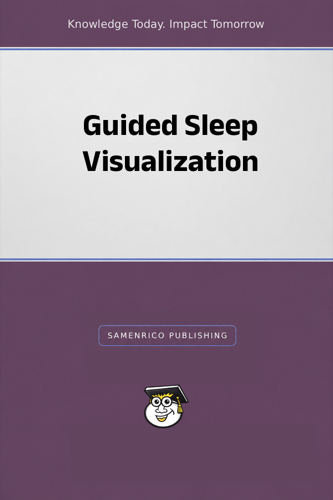
Guided Sleep Visualization eBook
Imagine peaceful scenes to redirect attention from
Imagine peaceful scenes to redirect attention from stressors.
Formats
Free sample
Chapter 1: The Waking Paradox...--–- You are lying in bed. The room is dark. The house is quiet. You have done everything right—dimmed the lights, put away the phone, brushed your teeth, and crawled under the covers at a reasonable hour. And yet, here you are.
Staring at the ceiling. Watching the minutes tick by on the clock. Your mind, instead of slowing down, has decided this is the perfect moment to replay every awkward conversation you have had in the last decade, to remind you of tomorrow’s deadline, and to invent a dozen catastrophic scenarios that will almost certainly never happen. The more you try to fall asleep, the more awake you become. This is the waking paradox.The Cruelest Joke of Modern Sleep Let us name this experience for what it is: sleep performance anxiety.
It is the direct result of treating sleep as a task to be completed rather than a state to be surrendered to. And it is one of the most frustrating, exhausting, and demoralizing experiences in human life.Think about what happens in those moments. You lie down. You close your eyes. And then a voice inside your head—let us call it the Inner Taskmaster—says something like, “Okay, we need to fall asleep now.
We have a big day tomorrow. Let us do this efficiently.” That voice is not helping you. That voice is the problem. Because sleep does not respond to effort. Sleep responds to safety, to ritual, to the slow settling of the nervous system.
When you try to force sleep, you trigger the exact opposite response: vigilance, tension, and the release of stress hormones that keep you wide awake.This is the paradox that will define everything we do in this book. The harder you try to fall asleep, the more you signal to your brain that something is wrong, that there is a threat, that you cannot relax. And your brain, doing its ancient job of keeping you alive, responds by keeping you alert.The Battle Inside Your Head: Amygdala vs. Prefrontal Cortex To understand why this happens, you need to meet two key players in your brain. The first is the amygdala—two small, almond-shaped clusters of neurons deep inside your temporal lobes.
Think of the amygdala as your brain’s smoke alarm. Its job is to scan the environment for potential threats and, when it detects one, to sound the alarm. That alarm takes the form of cortisol and adrenaline flooding your system, your heart rate increasing, your breathing becoming shallow, and your attention narrowing to focus on the perceived danger. The amygdala does not care about deadlines, relationships, or finances. It cares about survival.
But here is the problem: the amygdala cannot tell the difference between a real physical threat—say, a predator—and a psychological one, like the memory of an embarrassing moment or the fear of not sleeping before an important meeting. To your amygdala, a stressful thought is a threat. And it responds accordingly.The second player is your prefrontal cortex—the part of your brain just behind your forehead. This is your executive center, responsible for planning, rational thought, impulse control, and, crucially, the initiation of sleep. The prefrontal cortex is where your Inner Taskmaster lives.
It is the part of you that sets goals, makes lists, and tries to solve problems. Under normal circumstances, the prefrontal cortex and the amygdala work together. The prefrontal cortex can calm the amygdala by providing rational explanations: “That noise was just the house settling. We are safe.”But here is what happens when you lie down and try to force sleep. Your prefrontal cortex sets a goal: Fall asleep within the next twenty minutes.
As time passes and sleep does not come, the prefrontal cortex interprets this as a failure. That failure triggers the amygdala, which sounds the alarm: “Something is wrong. We are not sleeping. There must be a threat.” Cortisol rises. Your heart rate increases.
You become more alert. The prefrontal cortex, noticing that you are now even more awake, tries harder. It sets a more urgent goal. The amygdala responds with more alarm. This is a feedback loop.
A spiral. And it is the reason why “just try to relax” is the most useless advice anyone has ever given to someone who cannot sleep.Why Willpower Fails Where Imagination Succeeds This brings us to the central thesis of this book: imagination is more powerful than willpower. But we need to be precise about what that means. Willpower is the ability to override one impulse with another through conscious effort. It is the mental muscle that helps you choose the salad over the fries, or get up for a run when you would rather stay in bed.
Willpower is essential for many things. It is useless for sleep.Why? Because willpower operates through language and conscious goal-setting. It requires you to hold a thought in mind—“I must fall asleep”—and to monitor your progress toward that goal. That monitoring process is exactly what keeps the prefrontal cortex active and, by extension, keeps the amygdala on alert.
Willpower is effort, and effort is the enemy of sleep.Imagination, on the other hand, operates through a different channel. When you vividly imagine a scene—when you see it, hear it, feel it, smell it—you activate the same neural networks that would fire if you were actually there. This is called neural coupling. And here is the key: imagination does not require you to set a goal. It does not require you to monitor your progress.
It simply asks you to immerse yourself in an experience. That experience can be chosen specifically to signal safety, warmth, and calm to your nervous system.Imagine, for a moment, that you are sitting on a warm beach. You can hear the waves. You can feel the sand beneath your fingers. You can smell the salt in the air.
Your brain does not say, “We are now going to relax as a goal.” It simply relaxes. Because the imagined sensory input tells the amygdala: “There is no threat here. This is a safe place. We can rest.” That is the power of guided sleep visualization. It does not fight your brain.
It works with it.The Real Purpose of the Body Scan (This Is Not Relaxation)Before we go any further, we need to clear up a common misunderstanding. Many sleep books and meditation apps will tell you to do a body scan to relax. That is not what we are doing here. At least, not yet.The practice at the end of this chapter is a diagnostic body scan. Its purpose is not to make you feel calm.
Its purpose is to locate where stress physically lives in your body. Think of it as taking a mental map of the battlefield. You cannot redirect energy you cannot find. And most people carry stress in specific places—a clenched jaw, a knot in the stomach, a band of tension across the shoulders, a shallow breath that never seems to reach the belly. But because they have carried it for so long, they no longer even…
This is the end of the free sample. Get the eBook to keep going. Buy now
About this book
Details
- Author
- Olmstead Twila
- Publisher
- SamEnrico
- Language
- English
- Genre
- Non-Fiction, Self-Help, Guided Imagery
- Released
- 2026-06-08
- Pages (approx.)
- 138
- Available as
- eBook, Audiobook

Read better in the ZLOADR app
Your eBooks on your phone or tablet. Sign in with your SamEnrico account and start reading.
More by Olmstead Twila
 Military Officer Stress ManagementOlmstead Twila$11.99
 Overland Through BurmaOlmstead Twila$11.99
 Nursing School Stress WorkbookOlmstead Twila$11.99
 Antwerp Heist Interrogation TapesOlmstead Twila$11.99
 The Silk Road's Forgotten Empire: How the Han Dynasty Built the World's First Global SuperhighwayOlmstead Twila$11.99
 The Beagle’s Shadow: Darwin’s South American OdysseyOlmstead Twila$11.99
 Remote Blame ResolutionOlmstead Twila$12.99Remote Blame ResolutionOlmstead Twila$12.99
 Four Country Comparison GuideOlmstead Twila$12.99
 Steacyite MiningOlmstead Twila$11.99
 Understanding FibrochondrogenesisOlmstead Twila$17.99
 How to Become a Disaster Or Damage Control SpecialistOlmstead Twila$11.99
You may also like
 The Safe Place VisualizationLaflamme Candra$11.99
 Guided Imagery Sleep StoriesHoliday Cecil$11.99
 Beach Visualization Relaxation GuideLantz Hanna$11.99
 Anger Visualization MeditationPatino Lashaunda$11.99
 Anger Trigger VisualizationLongo Latesha$11.99
 Self Hypnosis Visualization Scripts HandbookDillard Ladonna$11.99
 Visualization For Inner Child Healing CourseBerman Nella$11.99
 Visual Imagery Trance Induction GuideChristie Minh$11.99
 Pain Visualization Healing ImageryFredericks Sunni$11.99
 Guided Imagery for Deep SleepKing Nathaniel$11.99
 Beach Relaxation Visualization GuideBurton Dean$11.99
 Walking Meditation ScriptsLund Anastasia$11.99