
Non-FictionInformativeEducational
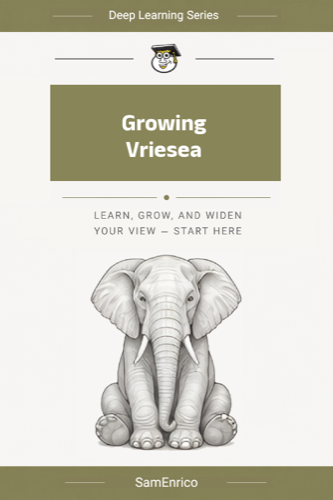
Growing Vriesea eBook
This publication, published by SamEnrico, covers G
by Place Cathi
This publication, published by SamEnrico, covers Growing Vriesea
Formats
Free sample
Chapter 1: The Flaming Sword Effect...--–- On a gray January morning in Seattle, a graphic designer named Mara placed a single plant on her north-facing desk. She had killed three succulents, a peace lily, and what she later learned was a very dead calathea. Her office received zero direct sunlight. The building’s HVAC system ran year-round, turning the air into something resembling a desert masquerading as a climate-controlled paradise. A well-meaning coworker had given her a “low-light plant” from the grocery store—a small bromeliad with dark green leaves crossed by tiger-like bands and a flat, sword-shaped spike that hadn’t yet colored up.
Mara didn’t know its name. She didn’t know it was a Vriesea splendens. She only knew she was tired of watching things die on her watch.Eighteen months later, that same plant had produced three pups, flowered twice (the second time after she learned the apple trick from a forum), and was now the centerpiece of her home office. She had never repotted it correctly. She had overwatered it for six months.
She had once left it in a freezing car overnight. And yet the plant refused to give up. Mara is not a horticulturist. She is not a “plant person” in the obsessive sense. She is a normal human who wanted one beautiful thing to survive in a dim corner.
And Vriesea delivered.This chapter is not about botany. It is not about taxonomy, Latin names, or the history of bromeliad collection in Victorian England. Those things have their place—later in this book, in fact—but they are not where we begin. We begin with a question that has driven the entire houseplant boom of the past decade: What plant can I keep alive when every other plant I’ve touched has turned to compost?The answer, for millions of people, is Vriesea. Specifically, the Flaming Sword.
But not all Vriesea are created equal, and understanding which one belongs in your life—and which one does not—is the first and most important decision you will make as a grower.Why This Plant, Why This Book Walk into any big-box garden center, and you will find bromeliads. They sit on shelves alongside overwatered orchids and optimistic fiddle-leaf figs. Most of them are Guzmania—those rosette-shaped plants with bright red, orange, or yellow bracts that look like fireworks frozen in time. They are beautiful. They are also temporary.
A Guzmania flower lasts two to four months, and after that, the plant begins a slow decline that many owners mistake for their own failure. Neoregelia, another common bromeliad, rarely flowers indoors at all; it is grown for its colorful leaves, which require more light than most homes can provide. Aechmea, with its pink bracts and purple flowers, is tougher but demands bright, indirect light and produces flowers that last only weeks.Vriesea sits apart from all of them.The Vriesea genus—named after the Dutch botanist Willem Hendrik de Vriese—contains over 250 species, but only a handful have entered the houseplant trade. The most famous is Vriesea splendens, the Flaming Sword, so called because of its flat, unbranched spike that emerges in brilliant red or orange, often tipped with yellow. That spike is not a flower in the traditional sense.
The actual flowers are small, yellow, and short-lived, appearing along the edges of the spike. But the spike itself—the “sword”—lasts for four to six months under normal conditions and has been known to persist for over a year in ideal (or accidentally ideal) environments.That longevity is Vriesea’s superpower. While other flowering houseplants give you a week or a month of color, Vriesea gives you half a year. And it does this in light levels that would make a succulent etiolate, a fern crisp, and an orchid refuse to bloom entirely.But here is where most guides mislead you. They say “Vriesea is a low-light plant,” and that statement is both true and dangerously incomplete.
Some Vriesea species—most notably Vriesea hieroglyphica, the King of Bromeliads—require significantly more light than Vriesea splendens. If you buy a Vriesea hieroglyphica based on the general claim that “Vriesea loves low light” and place it on a north-facing desk, you will watch its hieroglyph-like leaf bars fade, its leaves stretch, and its spirit slowly depart. That is not your fault. That is the fault of lazy advice that treats an entire genus as a monolith.This book exists because that lazy advice has dominated the market for too long. General bromeliad guides give Vriesea one chapter—or less—and then move on.
Online forums are filled with contradictory opinions: “Flush the tank weekly!” vs. “Never let water sit in the tank!” vs. “I’ve kept mine dry for months and it’s fine.” The result is a plant that is actually quite forgiving being treated as either a fragile diva or an indestructible weed, depending on who you ask.The truth, as with most things in horticulture, lies in the middle. And it is specific to each species, each environment, and each stage of the plant’s life.What This Chapter Will Do for You By the end of this chapter, you will be able to answer five essential questions:Is Vriesea the right plant for my specific light condition?Which Vriesea species or hybrid should I buy as a beginner?What can I realistically expect from this plant in terms of flower duration, size, and maintenance?What are the three most common mistakes that kill Vriesea—and how do I avoid them starting today?How do I know, within the first week, whether my plant is happy or already in trouble?You will not yet know how to water, fertilize, propagate, or troubleshoot every disease. Those are entire chapters of their own.
But you will know whether to proceed at all—and if you do proceed, you will do so with the confidence of someone who has already avoided the pitfalls that catch most beginners.The Low-Light Promise (And Its Limits)Let us talk about light with uncomfortable specificity.Most houseplant guides use phrases like “bright indirect light” or “low light” as if those terms meant the same thing in a Seattle apartment, a Phoenix living room, and a London flat. They do not. A north-facing window in Stockholm in December is a radically different environment from a north-facing window in Miami in July. Yet both are called “low light.”Vriesea splendens, the classic Flaming Sword, evolved in the understory of South American rainforests, where the canopy above filtered sunlight into a dappled, greenish gloom. It can survive in light levels as low as 50 foot-candles—a measurement that roughly corresponds to a well-lit room with no direct window access.
It thrives at 100 to 200 foot-candles, which is what you get two to three feet from a north-facing window or under standard office fluorescent lights.To put this in perspective: a snake plant (Sansevieria) can survive at 50 foot-candles but will never grow. A pothos will survive but become leggy. A Vriesea splendens, by contrast, will maintain its leaf banding, produce pups, and eventually flower at 100 foot-candles—though the flower spike may…
This is the end of the free sample. Get the eBook to keep going. Buy now
About this book
Details
- Author
- Place Cathi
- Publisher
- SamEnrico
- Language
- English
- Genre
- Non-Fiction, Informative, Educational
- Released
- 2026-06-03
- Pages (approx.)
- 154
- Available as
- eBook, Audiobook

Read better in the ZLOADR app
Your eBooks on your phone or tablet. Sign in with your SamEnrico account and start reading.
More by Place Cathi
 OCD Myths DebunkedPlace Cathi$11.99
 Pet Loss For JewsPlace Cathi$11.99
 Sunset Horizon VisualizationPlace Cathi$11.99
 Self Hypnosis for Sleep InductionPlace Cathi$11.99
 Participation Rights AnalysisPlace Cathi$11.99
 The Midwife Critical StressPlace Cathi$11.99
 Script Customization WorkshopPlace Cathi$11.99
 Anger And NeurodivergencePlace Cathi$11.99
 Time Blocking For DadsPlace Cathi$11.99
 The Jade Emperor's Celestial Bureaucracy: How Myth Shaped China's Cosmic OrderPlace Cathi$11.99
 The Bitten Apple: Steve Jobs and the Birth of the iPod RevolutionPlace Cathi$11.99
 The 101 Handbook: ForestryPlace Cathi$11.99
You may also like
 Hong Kong Handover 1997Dunn Johnnie$11.99
 Zumba For Postnatal Recovery CourseNeal Christian$11.99
 Zumba for BeginnersLadner Nikia$11.99
 YouTube Comment Mining GuideHumes Pandora$12.99
 Worry Box MeditationCarlin Rudy$11.99
 Workplace Stress MeditationNguyen Lynn$11.99
 Workplace Stress and Sleep RepairHawley Ivory$11.99
 Workplace Perfectionism CureDelaney Jeffry$11.99
 Workplace Injustice Anger GuideWallen Isabelle$11.99
 Work Addiction and Burnout LinkGreenwood Ester$11.99
 Women in Yoga and WellnessBeattie Galina$11.99
 Women in Stand Up ComedyChun Evangeline$11.99