
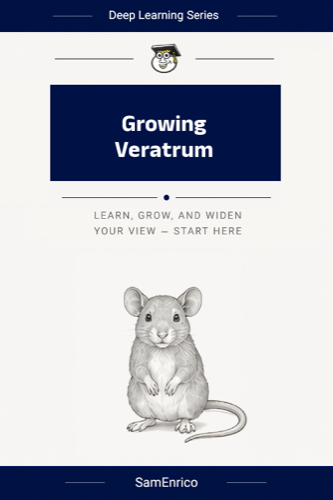
Non-FictionInformativeEducational
Growing Veratrum eBook
This publication, published by SamEnrico, covers G
This publication, published by SamEnrico, covers Growing Veratrum
Formats
Free sample
Chapter 1: The Black Flower...--For most gardeners, the path to growing a new plant begins with a seed catalog, a garden center tag, or a friend’s generous division. You dig a hole, drop in the roots, water once or twice, and nature does the rest. The plant that arrives in the mail or appears at the nursery bench has been domesticated, tamed, rendered predictable. It asks little of you beyond the occasional drink of water and a sprinkle of fertilizer. This is the implicit bargain of modern horticulture: we have bred the wildness out of the plants we love, and in exchange, they give us reliable blooms, predictable habits, and the comforting illusion that we are in control.Veratrum will break that illusion.This is not a plant for the casual weekend gardener.
It will not tolerate neglect, but it will also not tolerate coddling. It demands a specific set of conditions—moisture without waterlogging, shade without darkness, cold without freezing injury—and if you fail to provide them, it will die slowly, inexplicably, leaving you with a rotting rhizome and a sense of frustrated bewilderment. Yet for those who succeed, Veratrum offers something that few other garden plants can match: a presence so ancient, so architectural, and so strikingly beautiful that it transforms whatever space it occupies into something closer to a prehistoric fern grove than a suburban flower border.The name Veratrum comes from the Latin vere (truly) and ater (black), a reference to the dark, somber flowers of the European species Veratrum nigrum. But black is only part of the story. Depending on the species, the flowers may be greenish-yellow (V.
viride), white (V. californicum and V. formosanum), or deep maroon-black (V. nigrum). The leaves are perhaps even more striking: broad, heavily ribbed, and pleated like a fan, they emerge in a spiral from a basal rosette and can reach two feet in length on mature plants.
The overall effect is one of almost tropical excess—a plant that seems to belong in a misty mountain valley rather than a temperate garden.But before we dive into cultivation techniques, propagation protocols, and design strategies, we must first understand what Veratrum is. What distinguishes it from its better-known relatives? Where does it grow in the wild? Which species are suitable for cultivation, and which are best left to botanical gardens and specialists? This chapter answers those questions, providing the foundational knowledge that every successful Veratrum grower needs before planting a single seed.What Veratrum Is (And What It Is Not)The common name "False Hellebore" is both useful and misleading.
Useful because it alerts the gardener to the plant's toxicity—true hellebores (Helleborus species) are also poisonous, though less dramatically so. Misleading because Veratrum and Helleborus are not closely related. They belong to different plant families entirely: Veratrum is a member of the Melanthiaceae (bunchflower family), while Helleborus belongs to the Ranunculaceae (buttercup family). Their resemblance is superficial: both produce clumps of basal leaves and clusters of flowers on upright stalks, but the similarities end there.Morphological distinctions:Leaves: Veratrum leaves are strongly pleated (plicate), with prominent parallel veins running the length of the blade. The leaves are arranged spirally around a short, erect stem that elongates at flowering time.
Helleborus leaves are palmately divided or compound, with a leathery texture and no pleating.Flowers: Veratrum flowers are small, star-shaped, and borne in large, branching panicles that can reach three feet in height. Each flower has six tepals (three petals and three sepals that look identical), six stamens, and a three-lobed ovary. Helleborus flowers are larger, nodding or outward-facing, with five petal-like sepals (the true petals are modified into nectaries) and numerous stamens.Growth habit: Veratrum is a true herbaceous perennial that dies back completely to a rhizome in winter. Helleborus is evergreen or semi-evergreen in most climates, retaining its leathery leaves through the cold season.Taxonomic history: The genus Veratrum was first described by Carl Linnaeus in his 1753 work Species Plantarum, the foundation of modern botanical nomenclature. Linnaeus included several species that have since been reclassified, but the core of the genus has remained stable.
Recent molecular phylogenetic studies have confirmed that Veratrum is monophyletic (all members share a common ancestor) and is most closely related to the genera Melanthium and Anticlea, all of which produce similar alkaloids.The "false" in False Hellebore: The name likely arose from early European settlers in North America who noticed the superficial resemblance between Veratrum viride and the European hellebores they knew from home. Both plants were used medicinally (with dangerous results), both were toxic, and both grew in similar damp, shaded habitats. But the resemblance is coincidental—a case of convergent evolution in which two unrelated plants adapted to similar ecological niches developed similar forms. The "false" designation warns the careful observer not to confuse them.Global Distribution and Native Habitats Veratrum is a genus of the temperate Northern Hemisphere. Its range stretches from the mountains of Taiwan and Japan across Central Asia and Europe to the eastern and western United States and Canada.
Remarkably, no species are native to the Southern Hemisphere, and none are found in tropical regions. This distribution pattern—disjunct, with gaps between East Asia, Europe, and North America—suggests an ancient lineage that evolved before the continents drifted apart, then diversified in isolation.Habitat preferences: Most Veratrum species share a preference for three conditions: moisture, shade, and rich soil. They are commonly found in:Mountain meadows: Several species, including V. californicum and V. album, grow in subalpine and alpine meadows where snowmelt keeps the soil wet through early summer.
These populations often experience full sun because of the high elevation, but the soil never dries out.Stream banks and seeps: V. viride and V. insolitum are closely associated with running water. They grow in the splash zone of streams, in seeps where groundwater reaches the surface, and in saturated soils at the edges of wetlands.Forested slopes: V. formosanum and V.
nigrum can be found in deciduous and mixed forests, particularly on north-facing slopes where shade is dense and the soil remains cool and moist.Bogs and fens: Some populations of V. viride occur in acidic peatlands, though this is less common. These plants are adapted to low-nutrient conditions and may be smaller than their stream-bank counterparts.Altitude range: Veratrum species are found from sea level (in parts of the Pacific Northwest and coastal Asia) to over 10,000 feet (in the Rocky Mountains and the Himalayas). High-altitude populations tend to be shorter, flower later, and require longer cold dormancy periods—adaptations to the short growing season and harsh winters of alpine environments.Conservation note: Several Veratrum species are rare or declining due to habitat loss, overcollection, and climate change. Chapter 11 discusses conservation in detail, but for now, it is worth noting that wild populations should never be disturbed without proper permits.
The plants you grow in your garden should come from cultivated sources—specialty nurseries, seed exchanges, or divisions from other gardeners.Key Species for Cultivation Of the approximately 50 species in the genus Veratrum, only a handful are regularly cultivated. The rest are either too rare, too difficult, or too similar to the more common species…
This is the end of the free sample. Get the eBook to keep going. Buy now
About this book
Details
- Author
- Gunther Dotty
- Publisher
- SamEnrico
- Language
- English
- Genre
- Non-Fiction, Informative, Educational
- Released
- 2026-05-18
- Pages (approx.)
- 160
- Available as
- eBook, Audiobook

Read better in the ZLOADR app
Your eBooks on your phone or tablet. Sign in with your SamEnrico account and start reading.
More by Gunther Dotty
 The Ignite Talk MethodGunther Dotty$11.99
 Numbness Trigger ActivationGunther Dotty$11.99
 Sustainable Aviation FuelGunther Dotty$11.99
 Sheppard Case Ohio Supreme CourtGunther Dotty$11.99
 Iron Deficiency Recovery GuideGunther Dotty$11.99
 Contamination OCD GuideGunther Dotty$11.99
 Future Pacing Script TemplatesGunther Dotty$11.99
 Forgiveness After AngerGunther Dotty$11.99
 Lightfoot LoriGunther Dotty$11.99
 The Last Patient of Dr. Libby Zion: A Medical System in CrisisGunther Dotty$11.99
 The Hollow Hill's Last Bargain: A Fairy's Cruel PactGunther Dotty$11.99
 The Hollow Ones: The Forgotten Plague of the Black DeathGunther Dotty$11.99
You may also like
 Hong Kong Handover 1997Dunn Johnnie$11.99
 Zumba For Postnatal Recovery CourseNeal Christian$11.99
 Zumba for BeginnersLadner Nikia$11.99
 YouTube Comment Mining GuideHumes Pandora$12.99
 Worry Box MeditationCarlin Rudy$11.99
 Workplace Stress MeditationNguyen Lynn$11.99
 Workplace Stress and Sleep RepairHawley Ivory$11.99
 Workplace Perfectionism CureDelaney Jeffry$11.99
 Workplace Injustice Anger GuideWallen Isabelle$11.99
 Work Addiction and Burnout LinkGreenwood Ester$11.99
 Women in Yoga and WellnessBeattie Galina$11.99
 Women in Stand Up ComedyChun Evangeline$11.99