
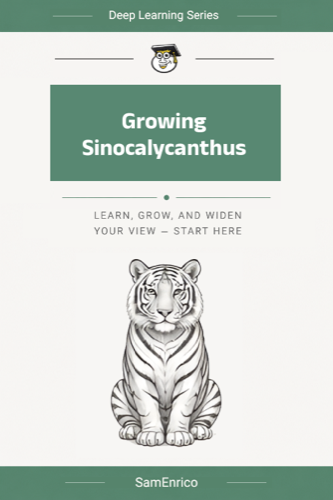
Non-FictionInformativeEducational
Growing Sinocalycanthus eBook
This publication, published by SamEnrico, covers G
by Nall Elenora
This publication, published by SamEnrico, covers Growing Sinocalycanthus
Formats
Free sample
Chapter 1: The Hidden Gem--– Sinocalycanthus chinensis is not a plant for the impatient gardener. It does not reward neglect with forgiveness. It does not thrive in compacted urban soil or bake under full afternoon sun without complaint. It asks for specific conditions—acidic, humus-rich earth, consistent moisture, protection from harsh winds—and in return, it offers something extraordinary. The gardener who provides what it needs earns a reward that few other woody ornamentals can match: large, luminous blossoms in late spring that seem almost too perfect to be real, suspended among glossy deep green leaves, accompanied by a delicate fragrance that intensifies in the evening air.This is the paradox of Sinocalycanthus.
For all its beauty, it remains almost unknown outside a small circle of dedicated plant enthusiasts, botanical gardens, and specialty nurseries. It is a hidden gem in the truest sense—rare not because it is difficult to grow (though it has specific requirements), but because it has never received the attention it deserves. This book exists to change that.A First Encounter Imagine walking through a woodland garden in late May. The canopy of deciduous trees filters the morning light into dappled patterns on the forest floor. The air is warm but not hot, carrying the scent of damp earth and emerging foliage.
Among the rhododendrons and ferns, you notice a shrub that stops you in your tracks.Its flowers are unlike anything else in the garden. Each blossom spans three to four inches across, composed of broad overlapping petals in creamy white, sometimes flushed with the palest pink. The petals surround a center of golden stamens, creating an effect that recalls a magnolia or a lotus flower. The blossoms seem to glow against the dark green foliage, drawing your gaze from across the garden.As you approach, you catch a scent—delicate, pleasant, not overwhelming. It is fruity, perhaps, or slightly spicy, but the comparison fails to capture its quality.
The fragrance becomes more noticeable as the day cools, lingering in the evening air like a promise.This is Sinocalycanthus chinensis. And once you have experienced it, you will never forget it.The Problem of Names Before we go further, a word about what to call this plant. The genus name Sinocalycanthus combines "Sino" (Chinese) with "Calycanthus" (the related genus of sweetshrubs native to North America). The species name chinensis simply means "of China." Together, they tell you where this plant comes from and what family it belongs to.Common names are less settled. Some gardeners call it Chinese sweetshrub, acknowledging its relationship to the Carolina allspice (Calycanthus floridus) that grows in American woodlands.
Others refer to it as the "wax flower," a reference to the almost surreal translucence of its petals. Neither name has achieved universal acceptance, and both fail to capture the plant's unique character. Throughout this book, we will use the botanical name Sinocalycanthus—or simply "the plant" when context makes the meaning clear—and trust that its beauty will earn it a proper common name in time.You may also encounter confusion in the botanical literature. Older references sometimes list the species as Calycanthus chinensis, reflecting a view that Sinocalycanthus should be merged into the larger genus. Some sources use Sinocalycanthus sinensis rather than chinensis.
Both mean "of China" in Latin; the accepted name is Sinocalycanthus chinensis. For the gardener, the taxonomic debates matter less than the plant itself. Whether you call it Sinocalycanthus or Calycanthus, the cultural requirements are the same.Discovery and Botanical History The story of Sinocalycanthus in Western horticulture begins in 1963. In that year, a plant specimen was collected in the Zhejiang Province of eastern China, in a region of cloud forests and mountain streams. The specimen made its way to botanical institutions, but it was not immediately recognized as something new.It was not until 1979 that Chinese botanists formally described the plant as a new genus.
What distinguished it from Calycanthus were subtle but important features of its floral structure—particularly the arrangement of the stamens and the shape of the fruit. The flowers of Sinocalycanthus are larger and lighter in color than those of Calycanthus, with a different petal arrangement. The fruit, a fleshy receptacle that encloses the seeds, differs in the arrangement of the achenes (small, dry, one-seeded fruits) within. These differences, though invisible to the casual observer, were sufficient to establish Sinocalycanthus as a distinct genus.For decades after its description, Sinocalycanthus remained rare in cultivation outside of China. Seeds and plants were difficult to obtain.
Propagation proved challenging. The plant was known primarily to botanists and a handful of dedicated collectors who traded plant material through informal networks.The situation began to change in the 1990s. Botanical expeditions organized by arboreta and botanical gardens brought new plant material to the West. Nursery collaborations made seeds and rooted cuttings more widely available. Today, while Sinocalycanthus is still not a common offering at mainstream garden centers, it can be found through specialty nurseries and mail-order sources.
The plant's rarity is no longer a barrier to cultivation—only the gardener's willingness to seek it out.The Hybrid Breakthrough The horticultural world took greater notice of Sinocalycanthus when hybridizers crossed it with Calycanthus to produce a stunning new plant: Calycanthus x raulstonii 'Hartlage Wine'. This hybrid combines the best traits of both parents. From Sinocalycanthus, it inherits large flower size and showy form. From Calycanthus, it inherits darker coloration (the flowers are a rich wine-red with creamy white centers) and greater hardiness.'Hartlage Wine' has received the Royal Horticultural Society's Award of Garden Merit, a prestigious recognition of its garden performance and ornamental value. The hybrid blooms over an unusually long period, from late spring through summer, sometimes into early autumn in favorable climates.
The blossoms can reach five inches across—even larger than those of pure Sinocalycanthus. The plant grows as a multi-stemmed deciduous shrub with upright then arching branches, reaching eight to ten feet tall and wide at maturity.For the gardener interested in Sinocalycanthus, the hybrid is worth understanding. It offers an alternative that may be more widely available and somewhat easier to grow in a range of conditions. Throughout this book, we will note where the cultivation of 'Hartlage Wine' differs from that of pure Sinocalycanthus chinensis. In most respects, the two plants are similar; where they diverge, those differences are significant.What This Plant Is Not To appreciate Sinocalycanthus, it helps to understand what it is not.
It is not a plant for the gardener who wants instant gratification. A newly planted specimen will take two to three years to establish its root system and begin flowering freely. Even then, the first few years of blooms may be sparse. Patience is required.It is not a plant for the gardener who cannot provide consistent moisture. Sinocalycanthus evolved in cloud forests and streamside woodlands.
It has no natural tolerance for extended drought. If you cannot water during dry spells, or if you garden in a region with long, dry summers, this plant will struggle.It is not a plant for the gardener with alkaline soil. Sinocalycanthus is calcifuge—it cannot tolerate high calcium levels. If your soil is derived from limestone or chalk, or if your…
This is the end of the free sample. Get the eBook to keep going. Buy now
About this book
Details
- Author
- Nall Elenora
- Publisher
- SamEnrico
- Language
- English
- Genre
- Non-Fiction, Informative, Educational
- Released
- 2026-05-08
- Pages (approx.)
- 94
- Available as
- eBook, Audiobook

Read better in the ZLOADR app
Your eBooks on your phone or tablet. Sign in with your SamEnrico account and start reading.
More by Nall Elenora
 Single Parent Financial Coping HandbookNall Elenora$11.99
 Baby Milestone Social Media PressureNall Elenora$11.99
 Thunberg Hope MovementNall Elenora$11.99
 The Adopted Teen Self EsteemNall Elenora$11.99
 Stress Resilience GuideNall Elenora$11.99
 Newborn Vaccine ScheduleNall Elenora$11.99
 Childhood Religious Shame OriginsNall Elenora$11.99
 Opioid Overdose SurvivorNall Elenora$11.99
 Mentorship For Self DoubtNall Elenora$11.99
 The Iron Masters of Meroë: Forging the FutureNall Elenora$11.99
 Iron Horses and Icebound Dreams: The Great Northern Railway's Arctic AmbitionNall Elenora$11.99
 Ash and Echoes: The Pompeii Scrolls and the Birth of VolcanologyNall Elenora$11.99
You may also like
 Hong Kong Handover 1997Dunn Johnnie$11.99
 Zumba For Postnatal Recovery CourseNeal Christian$11.99
 Zumba for BeginnersLadner Nikia$11.99
 YouTube Comment Mining GuideHumes Pandora$12.99
 Worry Box MeditationCarlin Rudy$11.99
 Workplace Stress MeditationNguyen Lynn$11.99
 Workplace Stress and Sleep RepairHawley Ivory$11.99
 Workplace Perfectionism CureDelaney Jeffry$11.99
 Workplace Injustice Anger GuideWallen Isabelle$11.99
 Work Addiction and Burnout LinkGreenwood Ester$11.99
 Women in Yoga and WellnessBeattie Galina$11.99
 Women in Stand Up ComedyChun Evangeline$11.99