
Non-FictionInformativeEducational
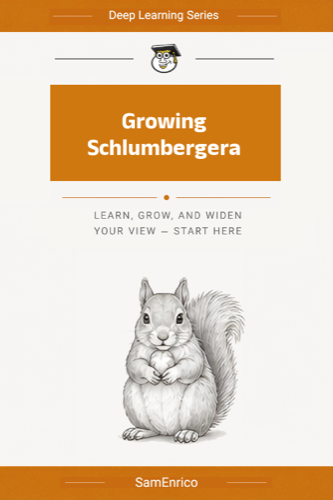
Growing Schlumbergera eBook
This publication, published by SamEnrico, covers G
This publication, published by SamEnrico, covers Growing Schlumbergera
Formats
Free sample
Chapter 1: Beyond the Desert Myth...--Most people kill their first Schlumbergera within ninety days of bringing it home. If you are reading this sentence, you have likely either buried one in the compost bin already or you are staring at a plant with limp segments, brown edges, or buds that shriveled and fell off before they ever opened. Neither of these outcomes is your fault. You were given the wrong instruction manual by nearly every garden center, online forum, and well-meaning grandparent who told you to treat this plant like a cactus. The problem is that Schlumbergera is not a cactus in the way you think it is.This chapter dismantles the single most destructive misunderstanding in holiday cactus care: the assumption that because the word "cactus" appears in its name, this plant wants desert conditions.
It does not. It never has. The Schlumbergera genus evolved in an environment that is practically the opposite of a desert, and until you internalize this fact, every watering, every potting decision, and every placement of your plant will be working against its biology.We begin with a story that illustrates the stakes. In 2019, a woman in Ohio inherited a Schlumbergera from her great-grandmother. The plant was fifty-seven years old, stood three feet in diameter, and produced over two hundred blooms every December.
She had no idea how to care for it. Within eight months, she had lost half the plant to root rot. She was following standard cactus advice: infrequent watering, full sun in a south-facing window, sandy soil. Every single one of those choices was exactly wrong. The plant survived because Schlumbergera is remarkably forgiving, but it took her two years of unlearning before she saw a single flower again.You will not make her mistakes.
By the end of this chapter, you will understand where Schlumbergera comes from, why its needs are so different from desert cacti, and how to identify exactly which species you own. More importantly, you will adopt a new mental framework for care that transforms confusion into intuition.The Rainforest Revelation Schlumbergera is native to the coastal mountains of southeastern Brazil, specifically the states of Rio de Janeiro, São Paulo, Minas Gerais, and Espírito Santo. This region is called the Mata Atlântica, or Atlantic Forest, and it bears almost no resemblance to the deserts of Arizona or the dry plains of Mexico that most people associate with cacti.The Atlantic Forest receives between forty and eighty inches of rain annually. To put that in perspective, the Sonoran Desert receives less than twelve inches. Seattle, famous for its rain, gets about thirty-seven inches.
Parts of the Schlumbergera's native range are wetter than Seattle. The humidity in these forests rarely drops below seventy percent, even during the drier winter months. Temperatures range from fifty-five to seventy-eight degrees Fahrenheit year-round, with no freezing and very little extreme heat.But the most critical detail is where Schlumbergera grows within this forest. It is not a ground-dwelling plant. It is an epiphyte.The word epiphyte comes from the Greek roots "epi" meaning upon and "phyte" meaning plant.
Epiphytes grow on other plants, typically trees, without parasitizing them. They are not vines that sink roots into tree tissue. They are not mosses that cling to bark without structure. Schlumbergera establishes itself in the crotches of tree branches, in crevices where decomposing leaves and organic matter accumulate, and on the rough bark of host trees like fig, avocado, and various Brazilian hardwoods. The plant's roots wrap around bark and wedged into crevices, but they never penetrate the tree's living tissue.Think about what this means.
The plant does not sit in soil. It sits in a loose, airy, rapidly draining mixture of decomposing leaves, bird droppings, insect frass, and bark fragments. This organic layer is thin, often no more than two to four inches deep, and it dries out quickly after rain because it is suspended in the air, exposed to wind and circulation from all sides. When it rains, water flows through this medium and then drains away completely. The roots are never waterlogged.This explains nearly everything about Schlumbergera care.
The plant evolved to receive frequent but brief water, followed by rapid drying. It evolved to have its roots exposed to air, not buried in dense water-retentive soil. It evolved under a canopy of tree leaves that filter sunlight into dappled, indirect brightness. It evolved with consistent moisture in the air, not dry desert breezes. And crucially, it evolved with cool nights because mountain forests at elevation lose heat rapidly after sunset.When you bury Schlumbergera roots in standard potting soil and water it once a week like a typical houseplant, you are doing the botanical equivalent of making a fish climb a tree.
The plant will survive for a while because it is resilient, but it will never thrive. It will produce pale, thin segments instead of thick, robust ones. It will refuse to bloom. Eventually, the roots will suffocate from lack of oxygen and rot from fungal pathogens that flourish in stagnant water.The good news is that once you understand the rainforest epiphyte model, every care decision becomes logical. You are not fighting the plant's nature.
You are working with it.Why "Cactus" Confuses Everyone The cactus family, Cactaceae, contains over 1,750 species spread across the Americas. They occupy an extraordinary range of habitats, from the humid jungles of Costa Rica to the Atacama Desert in Chile, one of the driest places on Earth. The common image of a cactus—spiny, barrel-shaped, adapted to extreme drought—describes only a fraction of the family.Schlumbergera belongs to a subgroup called epiphytic cacti, which also includes Rhipsalis, Hatiora, Epiphyllum, and several other genera. These cacti abandoned the desert lifestyle millions of years ago, adapting to compete for light and space in crowded tropical forests by moving up into the trees. They retained the basic cactus body plan: succulent stems that store water, areoles (the distinctive cactus structures from which spines, branches, and flowers emerge), and the CAM photosynthetic pathway that reduces water loss.
But they transformed nearly every other trait.Consider the spines. Desert cacti evolved fierce spines for two reasons: to shade the stem surface from intense sun and to deter thirsty animals. Schlumbergera spines are tiny, soft, almost invisible bristles that serve no defensive purpose. Some cultivated varieties have lost them entirely. The plant does not need to defend itself against desiccation or predators because it lives in a consistently moist environment where water is abundant and the main threats are fungal and insect, not drought and herbivores.Consider the stem shape.
Desert cacti are typically round, columnar, or barrel-shaped to minimize surface area and reduce water loss. Schlumbergera stems are flattened, leaf-like structures called cladodes. These broad surfaces maximize exposure to filtered light under the canopy. They are thin enough to be flexible in wind and to absorb humidity through their surfaces. They are segmented, with each joint capable of producing roots if it touches a moist surface—a useful adaptation for a plant that reproduces by dropping branches that lodge in tree crotches.Consider the roots.
Desert cacti send out extensive, shallow root systems that capture water from brief rains across a wide area. Many desert…
This is the end of the free sample. Get the eBook to keep going. Buy now
About this book
Details
- Author
- Beckman Adella
- Publisher
- SamEnrico
- Language
- English
- Genre
- Non-Fiction, Informative, Educational
- Released
- 2026-05-08
- Pages (approx.)
- 156
- Available as
- eBook, Audiobook

Read better in the ZLOADR app
Your eBooks on your phone or tablet. Sign in with your SamEnrico account and start reading.
More by Beckman Adella
 Retail Worker Stress GuideBeckman Adella$11.99
 Addressing Teen Substance UseBeckman Adella$11.99
 Atomic Habit Formation GuideBeckman Adella$11.99
 Fasting for Heart HealthBeckman Adella$11.99
 Amazon Review Research GuideBeckman Adella$11.99
 Self Talk for Depression LiftBeckman Adella$11.99
 Joe Biden ScrantonBeckman Adella$11.99
 Bipolar Alternative Treatment GuideBeckman Adella$11.99
 HGH And Cold ExposureBeckman Adella$11.99
 The Southern Cross and the Stars: New Zealand's Scientific LeapBeckman Adella$11.99
 The Hellfighters' Last Stand: The Battle of Chateau-ThierryBeckman Adella$11.99
 Love in the Shadows: The Secret Affair That Shook a KingdomBeckman Adella$11.99
You may also like
 Hong Kong Handover 1997Dunn Johnnie$11.99
 Zumba For Postnatal Recovery CourseNeal Christian$11.99
 Zumba for BeginnersLadner Nikia$11.99
 YouTube Comment Mining GuideHumes Pandora$12.99
 Worry Box MeditationCarlin Rudy$11.99
 Workplace Stress MeditationNguyen Lynn$11.99
 Workplace Stress and Sleep RepairHawley Ivory$11.99
 Workplace Perfectionism CureDelaney Jeffry$11.99
 Workplace Injustice Anger GuideWallen Isabelle$11.99
 Work Addiction and Burnout LinkGreenwood Ester$11.99
 Women in Yoga and WellnessBeattie Galina$11.99
 Women in Stand Up ComedyChun Evangeline$11.99