
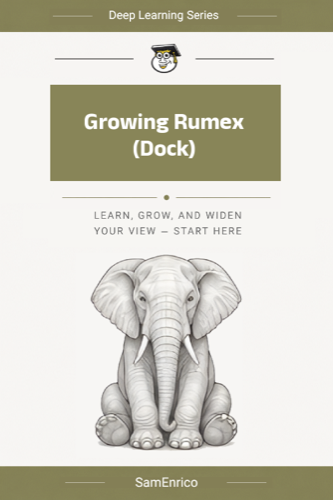
Non-FictionInformativeEducational
Growing Rumex (Dock) eBook
This publication, published by SamEnrico, covers G
This publication, published by SamEnrico, covers Growing Rumex (Dock)
Formats
Free sample
Chapter 1: Beyond the Label...--–- Let me begin with a confession: I spent fifteen years of my gardening life pulling Dock out of the ground and throwing it onto a burn pile. I believed, with the certainty of someone who had read the right books and listened to the right experts, that Rumex was an enemy. It was a weed. It was ugly. It had a taproot that seemed to reach to the center of the earth, and if you left a single fragment of that root in the soil, the plant would resurrect itself like something from a horror film.
I cursed it. I dug it. I poured vinegar and boiling water on it. And still, it came back.Then, six years ago, I watched a documentary about the Dust Bowl. The film showed aerial photographs of the American Great Plains in the 1930s: thousands of acres of bare, dead soil, the topsoil lifting off like brown snow and blocking out the sun.
A historian on the program mentioned, almost as an aside, that the first plants to recolonize that devastated land were not the carefully selected pasture grasses or the imported European clovers. They were the weeds. And chief among those weeds, in the damp draws and along the edges of failed wheat fields, was Dock. Rumex crispus, to be precise.That moment changed everything for me. I realized I had been asking the wrong question.
For fifteen years, I had been asking, "How do I kill this plant?" The question I should have been asking was, "What is this plant trying to tell me about my soil?"This chapter is about unlearning. It is about setting aside a century of agricultural propaganda that has taught us to see certain plants as villains and others as heroes, and instead learning to read the language of the land. Because Dock—whether you call it Curly Dock, Broadleaf Dock, Yellow Dock, or by its genus name Rumex—is not a weed. It is a messenger. And once you learn to listen to what it is saying, you will never look at your garden the same way again.The Invention of the "Weed"Before we can understand Dock, we must understand how it came to be hated.
The concept of a "weed" is not a biological category. It is a cultural and economic invention. A plant is not born a weed any more than a human is born a criminal. We assign that label based on where the plant grows and whose interests it interferes with.The modern war on weeds began in the mid-twentieth century, following the development of synthetic auxin herbicides like 2,4-D and later glyphosate. The agricultural industry, having invested billions of dollars in chemical solutions, had a powerful incentive to frame weeds not as ecological actors but as enemies to be exterminated.
Dock, with its deep taproot that resisted mechanical tillage and its prolific seed production that survived crop rotation, became a prime target. Agricultural extension offices published pamphlets with titles like Eradicating Dock from Pastures and The Dock Problem: A Farmer's Guide to Chemical Control. The message was consistent and simple: Dock is bad. Kill it.But this framing ignores a fundamental ecological truth. What we call "weeds" are almost always pioneer species—plants that have evolved specifically to colonize disturbed, damaged, or depleted soils.
Their job, in the grand narrative of ecological succession, is to stabilize the soil, cycle nutrients, and create conditions that allow more complex plant communities to eventually establish. Dock is not a parasite on healthy agricultural land. It is a symptom of unhealthy agricultural land. It shows up where the soil is compacted, where mineral balances are skewed, where the microbial life has been damaged by tillage or chemicals. Dock is not the problem.
Dock is the response to the problem.Let me say that again, because it is the single most important idea in this book: Dock is not the problem. Dock is the response to the problem.When you pull a Dock plant and curse it, you are punishing the messenger while ignoring the message. The plant is not trying to ruin your garden. It is trying to heal your soil. And if you understand how it does that—which we will explore in detail in Chapter 2—you can stop fighting it and start working with it.Three Faces of Rumex: A Botanical Introduction Before we go further, let us get clear about what exactly we are talking about.
The genus Rumex contains approximately 200 species distributed across every continent except Antarctica. They are members of the Polygonaceae family, which also includes buckwheat and rhubarb. In this book, we will focus on three species that are most relevant to the gardener, forager, and herbalist. Each has distinct characteristics, growing preferences, and uses.Rumex crispus: Curly Dock This is the Dock that most people recognize. It is the one growing in the corner of the horse pasture, the one pushing up through cracks in the driveway, the one with the tall, rust-colored seed stalks that persist through winter like skeletal sentinels.
Its common name comes from the wavy, curled margins of its leaves, which give the plant a crinkled, almost frizzy appearance from a distance.Curly Dock is a true perennial. Once established, it can live for four to six years, sending up a rosette of lance-shaped leaves each spring from a thick, branching taproot. That taproot is extraordinary. I have personally excavated Curly Dock roots that measured more than three feet in length and an inch and a half in diameter at the crown. In loose, deep soil, the root can penetrate four feet or more.
It is pale yellow on the inside, with a tough, fibrous texture that requires a sharp knife or a sturdy pair of pruners to cut.The flowering stalk of Curly Dock emerges from the center of the rosette in late spring, typically May or June depending on your latitude. It rises two to four feet, branching repeatedly near the top, and produces thousands of tiny, greenish flowers that are wind-pollinated. By late summer, those flowers have transformed into the plant's most distinctive feature: dense clusters of three-angled, reddish-brown achenes (the botanical term for the dry, one-seeded fruit). These seed heads are remarkably persistent. They will remain attached to the dead stalk through rain, snow, and freezing temperatures, often lasting until the following spring.
This is a survival strategy: the seeds are held above the snow line and released gradually over the winter, ensuring that at least some of them find suitable conditions for germination.Curly Dock is the most mineral-dense of the three species we will cover. Its taproot is a more aggressive accumulator of subsoil nutrients, and its leaves contain higher concentrations of iron and calcium. For this reason, it is the preferred species for medicinal root harvesting and for the chop-and-drop fertility method described in Chapter 2. However, its leaves are also the most bitter, requiring more careful preparation if you intend to eat them.Rumex obtusifolius: Broadleaf Dock If Curly Dock is the streetwise survivor of disturbed urban soils, Broadleaf Dock is the robust farmer of wet pastures and stream banks. Its…
This is the end of the free sample. Get the eBook to keep going. Buy now
About this book
Details
- Author
- Shade Roseann
- Publisher
- SamEnrico
- Language
- English
- Genre
- Non-Fiction, Informative, Educational
- Released
- 2026-06-03
- Pages (approx.)
- 160
- Available as
- eBook, Audiobook

Read better in the ZLOADR app
Your eBooks on your phone or tablet. Sign in with your SamEnrico account and start reading.
More by Shade Roseann
 Autistic Student Academic StressShade Roseann$11.99
 Medication Schedule PegsShade Roseann$11.99
 HGH Lab Testing GuideShade Roseann$11.99
 Visual Scribing For TeamsShade Roseann$11.99
 Antwerp Heist Confession TaleShade Roseann$11.99
 Japanese Green Incentives UpdateShade Roseann$11.99
 TM for FirefightersShade Roseann$11.99
 Pass Rush Explosion TechniquesShade Roseann$11.99
 HGH And MetabolismShade Roseann$11.99
 The Frozen Alchemist: How a 16th-Century Explorer Unlocked the Secrets of Arctic HeatShade Roseann$11.99
 The Unlikely Alliance: How a Hip-Hop Mogul and a Conservative Senator Saved the Music IndustryShade Roseann$11.99
 The Children of the Sky: The Strange Case of the Heaven’s Gate SuicidesShade Roseann$11.99
You may also like
 Hong Kong Handover 1997Dunn Johnnie$11.99
 Zumba For Postnatal Recovery CourseNeal Christian$11.99
 Zumba for BeginnersLadner Nikia$11.99
 YouTube Comment Mining GuideHumes Pandora$12.99
 Worry Box MeditationCarlin Rudy$11.99
 Workplace Stress MeditationNguyen Lynn$11.99
 Workplace Stress and Sleep RepairHawley Ivory$11.99
 Workplace Perfectionism CureDelaney Jeffry$11.99
 Workplace Injustice Anger GuideWallen Isabelle$11.99
 Work Addiction and Burnout LinkGreenwood Ester$11.99
 Women in Yoga and WellnessBeattie Galina$11.99
 Women in Stand Up ComedyChun Evangeline$11.99